

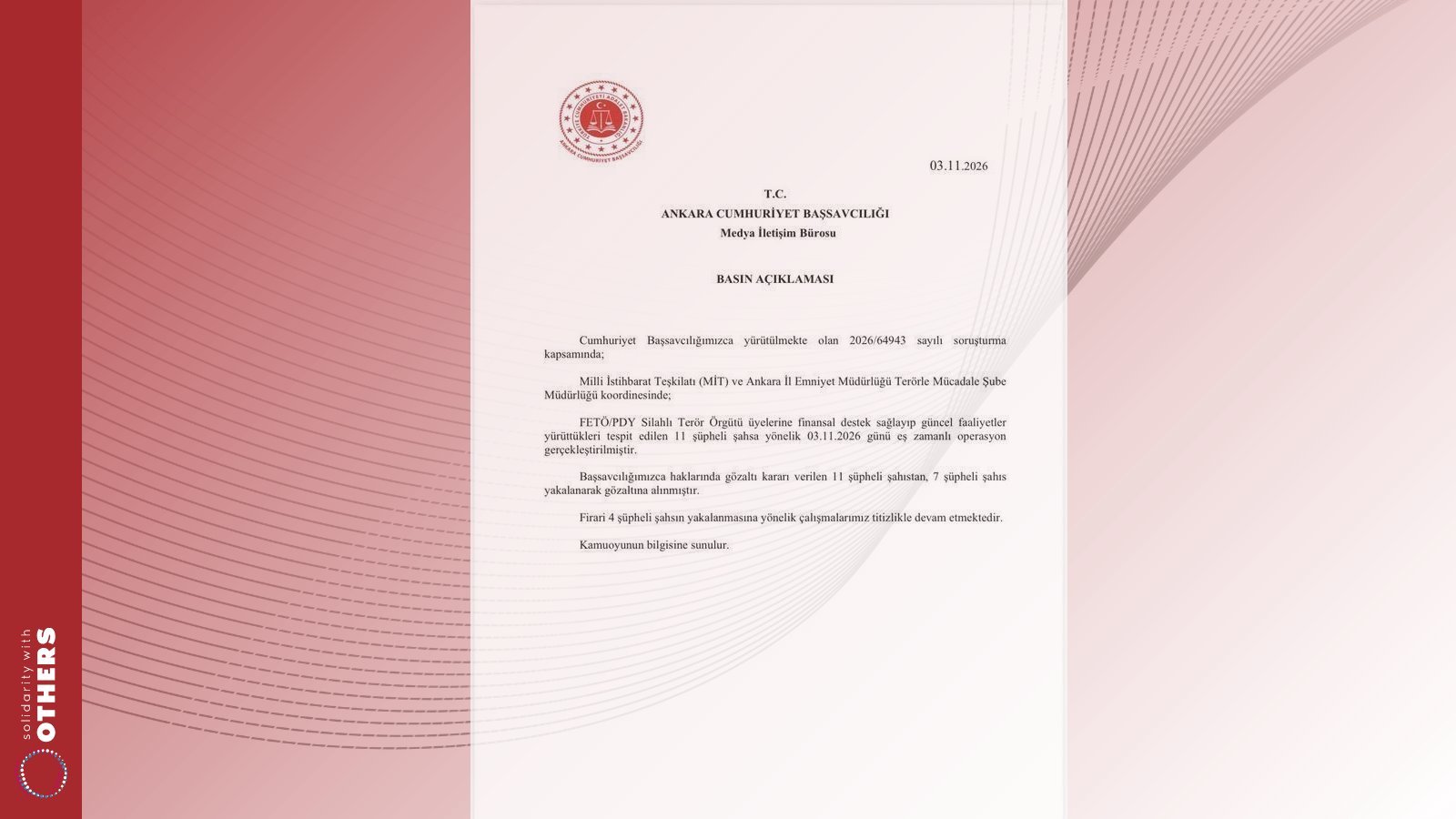
The Ankara Chief Public Prosecutor’s Office announced on 3 November 2026 that it had issued detention orders for eleven people in investigation 2026/64943, run with the National Intelligence Organisation and the Ankara police counter-terrorism branch. The eleven are said to have provided financial support to alleged members of the organisation and to have carried out current activities. Seven were detained. Four are recorded as fugitive.
The statement describes the eleven as having been “determined” — tespit edilen — to have done this. That is the language of a finding, issued before any indictment, by the office that will bring the charges.
The statement does not say what the money was, when it was given, or under which provision the eleven are being investigated. Financial support of an organisation can be prosecuted in Türkiye as membership under Article 314 § 2 of the Penal Code, as knowing assistance under Article 220 § 7, or as terrorism financing under Article 4 of Law No. 6415, and the three carry materially different sentences. The announcement names none of them.
What has counted as financial support in this body of cases is a matter of record. In Yüksel Yalçınkaya v. Türkiye, the Grand Chamber of the European Court of Human Rights examined a conviction in which the domestic courts treated the applicant’s account at a lawfully operating bank, and his membership of a trade union and an association, as corroborating evidence of membership of an armed terrorist organisation. Deposits, donations, scholarship payments and school fees have carried the same weight in other files. The question these cases raise is not whether money moved but whether a lawful transaction can be converted into a terrorism offence after the fact.
Turkish media reported a second file the same morning in which fourteen people were detained in ten provinces centred on Ankara, and described it as concerning a “covert public-service structuring” of the organisation. That phrase does not appear in the prosecutor’s statement, which refers only to financial support and current activities. The figures of twenty-one detained and twenty-five detention orders circulating in Turkish media are totals across the two files.
The day before, on 2 November, the Interior Ministry announced operations in thirty-two provinces in which seventy-two people were detained and forty-one remanded.
The Ministry of Justice has put the cumulative total at 720,580 proceedings and 127,102 convictions, with 1,065 operations and 2,451 detentions in the first half of 2026 alone. Professor Johan Vande Lanotte recorded 342 operations and 4,386 detentions in 2025, with nearly half of around a hundred large-scale operations directed at an alleged “current structure” rather than at the events of 2016.
Ten years on, detentions are being ordered on the basis of money said to have changed hands, under a provision the prosecuting authority has not identified.
Note on source language. The terms “FETÖ/PDY”, “fugitive” and “covert public-service structuring” are reproduced here as they appear in the Turkish prosecutor’s statement and in Turkish media reporting. Solidarity with Others does not adopt this language, and it is not the terminology used by the European Court of Human Rights, the United Nations human rights mechanisms or the Council of Europe.
Source:
Ankara Chief Public Prosecutor’s Office press statement, 3 November 2026, investigation 2026/64943 (11 suspects, financial support and current activities; MİT and Ankara police counter-terrorism branch; 7 caught, 4 fugitive). https://x.com/ankaracbs/status/2117522235334283579?a=-6sGQq9u1BVsIylFRRs&s=20