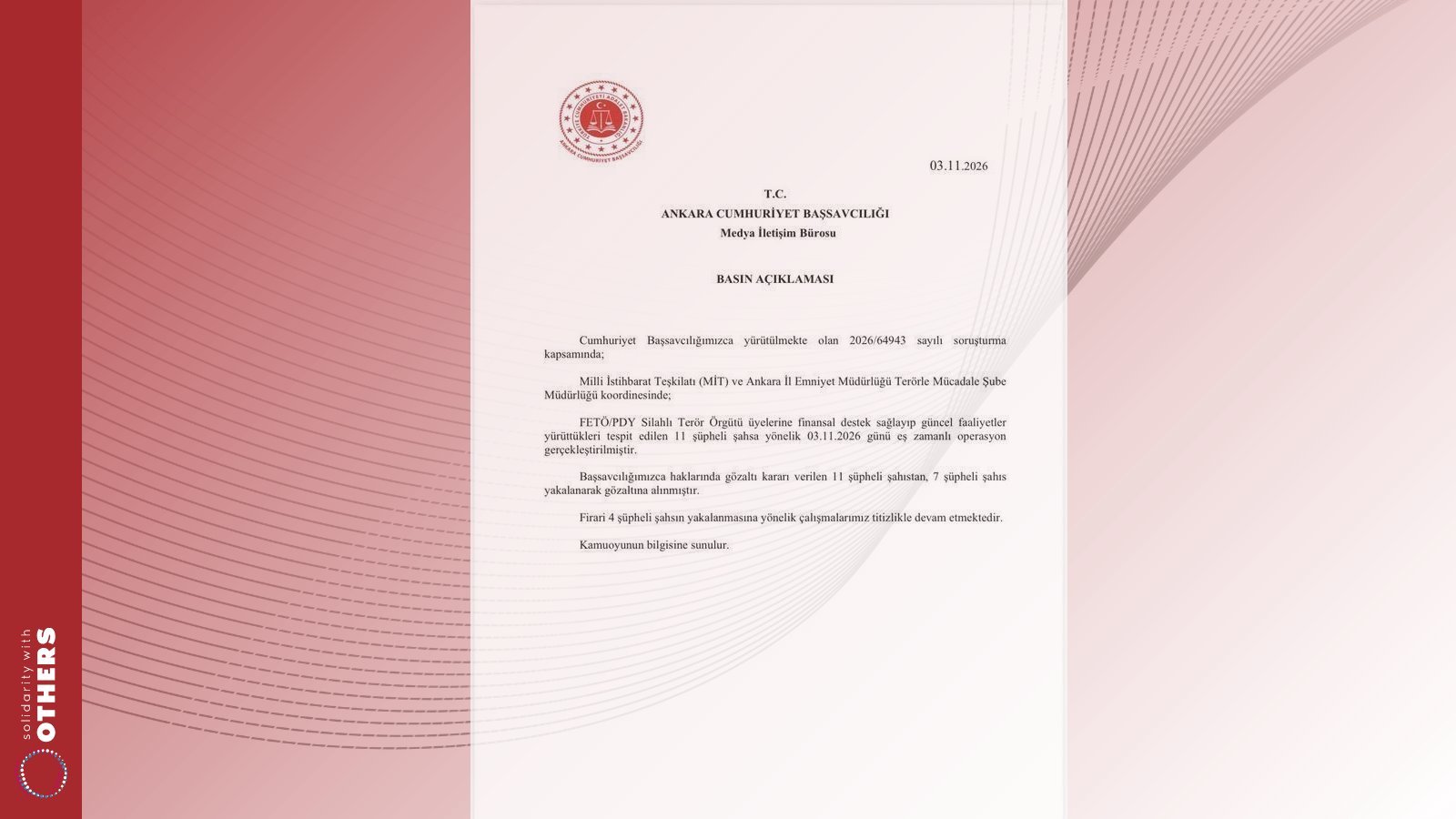


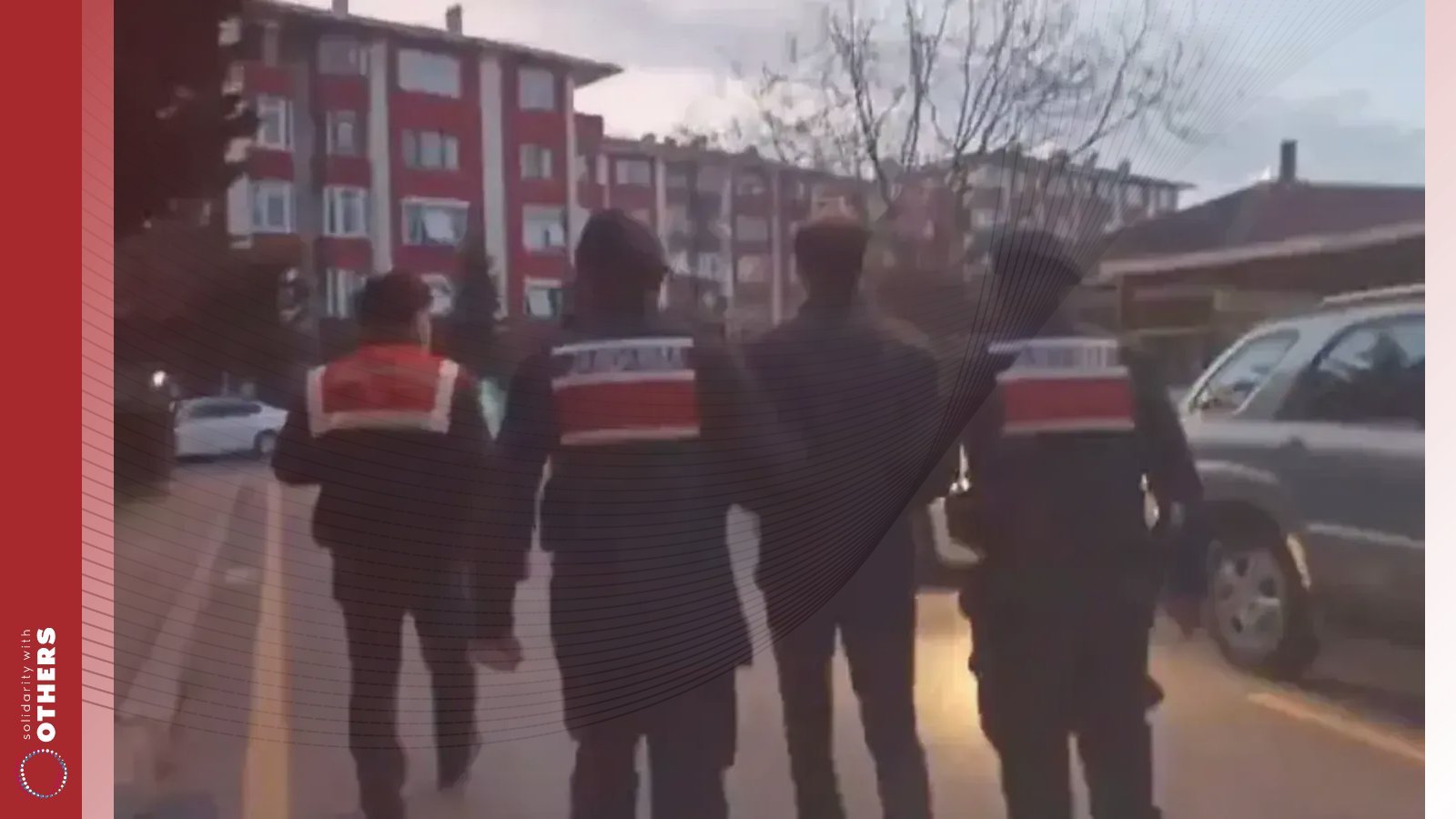
The Ministry of the Interior announced today that gendarmerie units had carried out operations in 32 provinces, apprehending 72 suspects. Forty-one have been remanded in custody. Proceedings continue against the rest. Organisational documents and digital materials were reported seized.
The ministry then set out what the suspects had done. Its verb is “tespit edildi” — it was established. Not alleged, not suspected. Established, by a ministry, on the day of the arrests, before any court had seen a file.
Four things were established. That the suspects were active within the organisation’s current structure. That they were in contact with persons holding responsible positions within it. That they provided finance to what the ministry calls so-called aid organisations affiliated with the organisation. And that they conducted propaganda through their social media accounts.
Read those again as descriptions of conduct. The first is a status. The second is a relationship. The third is giving money to a charity. The fourth is posting.
None of the four is an act of violence. The ministry did not claim otherwise, and in a statement of 32 provinces and 72 arrests it had every opportunity to.
The third deserves particular attention, because the ministry’s own wording concedes the point. “So-called aid organisations” are organisations that present themselves as, and may be, aid organisations. The allegation is not that the suspects funded a weapon. It is that they gave money to a charity the state does not approve of. The statement does not name a single one of these bodies, say whether any is lawfully registered in Türkiye, or identify any judicial decision closing any of them.
The Grand Chamber of the European Court of Human Rights addressed exactly this reasoning in Yüksel Yalçınkaya v. Türkiye in September 2023. It found that Turkish courts had convicted for membership of an armed terrorist organisation without establishing the material and mental elements of the offence, inferring criminal liability instead from conduct that was lawful when it occurred — among it holding a bank account and belonging to a trade union and an association. It found violations of Article 7, Article 6 § 1 and Article 11, and it observed that the problem was systemic. Strasbourg has since found violations requiring the reopening of domestic proceedings in 4,501 Gülen-related cases, and has 9,800 more pending.
Nothing in today’s announcement suggests that anything has changed.
There is also now a count. In a report published in July, Johan Vande Lanotte — Minister of State, former Deputy Prime Minister of Belgium and emeritus professor of public law at Ghent — inventoried every judicial action over alleged Gülen movement links reported in Türkiye during 2025: 342 operations and 4,386 reported detentions, each individually sourced. Of roughly a hundred large-scale operations that year, nearly half targeted the same category invoked today, the alleged “current structure”, accounting for about 1,500 detentions. A further 1,033 people were detained in sixteen operations aimed at those who had helped the prosecuted and their families. His conclusion was that prosecution has become less predictable, not more.
The state’s own figures point the same way. Türkiye’s justice minister has said that proceedings have been brought against 720,580 people over alleged Gülen links. Of the 636,744 cases decided, 127,102 ended in conviction. Four in five did not. In the first six months of 2026 there were 1,065 operations and 2,451 people taken into custody — a rate that today’s 72 across 32 provinces fits exactly.
For the wider picture, the Human Rights Association recorded that in 2025 at least 1,842 people in Türkiye were subjected to torture or ill-treatment, 6,719 were arbitrarily detained, and 20 people died in suspicious circumstances in detention facilities.
The ministry’s statement closes by congratulating the gendarmerie, the department, the prosecutors’ offices and all who contributed, and promises that the campaign will continue.
Velev, reporting the same statement, carried the same four grounds but put back the words the ministry had removed: persons said to hold responsible positions, aid organisations alleged to be connected. A newspaper attributed what a ministry asserted.
Forty-one people are in prison tonight on the strength of the version that left those words out.
Source-language note: The term “FETÖ” appears in this post as it was used in the Ministry of the Interior’s statement and in reporting by pro-government outlets. That designation is not adopted by our organisation, and it is not used by the United Nations, the European Court of Human Rights, the Council of Europe or the European Union.
Sources:
1- T.C. İçişleri Bakanlığı (@TCicisleri), 2 November 2026: https://x.com/TCicisleri/status/2117154467913068865
2- Velev, “32 ilde Gülen cemaatine operasyon: 72 gözaltı, 41 tutuklama”, 2 November 2026: https://velev.press/gundem/32-ilde-gulen-cemaatine-operasyon-72-gozalti-41-tutuklama/
3- Prof. Dr. Em. Johan Vande Lanotte, Turkey: Fewer prosecutions do not mean less risk, 27 July 2026, published by Solidarity with OTHERS, 1 September 2026: https://solidaritywithothers.com/new-report-by-prof-johan-vande-lanotte-turkey-fewer-prosecutions-do-not-mean-less-risk/