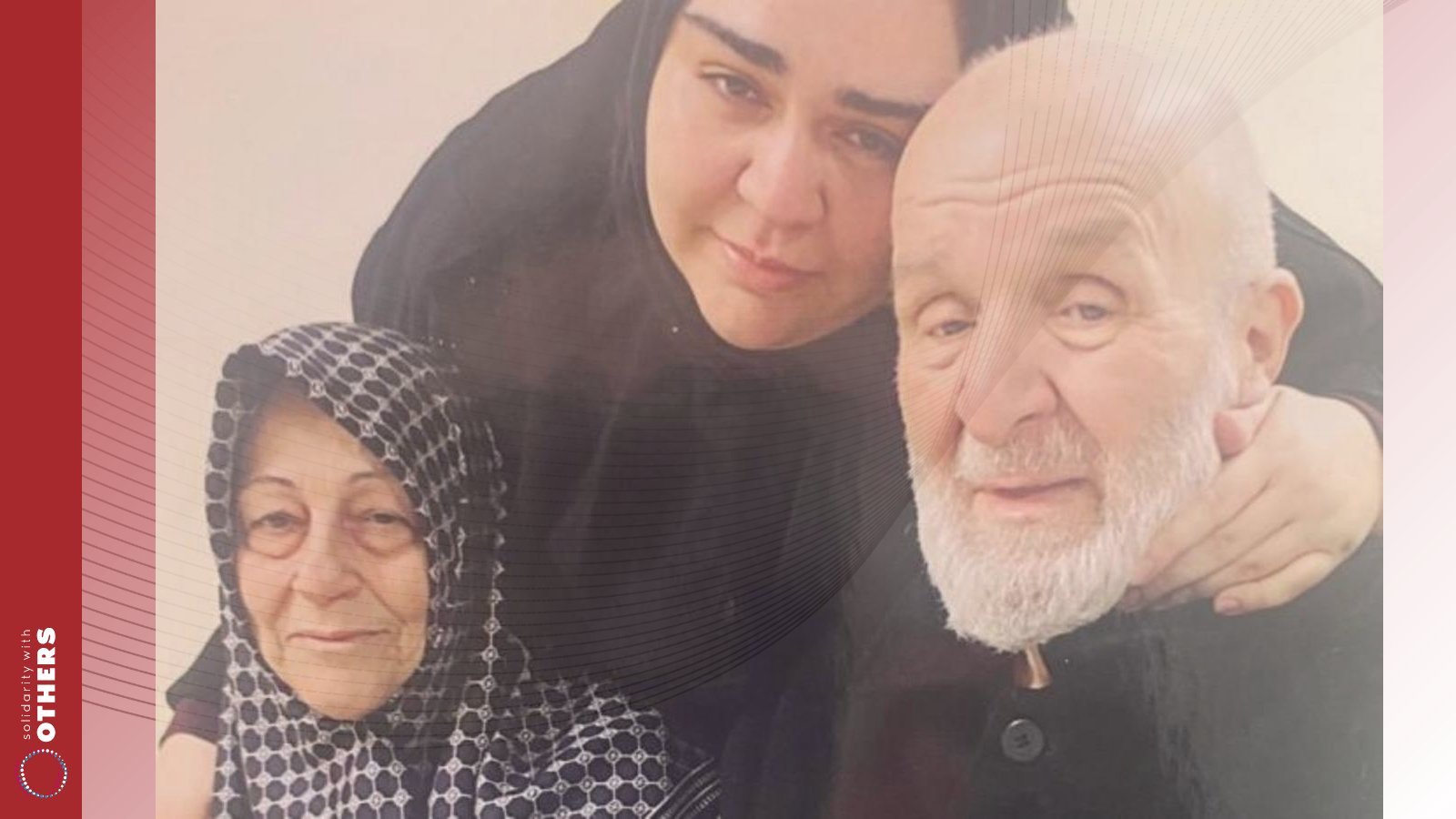



Sevinç Özarslan, the journalist who has followed his case, announced his death at one o’clock this afternoon. “Uncle Abdullah Tırpan has died,” she wrote. “I am very sorry. They made him suffer a great deal.”
At 10:12 this morning the Ministry of Health’s Başakşehir Çam and Sakura City Hospital issued a report stating that he was orotracheally intubated, on invasive mechanical ventilation, in poor general condition, and that there was danger to his life. He died about three hours later.
He was 73. He was born on 18 April 1953. For many years he made köfte and sucuk in Tekirdağ in a family business and kept a butcher’s shop.
He was detained on 16 August 2016 and held for nineteen months before trial. The Tekirdağ 3rd Heavy Penal Court sentenced him to seven years and six months. The grounds recorded in his case were deposits at Bank Asya, subscriptions to magazines and newspapers, sending his children to schools that were later closed, and charitable donations. In his defence in 2018 he said he had not been a member of anything and that his bank account and his subscriptions had been lawful when he opened them. The Court of Cassation upheld the conviction and he was returned to prison on 26 February 2025.
He died twenty months later, to the day.
The record of those twenty months is not in dispute, because a member of parliament has been reading it aloud for most of them. Ömer Faruk Gergerlioğlu told the Turkish parliament in November 2025 that Tırpan had been taken to hospital roughly forty times since his arrest. He asked then: “If he dies tomorrow in some other prison, who will be to blame for it?”
Three days before he asked that question, on 3 November 2025, Tırpan had lost consciousness in his ward. He was taken to the emergency department and returned to prison. He was taken again for breathlessness and constant vomiting, and returned again without being kept for observation. His family said at the time that his condition was not fit for one more day in prison, and explained why nothing happened: “He is not released without a Forensic Medicine report.”
In February this year he began having difficulty speaking and a brain MRI was ordered. It was carried out about four months later and found serious narrowing of the vessels in his brain and a risk of stroke.
On 20 October he was admitted to hospital and doctors obtained his family’s consent to amputate. On the night of 22 October, at one in the morning, his left leg was taken off below the knee. The infection had already spread above the amputation. Gergerlioğlu says a request for a family member to be present with him before surgery was refused.
On 25 October he was moved to intensive care and intubated. His heart stopped and was restarted with drugs. The family learned he was in intensive care by looking at e-Nabız, the state’s own patient portal, because nobody told them.
His daughter wrote, addressing the Forensic Medicine Institution and the Ministry of Justice: “Are you waiting for him to die before you issue that report?”
The report had already been issued. According to TR724, the Forensic Medicine Institution reported that Abdullah Tırpan could remain in an R type prison notwithstanding his serious health problems. Its date has never been published.
Article 16 of Law No. 5275 has allowed the deferral of a sentence since 2013 where imprisonment poses a definite danger to life, or where serious illness means a person cannot sustain his life alone in prison conditions. The decision belongs to the chief public prosecutor’s office, on a hospital report that the Forensic Medicine Institution must approve. His family asked for it, publicly and repeatedly, for twenty months.
He served roughly thirty-nine months of a ninety-month sentence. The case against him had been running for ten years and two months.
In May the chair of the parliamentary sub-commission on prisons told the General Assembly that 1,001 prisoners died in Türkiye in 2025. The Human Rights Association counted at least 1,412 sick prisoners as at April 2025, 335 of them seriously ill and 230 unable to sustain their lives alone. A CHP report in July put the figures at 1,605 and 649.
The Justice Ministry made no statement while he was dying. What is owed now is not a statement but an investigation: into the four months it took to perform a scan his doctors had ordered, the forty journeys to hospital and back, the night he lost consciousness in his ward and was returned to his cell, and the report that said a 73-year-old man with peripheral vascular disease could survive in prison.
Source:
Sevinç Özarslan (@sevincozarslan), 26 October 2026, 13:01: https://x.com/sevincozarslan/status/2114688970797854748
Legal note:
Article 2 — the State’s obligation to protect life.
The death of a prisoner following a prolonged and documented deterioration in health raises serious questions under Article 2 of the European Convention on Human Rights. The State has a positive obligation to take appropriate measures to safeguard the lives of persons in its custody, including by providing necessary medical assistance and responding adequately to known risks to life. In Keenan v. the United Kingdom (no. 27229/95, §§ 88–93, 3 April 2001) and Taïs v. France (no. 39922/03, §§ 83–103, 1 June 2006), the Court examined these obligations in the context of custodial deaths.
Where a person dies while under State control, the authorities must provide a satisfactory and convincing explanation of the circumstances, particularly where relevant information lies within their exclusive knowledge. Strong presumptions of fact may arise in such circumstances: Salman v. Turkey [GC] (no. 21986/93, §§ 99–100, 27 June 2000) and Anguelova v. Bulgaria (no. 38361/97, §§ 109–111, 13 June 2002). In Jasinskis v. Latvia (no. 45744/08, §§ 59–68, 21 December 2010), the Court found a violation of Article 2 arising from the authorities’ failure to respond adequately to a detainee’s evident need for medical assistance.
Article 2 — the obligation to investigate.
The circumstances of Abdullah Tırpan’s death call for a prompt, effective and independent official investigation into the adequacy of his medical treatment, the delays in diagnostic procedures, the decisions repeatedly returning him to prison, and the medical assessment that he could remain detained. Such an investigation must be capable of establishing the circumstances and cause of death and, where appropriate, identifying those responsible. The next of kin must be involved to the extent necessary to protect their legitimate interests.
The Court established the essential requirements of an effective investigation in McCann and Others v. the United Kingdom [GC] (no. 18984/91, § 161, 27 September 1995), Jordan v. the United Kingdom (no. 24746/94, §§ 105–109, 4 May 2001) and Nachova and Others v. Bulgaria [GC] (nos. 43577/98 and 43579/98, §§ 110–113, 6 July 2005). The precise procedural requirements depend on the circumstances of the death. In cases involving suspected unlawful State conduct, the obligation to investigate arises of the authorities’ own motion; in ordinary medical-negligence cases, effective judicial remedies may also fulfil the State’s procedural obligations: Šilih v. Slovenia [GC] (no. 71463/01, § 156, 9 April 2009) and Lopes de Sousa Fernandes v. Portugal [GC] (no. 56080/13, §§ 214–221, 19 December 2017).
Article 3 — continued detention despite serious illness.
The authorities’ handling of Tırpan’s deteriorating health also raises a distinct issue under Article 3, which prohibits inhuman or degrading treatment. The Convention does not establish an unconditional entitlement to release on health grounds. It does, however, require the authorities to ensure that detention remains compatible with a prisoner’s health, that appropriate treatment is provided, and that the hardship imposed does not exceed the suffering inherent in imprisonment.
In Gülay Çetin v. Turkey (no. 44084/10, 5 March 2013), the Court found a violation of Article 3, taken alone and in conjunction with Article 14, in the case of a gravely ill prisoner whose medical condition and requests for release had not been adequately accommodated. In Dorneanu v. Romania (no. 55089/13, 28 November 2017), it found that the treatment and continued detention of a terminally ill prisoner amounted to inhuman treatment.
The obligation to provide appropriate medical care also requires the authorities to take medical recommendations seriously. In Xiros v. Greece (no. 1033/07, 9 September 2010), the Court criticised the failure to give sufficient weight to recommendations for specialist treatment. In Wenner v. Germany (no. 62303/13, 1 September 2016), it found a violation of Article 3 arising from the failure to obtain appropriate independent medical advice concerning necessary treatment.
Medical expert evidence and effective review.
The Forensic Medicine Institution’s reported conclusion that Tırpan could remain in an R-type prison requires particular scrutiny. An expert assessment does not, by itself, settle the Convention question of whether continued detention was compatible with his medical condition or whether adequate care was actually available.
Where expert medical evidence has a decisive role in judicial proceedings, procedural fairness requires sufficient safeguards concerning its reliability, impartiality and the affected person’s ability to challenge it. These principles are reflected in Mantovanelli v. France (no. 21497/93, §§ 33–36, 18 March 1997) and Korošec v. Slovenia (no. 77212/12, §§ 46–56, 8 October 2015). In the specific context of investigations into deaths involving medical treatment, the Court has also emphasised the independence and impartiality of medical experts: Bajić v. Croatia (no. 41108/10, 13 November 2012).
The date, reasoning and medical basis of the institution’s assessment, together with the possibility of challenging it and the authorities’ response to subsequent deterioration, are therefore material to any examination of State responsibility under Articles 2 and 3.
Article 7 — the underlying conviction.
The legal basis of Tırpan’s imprisonment raises a separate question under Article 7. In Yüksel Yalçınkaya v. Turkey [GC] (no. 15669/20, 26 September 2023), the Grand Chamber found violations of Articles 7, 6 § 1 and 11 in proceedings concerning a conviction for membership of an armed terrorist organisation. The Article 7 violation arose from an expansive and unforeseeable interpretation of criminal liability, principally through reliance on ByLock, without the material and mental elements of the offence being duly established on an individualised basis.
The Grand Chamber also examined the use of otherwise lawful activities, including transactions with Bank Asya and membership of a trade union and association, as evidence in criminal proceedings. The grounds reported in Tırpan’s case — Bank Asya deposits, newspaper and magazine subscriptions, his children’s school enrolments and charitable donations — raise closely related concerns about legality, foreseeability and the individualised establishment of criminal responsibility. Whether his conviction violated Article 7 requires examination of the complete reasoning of the domestic courts and the evidence relied upon.
He died while serving that sentence.