


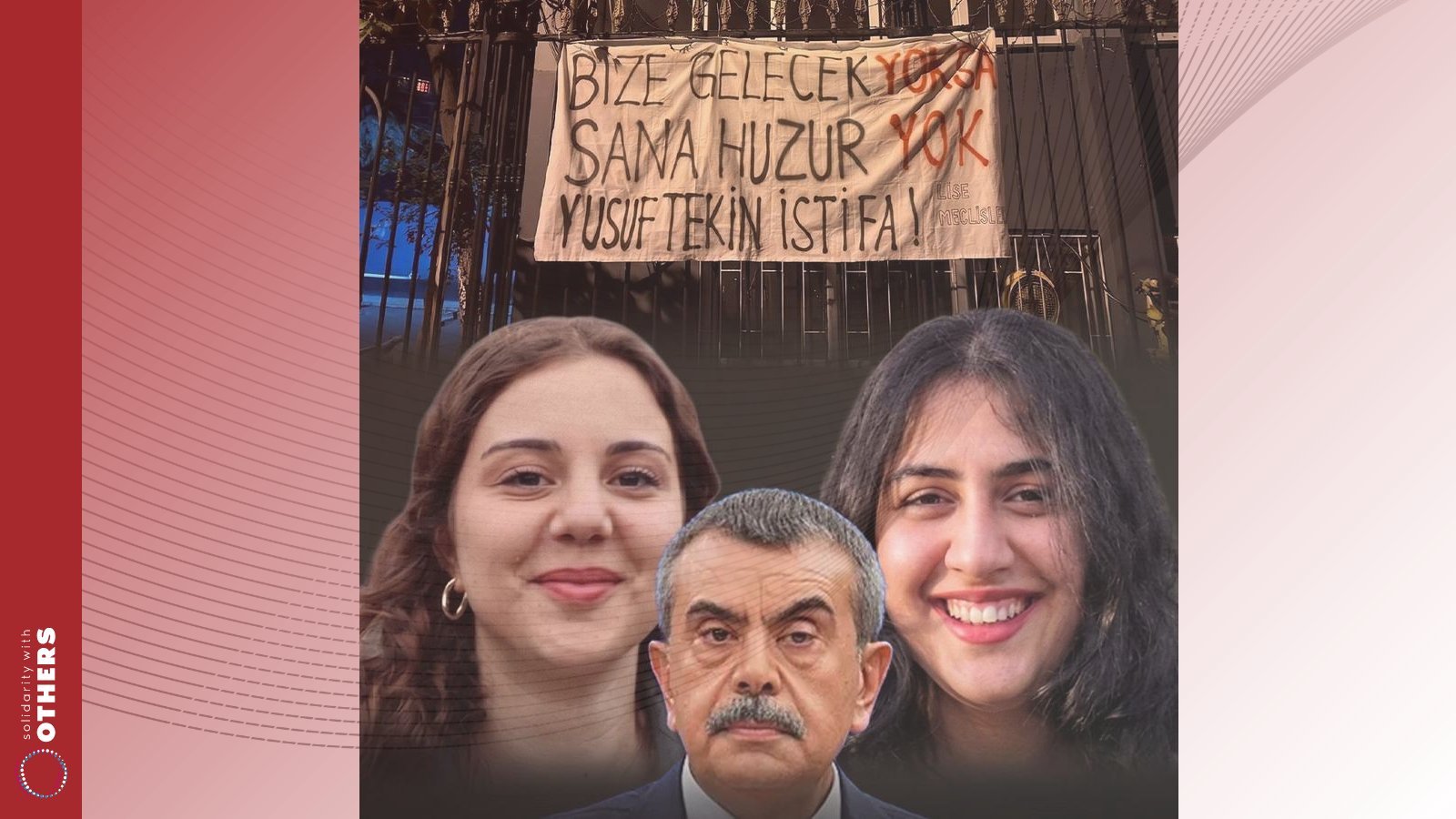
Before the Minister of National Education, Yusuf Tekin, visited Kadıköy Lisesi in Istanbul, a banner was hung at the school. It read: “If there is no future for us, there is no peace for you. Yusuf Tekin resign.”
Nevin Tekin and Nehir Dizdar, members of the Workers’ Party of Türkiye (TİP) and of its student committee, aged 19 and 20, had their homes raided around midnight on Saturday. They spent the night in police custody. On Sunday afternoon a criminal judgeship of peace remanded them both in custody. Nevin Tekin shares a surname with the minister; no source suggests any connection.
Sera Kadıgil, a TİP member of parliament and a lawyer, published part of the detention record. It is worth reading in the order the judgeship wrote it.
The judgeship first set out that there was strong suspicion that the suspects had committed the offence it describes as “Threat by More Than One Person”, and listed the concrete evidence establishing that suspicion. The list, in the decision’s own parentheses, is: police records, the suspects’ defence statements, investigation records, image-identification records, and “the suspects’ failure to show remorse”.
Two items on that list are not evidence that an offence took place. One is what the accused said in their own defence. The other is that they did not repent. Both appear in the limb of the decision that establishes suspicion of guilt, not in the separate limb dealing with grounds for detention.
The judgeship then explained what made the banner criminal. The phrase “there is no peace for you” was assessed as being, in its words, “in the nature of an open threat and intimidation directed at the person’s future, at the individual’s peace and liberty.”
It found that the evidence had not been fully gathered and might be tampered with, that the suspects posed a risk of flight, and that in view of the penalty laid down by law, judicial control would be inadequate. It ordered that each be detained separately under Article 100 of the Code of Criminal Procedure.
Threat is not one of the catalogue offences listed in Article 100(3) of that Code. For catalogue offences a court may presume that grounds for detention exist. Here it could not. It had to find them, and the material it relied on to do so included the fact that two young women had not apologised.
Kadıgil says the prosecutor sought their detention without seeing the need to take their statements first. The decision nonetheless lists their defence statements among the evidence. Both accounts can stand if the statements were taken by the police or at the judgeship rather than by the prosecutor; the discrepancy is on the record and we note it.
The aggravated form of threat under Article 106(2) of the Penal Code carries two to five years’ imprisonment. It is that penalty range, the judgeship held, that made release under judicial control insufficient for an investigation into a bedsheet hung on a school railing.
“Inviting a minister to resign by unfurling a banner is a crime,” Kadıgil wrote. She said she was publishing the record “in shame, as a lawyer”.
Eğitim Sen, the teachers’ union, said that peaceful protest cannot be termed a crime and called for the students’ release and for the investigations against them to be dropped. TİP said: “You cannot cover up the truth with your repression, and you cannot stop young people from demanding account.”
What the judgeship assessed as a threat to the minister’s peace and liberty was a demand that he resign. What it recorded as evidence that the offence had been committed was that the two people who made that demand would not say they were sorry for it.
Sources:
1- Sera Kadıgil (@serakadigil), 25 October 2026, publishing the detention record: https://x.com/serakadigil/status/2114391482450747458
2- Sözcü (@gazetesozcu), 26 October 2026: https://x.com/gazetesozcu/status/2114588797748793461
3- Bianet, “Yusuf Tekin’in ziyareti öncesi pankart asan iki öğrenci tutuklandı”, 26 October 2026: https://bianet.org/haber/yusuf-tekinin-ziyareti-oncesi-pankart-asan-iki-ogrenci-tutuklandi-324792