

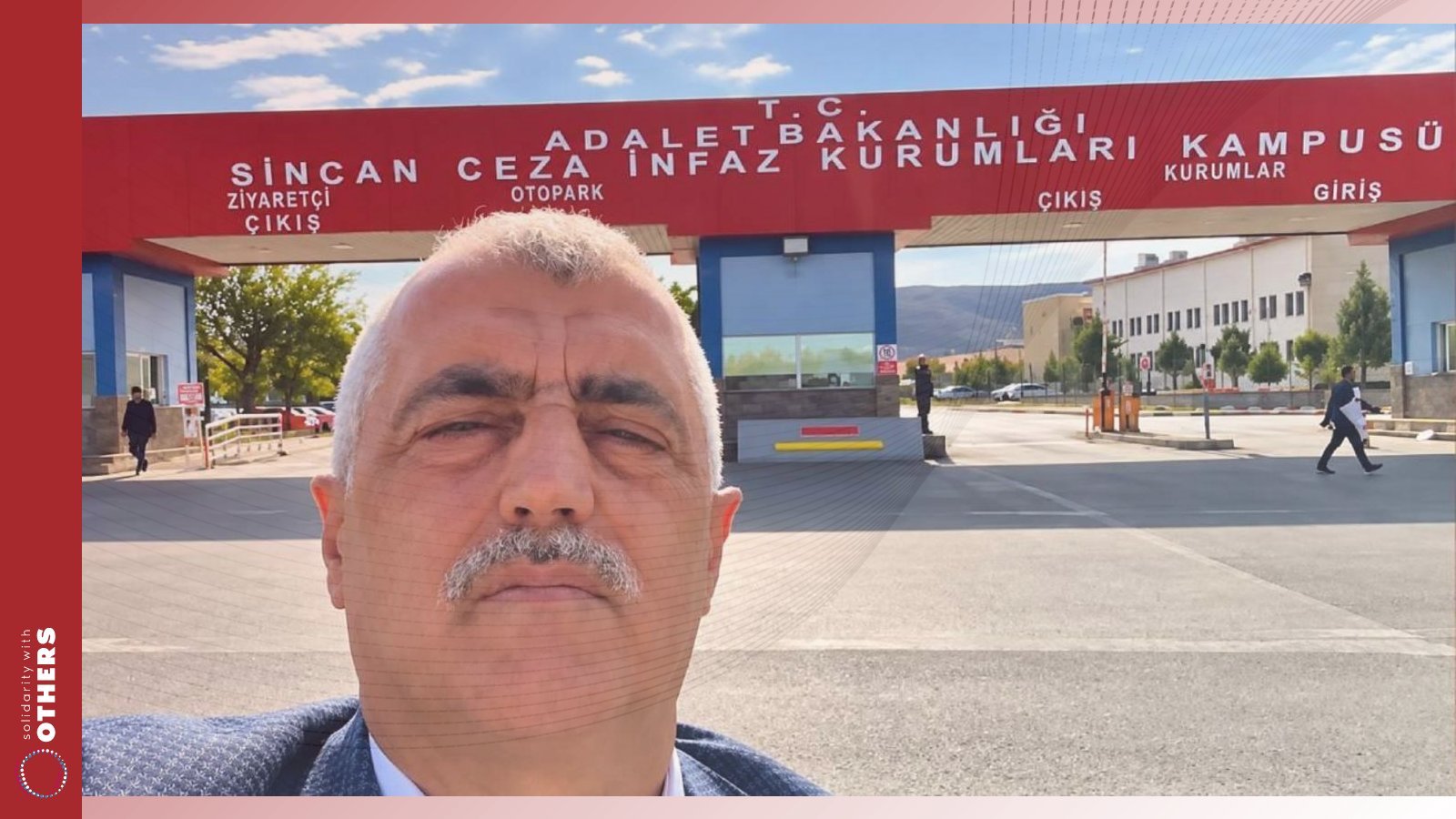
Ömer Faruk Gergerlioğlu, DEM Party member of parliament for Kocaeli, said on 7 October that the Ministry of Justice has begun obstructing his prison visits.
“I am a member of parliament who has made more prison visits than anyone else in this country over two terms, who has met nearly 2,000 prisoners, and who knows the prisons rather well,” he wrote. He named Justice Minister Akın Gürlek, the Ministry and the General Directorate of Prisons and Detention Houses, and said written parliamentary questions on conditions inside go unanswered: “They think that by not replying to us they are relieved of responsibility.”
“The disrespect shown to me is shown to the nation,” he wrote, “because constitutionally I am the deputy of 86 million.”
On 2 October he had stood outside the Sincan Prison Campus in Ankara after being refused entry. “I am in front of the Ankara Sincan Penal Institutions Campus, but the Ministry of Justice is not giving me permission to visit the prisoners held there.” He says the applications were rejected without reasons, and that three years of unobstructed visits have been interrupted.
The Ministry has given no public explanation. The pro-government daily Aydınlık reported the refusal under the headline “No permission for Gergerlioğlu’s FETÖ propaganda”, but cites no official source for that characterisation.
According to Justice Ministry figures, 433,520 people are held in Turkish prisons, more than 129,000 above the system’s stated capacity.
Gergerlioğlu is the member of parliament through whom a considerable part of what is known about conditions in Turkish prisons has reached the public. His office has raised the case of İbrahim Halil Al, the cancer patient held at Edirne whom the Forensic Medicine Institute has found fit to remain in prison; the confiscation of Erol Boydak’s hearing aid at Sincan; and the position of families travelling 27 hours each way to a visit. He has also reported receiving death threats, and prosecutorial inaction on his criminal complaints.
He has informed Nacho Sánchez Amor, the European Parliament’s rapporteur for Türkiye, and says he will take the matter to the European Parliament, the Council of Europe, the European Commission, the United Nations and the European Court of Human Rights.
A prison system holding 129,000 people more than it was built for has now closed its doors to the parliamentarian who reports on it.
Sources:
1- Ömer Faruk Gergerlioğlu (@gergerliogluof) on X, 7 October 2026: https://x.com/gergerliogluof/status/2107738180644430275
2- omerfarukgergerlioglu.com, “Gergerlioğlu’nun cezaevi ziyaretine engel: Konuyu Nacho Sánchez Amor’a iletti”, 2 October 2026: https://www.omerfarukgergerlioglu.com/basin/gergerlioglunun-cezaevi-ziyaretine-engel-konuyu-nacho-sanchez-amora-iletti/40793/
3- Karar, “Gergerlioğlu’ndan Sincan Cezaevi Önünde ‘ziyaret yasağı’ tepkisi”, 2 October 2026: https://www.karar.com/guncel-haberler/gergerlioglundan-sincan-cezaevi-onunde-ziyaret-yasagi-tepkisi-bu-buyuk-2075759
Legal note:
Article 3 ECHR is absolute: the prohibition of torture and inhuman or degrading treatment or punishment permits no exception or derogation, including during a public emergency. Persons deprived of their liberty are in a position of particular vulnerability, and independent external monitoring constitutes an important safeguard against ill-treatment. The European Court of Human Rights frequently takes account of findings by independent monitoring bodies, particularly the European Committee for the Prevention of Torture (CPT), as evidence when assessing conditions of detention under Article 3. In Öcalan v. Turkey [GC] (no. 46221/99, 12 May 2005), the Court had before it the findings of CPT visits concerning the applicant’s physical condition, detention conditions and isolation. In Ilaşcu and Others v. Moldova and Russia [GC] (no. 48787/99, 8 July 2004), it expressly relied on CPT findings concerning conditions of detention, prolonged solitary confinement and inadequate medical treatment.
Rules 92 and 93 of the European Prison Rules (Recommendation Rec(2006)2-rev) distinguish governmental inspection from independent monitoring. Rule 93 requires the conditions of detention and treatment of prisoners to be monitored by independent bodies. Such bodies must have access to all prisons and parts of prisons and to the information and records necessary for their work, must be free to choose which prisons to visit and which prisoners to interview, including through unannounced visits, and must be able to conduct private and confidential interviews. Their monitoring reports, together with the authorities’ responses, are to be made public.
Under the Optional Protocol to the UN Convention against Torture (OPCAT), ratified by Turkey on 27 September 2011 and in force for Turkey since 27 October 2011, the State must facilitate regular preventive visits to places of deprivation of liberty by the UN Subcommittee on Prevention of Torture and by the designated National Preventive Mechanism. OPCAT does not itself establish a general right of prison access for members of parliament; any such parliamentary entitlement must therefore be established separately under the applicable domestic legal framework.
The exercise of an elected mandate receives particularly strong Convention protection. In Castells v. Spain (no. 11798/85, 23 April 1992), the Court held that freedom of expression is especially important for an elected representative, who represents the electorate, draws attention to its preoccupations and defends its interests, and that interference with the expression of an opposition member of parliament therefore calls for the closest scrutiny. This principle does not by itself create a freestanding right of parliamentary access to places of detention, but it is relevant where a restriction interferes with the exercise of an elected representative’s freedom of political expression and scrutiny.
In Selahattin Demirtaş v. Turkey (No. 2) [GC] (no. 14305/17, 22 December 2020), the Grand Chamber found violations of Article 10, Article 5 §§ 1 and 3, Article 3 of Protocol No. 1, and Article 18 in conjunction with Article 5. It held, in particular, that making it effectively impossible for an elected member of parliament to participate in the activities of the National Assembly because of his detention constituted an unjustified interference with the free expression of the opinion of the people and with his right to be elected and sit in Parliament. Execution of the judgment remains pending under the enhanced supervision of the Committee of Ministers.
Article 13 requires an effective domestic remedy in respect of an arguable complaint that a Convention right has been violated. The remedy must be effective in law and in practice and capable of examining the substance of the Convention complaint and granting appropriate relief. Where the factual or legal basis for an impugned restriction is not sufficiently disclosed, this may undermine the effectiveness of the available remedy if the person concerned is thereby unable meaningfully to understand and challenge the measure. Whether a failure to answer written parliamentary questions gives rise to a separate Convention issue requires distinct analysis and should not, without further authority, be equated with a violation of Article 13.