

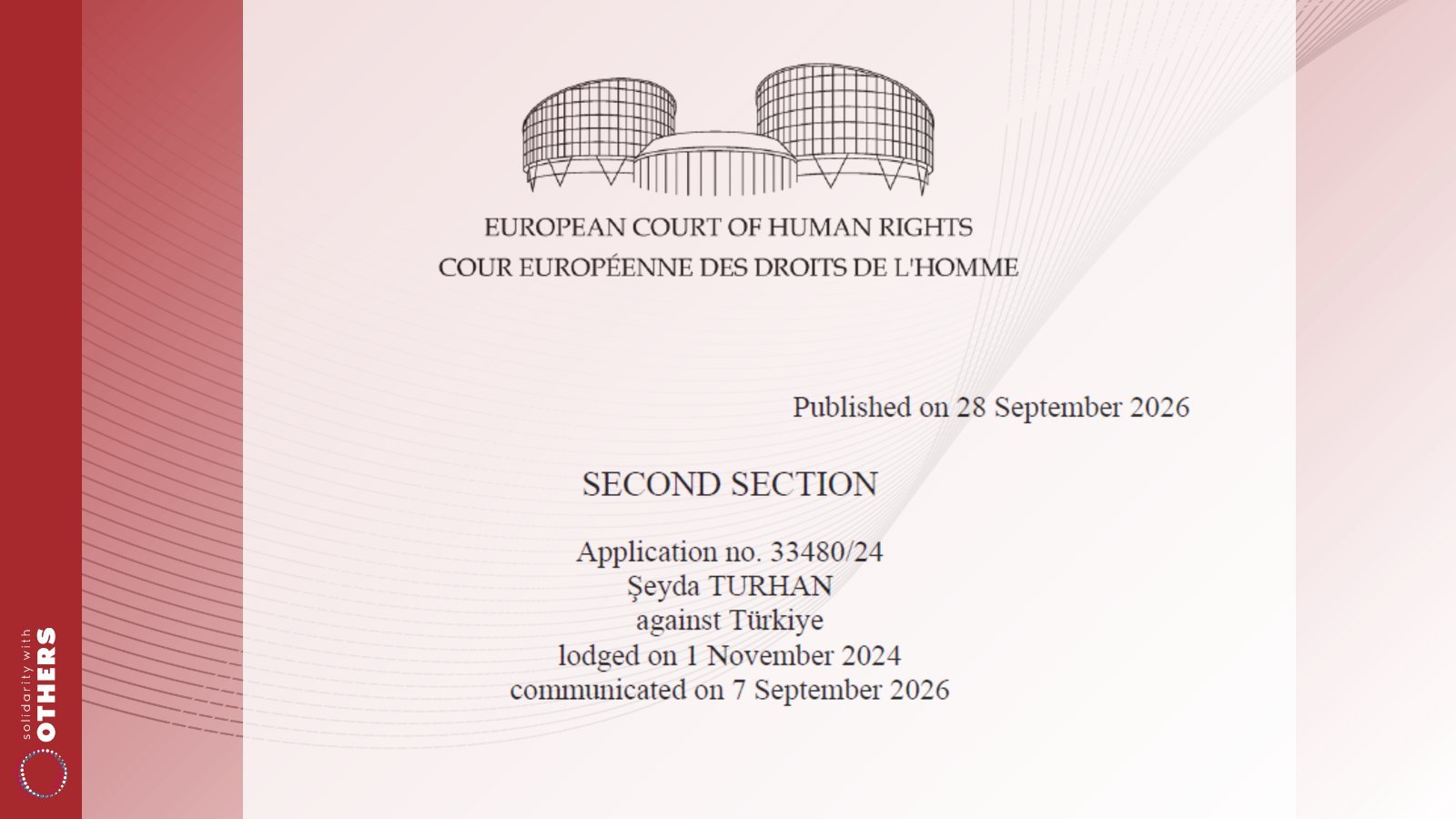
The European Court of Human Rights has communicated to the Turkish government an application concerning the removal of a mother’s custody of her two children on the basis of alleged links to a terrorist organisation. The case is Turhan v. Türkiye, application no. 33480/24, lodged on 1 November 2024, communicated on 7 September 2026 and published on 28 September. The Court has put questions to the government and has made no finding.
Şeyda Turhan and her former husband, identified in the Court’s text as M.Y., have two children, born in 2010 and 2015. She began divorce and custody proceedings in November 2017. In those proceedings M.Y. alleged that she had failed to fulfil her responsibilities as a wife and mother because of her alleged affiliation or links, in the domestic formulation iltisak veya irtibat, with the organisation the Turkish authorities call “FETÖ/PDY”. Several witnesses called by M.Y. supported the allegations before the family court.
In September 2018 a board composed of social services experts, a psychologist and a pedagogue submitted a social assessment report recommending that custody be granted to the mother, given the children’s young ages and the fact that they had been living with her for the preceding nine months.
In April 2019 an indictment was filed against her for membership of the organisation. The same witnesses repeated their statements in the criminal proceedings, and one claimed she had once said she was raising two disciples for “FETÖ”.
In November 2019 the criminal court acquitted her. It held that no weight could be attached to the witnesses’ statements, because they had been made by persons connected to her husband for the purpose of producing evidence against her in the divorce and custody proceedings.
The following day the family court pronounced the divorce and granted her custody of the children.
In November 2020 the Regional Court of Appeal quashed that decision and granted custody to M.Y. It held that even though she had been acquitted, the evidence in the criminal proceedings showed she was a “sympathiser of FETÖ/PDY”, and that this would threaten the children’s development. The Court of Cassation upheld the decision in April 2021.
In February 2021 she brought fresh proceedings seeking a modification of the arrangement. In September 2021 a psychologist submitted a further report recommending custody to the mother, citing the children’s young ages and their own stated wishes. In February 2022 the family court refused, on the ground that there was no reason to depart from the earlier decision. The regional court of appeal dismissed her appeal in September 2022.
In March 2024 the Constitutional Court joined her two individual applications, examined them under the right to respect for family life, and held by three votes to two that there had been no violation of Article 8.
Before the Strasbourg Court she complains under Article 8 that custody was awarded to her former husband solely on the assumption that she was a sympathiser, despite her acquittal, and under Article 6 that the domestic courts relied on witness statements given by persons with whom she was in conflict.
The Court has asked the government whether the refusal of custody was in accordance with the law and necessary under Article 8(2); whether the reasons given by the domestic courts were relevant and sufficient; whether those courts attached paramount importance to the best interests of the children; and whether the decision-making process was fair and capable of ensuring due respect for the competing interests.
Two expert assessments recommended that the children remain with their mother. A criminal court found the witnesses against her unreliable and acquitted her. An appeal court then relied on the same evidence to reach a conclusion the criminal court had refused to draw, using a description that is not an offence in Turkish law.
Sources:
1- ECtHR, Turhan v. Türkiye, no. 33480/24, communicated 7 September 2026, published 28 September 2026: https://hudoc.echr.coe.int/eng?i=001-252771
2- Ufuk Yeşil on X, 28 Sept 2026: https://x.com/DrUfukYesil33/status/2104501363136737301
Legal Note:
Family life and custody (Article 8 ECHR). In custody disputes, the domestic courts must provide relevant and sufficient reasons, undertake an in-depth examination of the family situation and conduct a fair decision-making process capable of protecting the interests safeguarded by Article 8. The child’s best interests must be a primary consideration. See Petrov and X v. Russia, no. 23608/16, §§ 98–114, 23 October 2018; A and Others v. Iceland, nos. 25133/20 and 31856/20, §§ 84–90, 15 November 2022; and Vujica v. Croatia, no. 56163/12, 8 October 2015.
Acquittal and subsequent custody proceedings. An acquittal does not in itself prevent family or child-protection courts from assessing underlying facts under the evidential standards applicable to child-welfare proceedings. In A and Others v. Iceland, however, the Court emphasised that the domestic court had respected the binding force of the acquittal, had not treated the acquitted parent as criminally guilty, and had relied on extensive independent and subsequently obtained child-welfare evidence.
Presumption of innocence following acquittal (Article 6(2)). Allen v. the United Kingdom [GC], no. 25424/09, 12 July 2013: following an acquittal, the individual is innocent in the eyes of the law and must be treated consistently with that innocence. Article 6(2) may apply to subsequent proceedings where there is a sufficient link with the concluded criminal proceedings, including where a later court reviews the criminal judgment or evidence or comments upon possible criminal guilt.
Individualised assessment of alleged organisational membership (Article 7). In Yüksel Yalçınkaya v. Turkey [GC], no. 15669/20, 26 September 2023, and Yasak v. Turkey [GC], no. 17389/20, 5 May 2026, the Grand Chamber emphasised, in the context of criminal liability for membership of an armed terrorist organisation, the need for an individualised assessment of the constituent material and mental elements of the offence. Those Article 7 principles concern criminal liability and should be distinguished from the child-welfare assessment required under Article 8.
Children’s rights. Under the UN Convention on the Rights of the Child, Article 3(1) requires the child’s best interests to be a primary consideration; Article 9 protects against separation from parents except where competent authorities, subject to judicial review, determine that separation is necessary for the child’s best interests; and Article 12 protects the child’s right to express views in proceedings affecting him or her. Turkey ratified the Convention in 1995.