

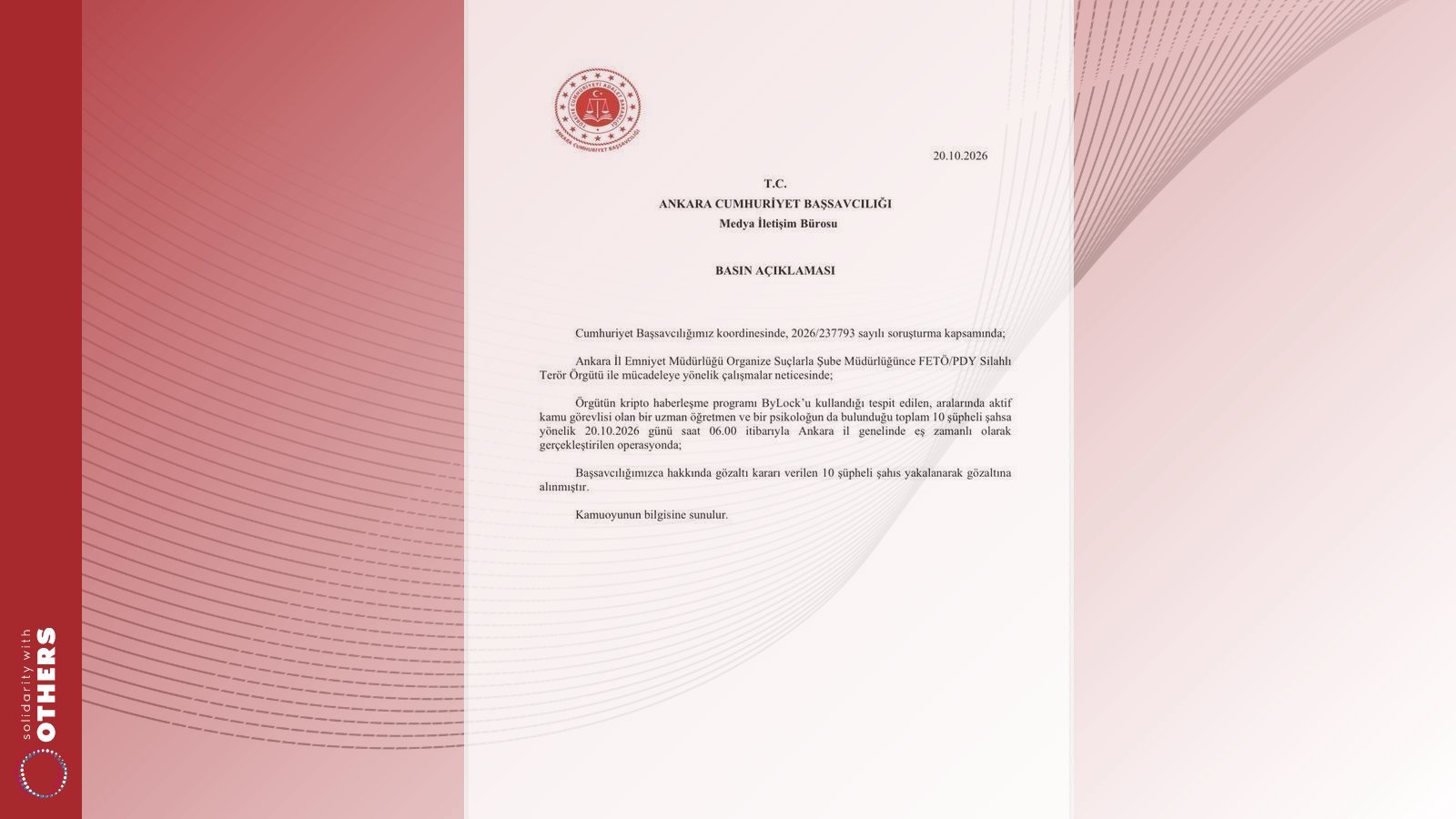
At six in the morning on Tuesday the Ankara Chief Public Prosecutor’s Office carried out simultaneous raids across the province. Ten people were the subject of detention orders. The office’s press release gives one ground for all of them: that they used ByLock.
Nothing else is alleged. No bank account, no telephone records, no witness, no document. One application.
Among the ten, the statement says, are an active public servant who holds the grade of specialist teacher and a psychologist. The grade of uzman öğretmen is not a description; it is a rank the Turkish state confers under Law No. 7354 on a teacher with at least ten years’ service who has completed a 180-hour professional development programme, has no outstanding disciplinary penalty, and has passed a written examination set by the Ministry of National Education at 70 or above. The state examined this person, promoted this person, and employs this person. On Tuesday it sent police to the door at six.
The operation was run by the Organised Crime Branch of the Ankara police.
The statement describes ByLock as “the organisation’s crypto communication programme”. That characterisation is not a finding of any court in these ten cases. It is the question.
On 26 September 2023, in Yüksel Yalçınkaya v. Türkiye, the Grand Chamber of the European Court of Human Rights held that Turkish courts had breached Article 7 by treating the use of that application as conclusive proof of every element of membership of an armed organisation, and Article 6 § 1 by convicting on data the defendant was never given and whose reliability his objections were never allowed to test. The Court said the problem was systemic and indicated general measures under Article 46.
That was three years and three weeks before Tuesday.
On 16 December 2025 the Court decided three further cases covering 2,420 applicants, holding in terms that establishing ByLock use had served “on its own, as conclusive proof of the presence of all the constituent elements of the crime”, and that this stemmed from “a systemic problem affecting a large number of persons”. On 5 May 2026, in Yasak v. Türkiye, the Grand Chamber held that courts cannot substitute a list of evidence for proof of criminal intent. On 23 June 2026 three more judgments covered 893 applicants. On 29 September 2026 three more covered 947.
That last set was twenty-one days before this operation.
There is a second point, and it concerns the document itself. The press release states that all ten people were caught and taken into custody. The same office’s account, given to the news agencies that morning and carried at 09:18, says that of the ten ordered detained, nine were caught and one remains a fugitive. Anadolu Ajansı’s combined figure for Ankara and İstanbul that day is twenty-four, which is nine plus fifteen. The published statement and the briefed statement do not agree, and the published one claims more than was achieved.
The İstanbul operation announced the same day took fifteen people in İstanbul, Burdur and Ordu. According to Anadolu Ajansı’s account of it, the evidence there included increases in Bank Asya balances on particular dates and payments recorded as sacrifice, scholarship and donation to bodies said to be linked to the organisation. Giving to charity, entered as proof.
Twenty-five people in one day, in two cities, on these grounds.
“FETÖ/PDY” is the Turkish authorities’ designation and is used here as quotation only. This organisation does not adopt it.
None of those detained on Tuesday has been charged, brought before a judge or convicted. A teacher with ten years’ service and a state examination behind him, and a psychologist, were taken from their homes at dawn on the strength of a single category of evidence about which the European Court of Human Rights has now ruled five times in three years.
Source:
Ankara Cumhuriyet Başsavcılığı, Medya İletişim Bürosu, Basın Açıklaması, file 2026/237793, 20 October 2026: https://x.com/ankaracbs/status/2112495051049963957