

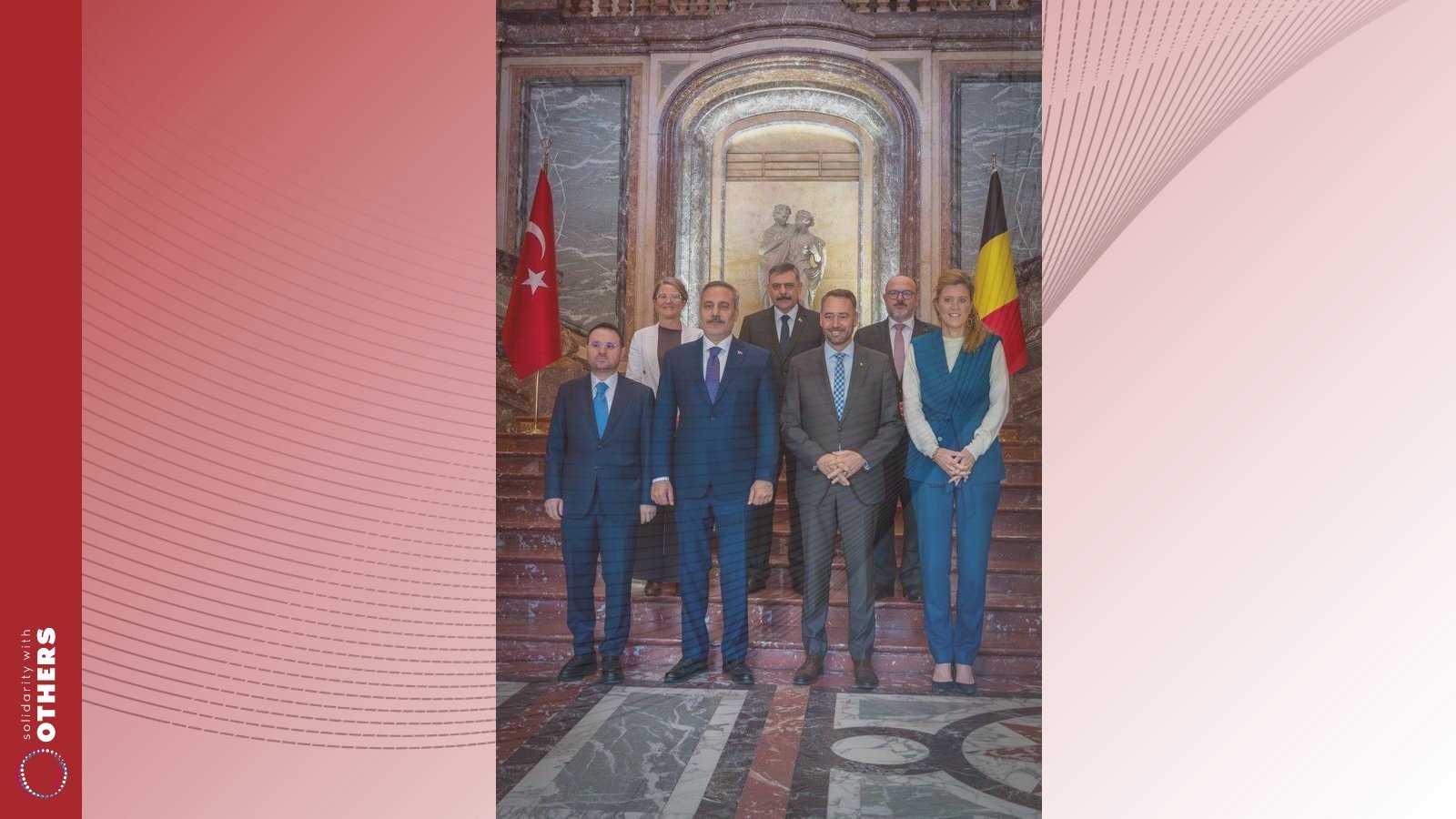
Seven ministers met in Brussels on 20 October for the first Türkiye–Belgium trilateral in ten years. Foreign Minister Hakan Fidan, Justice Minister Akın Gürlek and Interior Minister Mustafa Çiftçi met Maxime Prévot, Annelies Verlinden, Bernard Quintin and Anneleen Van Bossuyt. A bilateral police cooperation action plan for 2027–2028 was signed.
Read the two governments’ accounts side by side and they describe different meetings.
Interior Minister Çiftçi published his under the heading “OUR MESSAGE FROM BRUSSELS: NO COUNTRY SHOULD BE A HAVEN FOR TERRORIST ORGANISATIONS.” He named five: “PKK, FETÖ, DEAŞ, al-Qaeda and DHKP-C above all — terrorist organisations may operate under different names and by different methods, but the threat they constitute is shared.” He said tolerating financing, propaganda and recruitment directed at other countries is unacceptable. He told TRT that the Gülen movement “has unfortunately been using Belgium almost as a refuge.”
Justice Minister Gürlek said: “We expect our ally Belgium to take concrete and effective measures against FETÖ’s organisation in its own country.” He asked Belgium to scrutinise schools, associations and civil society organisations, to extradite, and — this is the part that matters — he argued that international protection mechanisms should not obstruct extradition for serious crimes.
Now the Belgian side. Interior Minister Quintin’s post reads in full as a policing matter: “Faced with criminal networks that are increasingly operating on an international scale, our police services will continue to strengthen their coordination.” The new agreement provides for faster information exchange, shared expertise and joint training. “The goal is clear: better protect our citizens by striking organized crime faster and harder.” He names no organisation.
Foreign Minister Prévot called Türkiye a strategic partner, cited NATO, the customs union and the 33 agreements signed by nearly 200 Belgian companies on an economic mission, and described the relationship as “working on shared issues while keeping the door open for honest dialogue on our differences.” He names no organisation either.
Nor does the Belgian foreign ministry’s own statement. It refers to the fight against terrorism and organised crime in general terms, and names nothing. It does not mention extradition. What it does say is that the revived dialogue “does not erase differences, particularly on human rights, fundamental freedoms and the rule of law”, that “Belgium remains firmly committed to these principles”, and that cooperation on criminal investigations must respect “the rule of law and fundamental legal safeguards.”
So one government announced a deal against organised crime and restated its reservations about the other’s human rights record. The other announced that it had demanded terrorists.
Turkish state media carried the second version without the first. TRT World reported the demands in detail and quoted no Belgian minister at all, because there was nothing to quote. Hürriyet Daily News reported that Ankara “pressed Belgium on terror groups and extraditions” and then stated, in its own voice and without attribution, that the “FETÖ terror group is responsible for the 2016 attempted coup” — a conclusion the movement denies and which no court outside Türkiye has reached.
Çiftçi’s own post contains the admission. “Real solidarity in the fight against terrorism is possible not through joint statements alone, but through concrete steps that are matched on the ground.” He wrote that after a meeting that produced a joint statement and no concrete step.
The reason is not diplomatic reticence. It is that the request has been made everywhere and granted almost nowhere, and Türkiye’s own justice minister has published the figures. In April, Gürlek said Türkiye has submitted 2,889 extradition requests concerning 2,707 people to 119 countries over alleged Gülen movement links. Three people have been extradited: two from Romania and one from Algeria. That is one in nine hundred. He said thousands of Interpol Red Notices have been sought and that none have been acted upon. “We have not received a positive response from our allies.”
Belgium’s courts are part of the reason. On 13 January this year the Council for Alien Law Litigation, Belgium’s asylum appeals court, granted refugee status to a former teacher at Gülen-linked schools, overturning a refusal by the asylum office. It held that the absence of a prosecution before he left Türkiye did not remove the risk, because investigations there can be opened retroactively; that dismissal, surveillance and restrictions on banking and property are serious enough to constitute persecution; and that indicators such as a Bank Asya account, attendance at religious discussion meetings and help given to detainees’ families must be weighed together rather than dismissed one by one. It found that the Turkish state was the principal persecutor, which made protection by Turkish authorities illusory. The Dutch Council of State reached a comparable assessment in March.
Belgium is not the first to be asked. Solidarity with OTHERS set out the record in a report published in January 2025, The Gülen Movement: Challenging Turkey’s “Terrorist Organization” Narrative Through Global Perspectives, which surveys how states, courts and international bodies have treated the designation Ankara asks them to adopt. Its conclusion is that no major international body, democratic state or independent court recognises the movement as a terrorist entity. The United Nations Security Council has never listed it. The European Commission’s own enlargement report refers to the “Gülen Movement” rather than to Ankara’s acronym. The United States State Department’s Country Reports on Terrorism record that it is not a designated terrorist organisation there.
Courts have been more specific than governments. Westminster Magistrates’ Court refused extradition in three sets of proceedings, on 28 November 2018 and 6 December 2019, finding the requests politically motivated and the allegations lacking in specificity, and holding that use of the ByLock application is not in itself a criminal act. The Bucharest Court of Appeal denied extradition on 14 December 2018. Brazil’s Federal Supreme Court denied it on 7 August 2019, finding no double criminality because depositing money into a bank account is not an offence in Brazil. Spain’s National Criminal Court denied it on 30 October 2020, also on double criminality. The categories of evidence these courts examined are the same ones still in use: a ByLock installation, a Bank Asya deposit, attendance at an event, possession of a book.
The answer Ankara now gives is that this is history — that the prosecutions have narrowed and eased since then. That claim has been tested, and by a Belgian. In a report dated 27 July 2026, Turkey: fewer prosecutions do not mean less risk, Johan Vande Lanotte — Minister of State, former Deputy Prime Minister and Minister of the Interior of Belgium, emeritus professor of public law at Ghent University — inventoried every judicial action over alleged Gülen movement links reported in Turkish and social media during 2025. He counted 342 operations and 4,386 reported detentions, each individually sourced and published in annexes, and concluded from comparison with partial official figures that the true number detained was likely at least double.
The headline numbers have indeed fallen: reported operations from an average of 1,149 a year between 2016 and 2019 to 431 between 2021 and 2025, detentions from roughly 28,100 a year to 5,950. His finding is that this reflects how many people have already been prosecuted or have left the country rather than any change of policy, and that the focus has shifted rather than narrowed. Of about a hundred large-scale operations in 2025, nearly half targeted what prosecutors called the movement’s current structure. A further 1,033 people were detained in sixteen operations directed at those who had supported convicted, prosecuted or dismissed people and their families. Among the conduct cited as evidence: coaching students for exams, housing students, arranging foreign travel, taking children to the cinema or bowling, visiting a grave, helping affected families, and using prepaid SIM cards, WhatsApp or Jitsi. Some files still rest on ByLock and Bank Asya records a decade old. His conclusion is one sentence: “Prosecution has therefore become less predictable, not more.”
He also observes that Turkish courts continue to infer criminal intent from ByLock use rather than examining whether a defendant knowingly intended to join an armed organisation, which is what Strasbourg requires — and he appeared for the applicants in both of the Grand Chamber cases that imposed that requirement. European judges are already using the work. The District Court of The Hague, in three judgments on 6 July this year, ordered the Dutch minister to grant refugee status to three Turkish nationals and cited his earlier report in support of two findings: that people once suspected of involvement can come back under official attention, and that those who help detained Gülenists are now themselves prosecuted for restructuring the movement. The court took those citations from the Council of State’s judgment of 25 March 2026 — the same judgment on which the argument that prosecutions have declined and narrowed chiefly rests.
That is the material a Belgian justice minister now has in front of her when a Turkish justice minister asks that international protection not be allowed to obstruct extradition.
The movement is on no EU terrorist list and has never been designated by the Union or by any member state. The EU’s former counter-terrorism coordinator, Gilles de Kerchove, put the standard plainly: changing that would require “concrete substantive data which shows that they were involved”, and material such as having downloaded an app is not enough.
Gürlek asked Belgium to ensure that international protection does not obstruct extradition. Belgium replied that criminal cooperation must respect fundamental legal safeguards. Those two sentences are about the same people, and they are not compatible.
Source-language note: The term “FETÖ” appears in this post as it was used in statements by Turkish ministers and in reporting by pro-government outlets. That designation is not adopted by our organisation, and it is not used by the United Nations, the European Court of Human Rights, the Council of Europe or the European Union.
Sources:
1- Stockholm Center for Freedom, “Turkey presses Belgium for Gülen movement extraditions”, 21 October 2026: https://stockholmcf.org/turkey-presses-belgium-for-gulen-movement-extraditions/
2- Hürriyet Daily News, “Ankara presses Belgium on terror groups and extraditions”, 21 October 2026: https://www.hurriyetdailynews.com/ankara-presses-belgium-on-terror-groups-and-extraditions-228405
3- Mustafa Çiftçi (@mustafaciftcitr), 20 October 2026: https://x.com/mustafaciftcitr/status/2112586600278290770
4- Bernard Quintin (@BernardQuintin), 20 October 2026: https://x.com/BernardQuintin/status/2112603252785393917
5- Maxime Prévot (@prevotmaxime), 20 October 2026: https://x.com/prevotmaxime/status/2112586519508554122
6- Kingdom of Belgium, Federal Public Service Foreign Affairs, “Belgium and Türkiye revive ministerial dialogue after ten years to strengthen cooperation”: https://diplomatie.belgium.be/en/news/belgium-and-turkiye-revive-ministerial-dialogue-after-ten-years-strengthen-cooperation
7- TRT World, “Türkiye urges Belgium to act against terrorists, criminals at Brussels meeting”, 20 October 2026: https://www.trtworld.com/article/928a9f8ea038
8- Turkish Minute, “Turkey presses Belgium for Gülen movement extraditions, action against PKK”, 21 October 2026: https://www.turkishminute.com/2026/10/21/turkey-presses-belgium-for-gulen-movement-extraditions-action-against-pkk/
9- Turkish Minute, “Turkey’s justice minister slams Western allies over extradition refusals in Gülen-linked cases”, 13 April 2026: https://www.turkishminute.com/2026/04/13/turkeys-justice-minister-slams-western-allies-over-extradition-refusals-in-gulen-linked-cases/
10- Turkish Minute, “Past Gülen ties, not only arrest warrants, can prove risk in Turkey sufficient for asylum: Belgian court”, 12 June 2026: https://www.turkishminute.com/2026/06/12/past-gulen-ties-not-only-arrest-warrants-can-prove-risk-in-turkey-sufficient-for-asylum-belgian-court/
11- Stockholm Center for Freedom, “EU’s counter-terrorism chief: EU does not deem Gülen movement as ‘terror organisation’”, 30 November 2017: https://stockholmcf.org/eus-counter-terrorism-chief-eu-does-not-deem-gulen-movement-as-terror-organisation/
12- Solidarity with OTHERS (OTHERS AISBL, Brussels), The Gülen Movement: Challenging Turkey’s “Terrorist Organization” Narrative Through Global Perspectives, 29 January 2025: https://solidaritywithothers.com/the-gulen-movement-challenging-turkeys-terrorist-organization-narrative-through-global-perspectives/
13- Prof. Dr. Em. Johan Vande Lanotte, Turkey: Fewer prosecutions do not mean less risk, 27 July 2026: https://lnkd.in/p/ex3hKvVt
14- Turkish Minute, “Report says Turkey’s Gülen crackdown has shifted, not eased”, 3 September 2026: https://turkishminute.com/2026/09/03/report-says-turkeys-gulen-crackdown-has-shifted-not-eased/
15- Solidarity with OTHERS, “Hague court orders refugee status in three Gülen-related cases, citing Johan Vande Lanotte January 2025 dated report” (Rechtbank Den Haag, 6 July 2026, ECLI:NL:RBDHA:2026:18531, 18533 and 18534): https://solidaritywithothers.com/hague-court-orders-refugee-status-in-three-gulen-related-cases-citing-johan-vande-lanotte-january-2025-dated-report/