

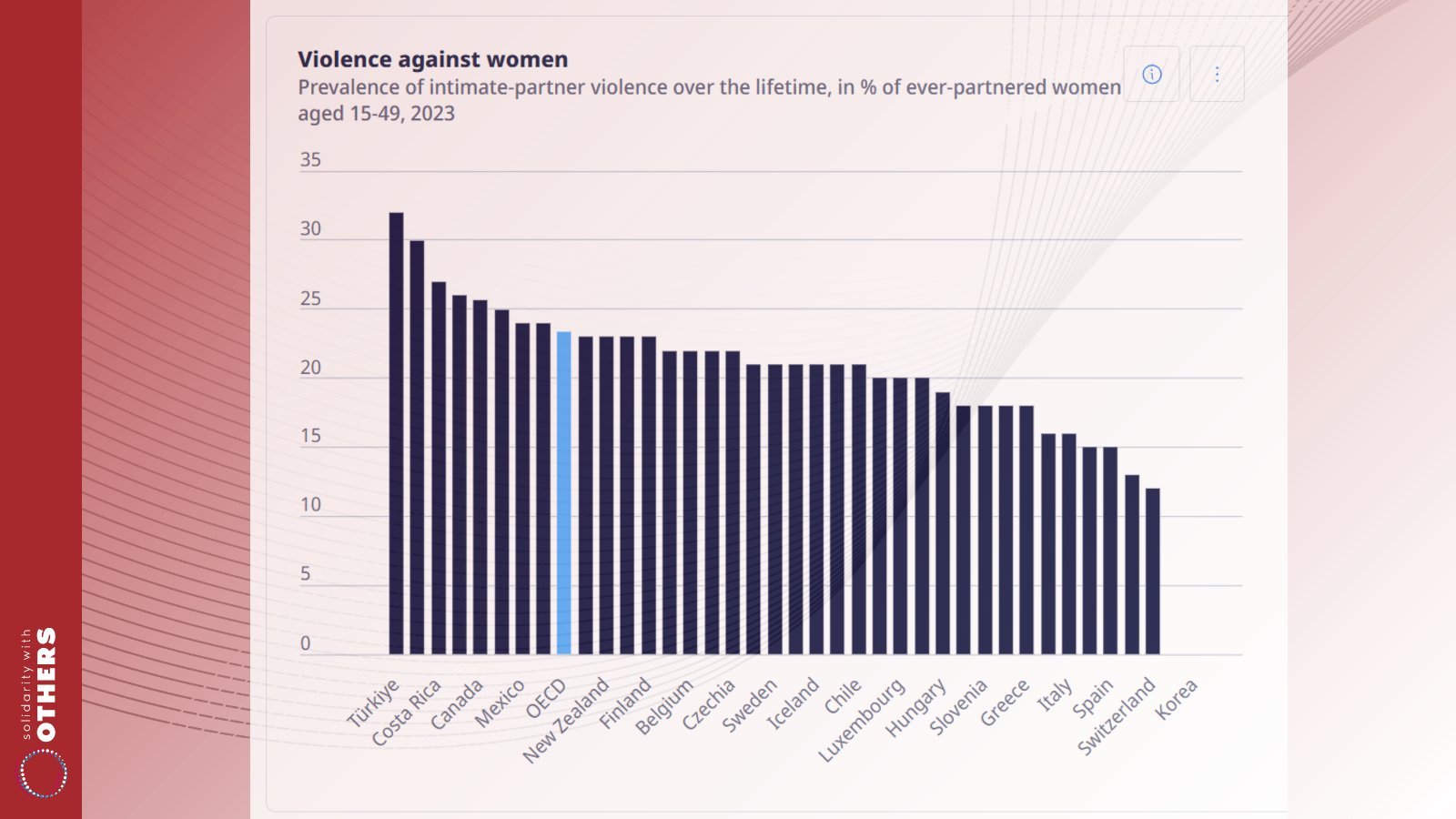
**Violence against women **chart puts Türkiye at the top of the OECD for violence against women. The underlying figures come from the OECD’s intimate partner violence indicator, which draws on the WHO Global Health Observatory.
For 2023 the OECD records that 34.7% of ever-partnered women in Türkiye aged 15 to 49 have experienced physical or sexual violence from an intimate partner at some point in their lives. The OECD average is 21.9%. Among women aged 15 and over the Turkish figure is 36.6%, against an OECD average of 21.5%. For violence in the past twelve months alone, Türkiye records 13.3% against an OECD average of 4.7% — nearly three times the average. Türkiye is the highest of the member states for which data exist; Korea and Israel report none.
These are modelled estimates and the OECD says so. It also notes that survey estimates of this kind “likely underestimate the problem”, and that definitions and question wording differ between countries. The direction of the error is downward.
Türkiye’s own official numbers tell a different story, and the difference is the point.
On 6 March 2026 the Turkish Statistical Institute published the Türkiye Violence Against Women Survey 2024, the first national survey of its kind in a decade. It was conducted for the Ministry of Family and Social Services, with fieldwork between 18 November 2024 and 31 January 2025, and 18,275 women aged 15 to 59 were interviewed. It found that 12.8% of women had experienced physical violence in their lifetime, 28.2% psychological violence and 18.3% economic violence.
The state’s previous survey, carried out by Hacettepe University’s Institute of Population Studies in 2014 among 7,462 women in the same age band, found that 36% of ever-married women had experienced physical violence from a husband or partner, 38% physical or sexual violence, 44% psychological violence and 30% economic violence.
The two surveys cannot be set directly against each other. The 2014 figure measures violence by a husband or partner; the 2024 figure measures physical violence from any source. Sevinç Ünal of the Equality for Women Platform has pointed out that the new survey does not break its results down by the perpetrator’s identity as the 2008 and 2014 surveys did, which removes the basis for comparison, and that women may have been less willing to disclose. What can be said is that Türkiye’s own statistical office has produced a figure far below both its predecessor and the international estimate, using a methodology that no longer permits the comparison to be made.
One finding in the new survey is not in dispute. Of the women who had experienced violence from a spouse or partner, 47.7% had told no one at all.
Türkiye signed the Council of Europe Convention on Preventing and Combating Violence against Women and Domestic Violence in Istanbul on 11 May 2011, and was the first state in Europe to ratify it, on 14 March 2012. Its own foreign ministry announced that fact. The convention entered into force for Türkiye on 1 August 2014.
On 20 March 2021 a presidential decision withdrawing from it was published in the Official Gazette. The withdrawal took effect on 1 July 2021 — 1,939 days ago. Türkiye remains the only state ever to have left the convention. Before the Danıştay, both the rapporteur judge and the Danıştay public prosecutor advised that the decision was unlawful and should be annulled. The Tenth Chamber rejected the annulment claims, and the Plenary Session of the Administrative Law Chambers upheld that rejection by majority.
GREVIO, the convention’s monitoring body, last examined Türkiye in a report published on 15 October 2018. There has been no independent monitoring of the country’s record on violence against women under that treaty since.
The CEDAW Committee, in concluding observations dated 12 July 2022, described the denunciation as “a retrogressive measure”, invited Türkiye to reconsider, found gender-based violence “considerably underreported”, and recommended that the state collect comprehensive data disaggregated by, among other things, the relationship between victim and perpetrator. The survey published four years later does not do so.
The We Will Stop Femicides Platform, which counts because the state does not publish the figure, recorded at least 294 women killed in Türkiye in 2025 and a further 297 women found dead in suspicious circumstances. Of the 294, 203 were killed by a man in their own family and 180 were killed at home. Twenty-three were killed while a protection order was in force. In 179 cases no motive was established. In September 2026 the platform recorded 28 women killed and 19 suspicious deaths.
Türkiye has the highest recorded prevalence of intimate-partner violence in the OECD, no treaty-based monitoring of it, and an official survey that has stopped measuring it in a way that can be compared with anything.
Sources:
1- OECD, SF3.4 “Intimate Partner Violence”, OECD Family Database, reference year 2023, source WHO Global Health Observatory (2026): https://webfs.oecd.org/els-com/Family_Database/SF-3-4-Intimate-Partner-Violence.pdf
2- OECD, “Violence against women” indicator: https://www.oecd.org/en/data/indicators/violence-against-women.html