

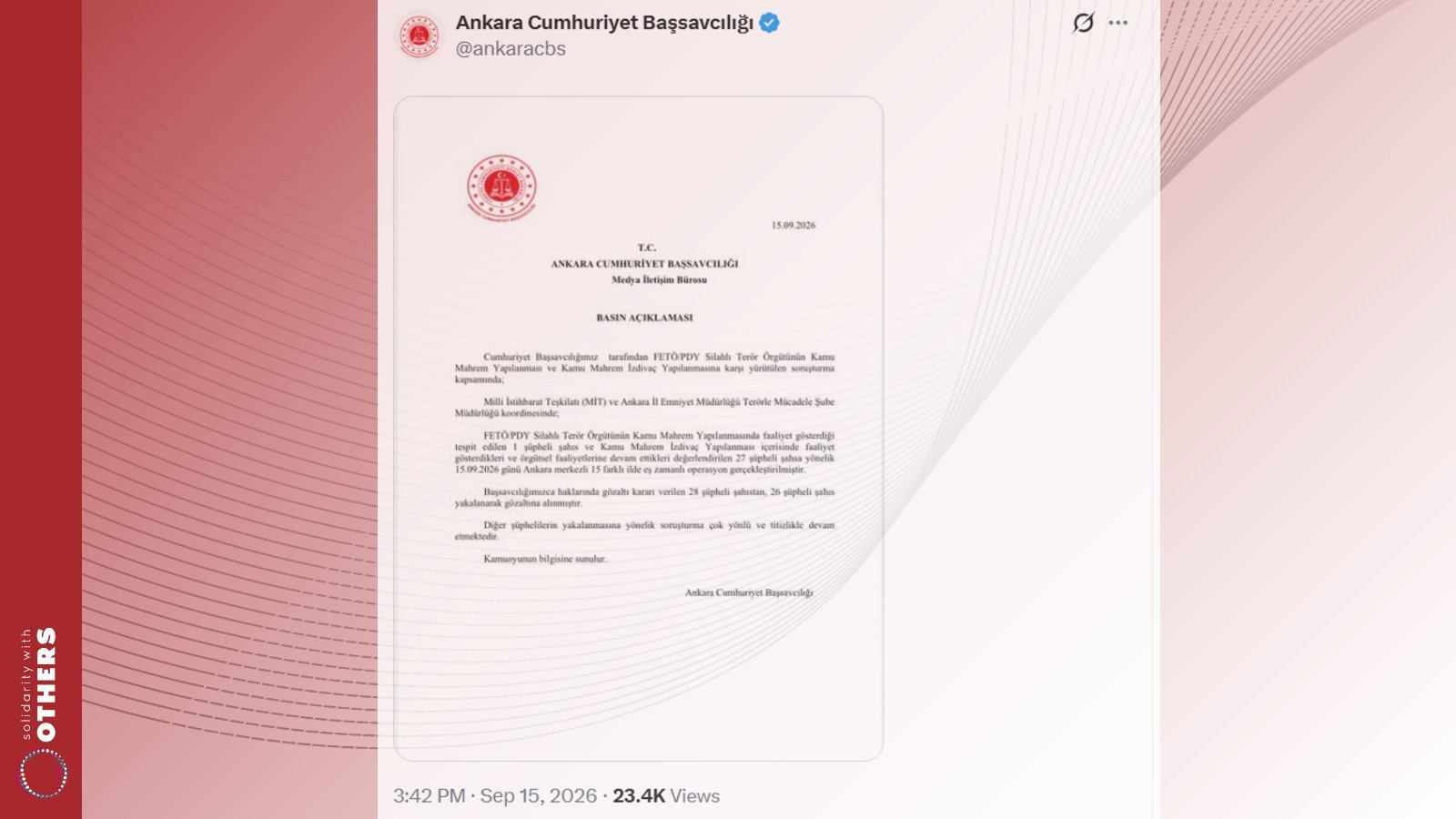
The Ankara Chief Public Prosecutor’s Office announced on 15 September 2026 that simultaneous operations had been carried out in 15 provinces, coordinated by the National Intelligence Organisation (MİT) and the Ankara Police Counter-Terrorism Branch.
According to the statement, the investigation concerns two alleged structures within the Gülen movement, which the prosecutor’s office calls the “public covert structure” and the “public covert marriage structure”. One suspect is said to have been active in the first. The remaining 27 are described as having been assessed to be active within the marriage structure and to be continuing organisational activity. Turkish media describe the second category as the structure said to organise marriages within the movement.
Detention orders were issued for 28 people. Twenty-six were detained and two remain sought. The statement says the investigation continues.
No identities were released. No evidence was described. The statement sets out no act attributed to any of the 28 beyond membership of the two categories.
The operation follows one announced the previous day, in which MİT and Ankara police detained four people accused of sheltering in what the authorities call “cell houses” or of helping others sheltering there.
A report published in July 2026 by Johan Vande Lanotte, emeritus professor at Ghent University, inventoried Gülen-related judicial actions reported in the media during 2025. It found that operations directed at the alleged “current structure” of the movement accounted for roughly half of all structural actions that year, and that the conduct relied on increasingly consisted of ordinary social and family activity.
Turkish Justice Ministry figures from July 2026 record 127,102 convictions for alleged links to the movement since 2016, with 83,404 cases pending.
Twenty-seven of the twenty-eight people sought are accused in a category defined by marriage.
Sources:
1- Ankara Chief Public Prosecutor’s Office statement, 15 Sept 2026: https://x.com/ankaracbs/status/2099856296405012492
2- Ahmet Arslan on X, 15 Sept 2026: https://x.com/ermitaj/status/2099890606927483024
3- Türkiye Gazetesi, 15 Sept 2026: https://www.turkiyegazetesi.com.tr/gundem/fetonun-kamu-mahrem-izdivac-yapilanmasina-15-ilde-buyuk-operasyon-1816200
4- Johan Vande Lanotte, Report concerning the current state of affairs regarding the judiciary actions targeting persons linked to the Hizmet movement, Ghent, 27 July 2026: https://lnkd.in/p/ex3hKvVt
Legal Note:
Private and family life (Article 8 ECHR). Article 8 protects private life, family life and the home. Niemietz v. Germany, no. 13710/88, 16 December 1992: private life includes the right to establish and develop relationships with other human beings. Interference must be in accordance with the law and necessary in a democratic society.
Marriage (Article 12 ECHR). Article 12 guarantees the right to marry and found a family according to national laws governing its exercise. In O’Donoghue and Others v. the United Kingdom, no. 34848/07, 14 December 2010, the Court held that restrictions on marriage must not impair the essence of the right.
Inferring membership from lawful acts (Article 7).
Yüksel Yalçınkaya v. Türkiye [GC], no. 15669/20, 26 September 2023: criminal liability cannot be imputed almost automatically without establishing every element of the offence, including intent.
Yasak v. Türkiye [GC], no. 17389/20, 5 May 2026: courts must conduct an individualised assessment closely anchored to the specific facts, and may not infer intent from membership of a structure that was, at the material time, widely perceived as a religious group.
Presumption of innocence (Article 6(2)). Allenet de Ribemont v. France, no. 15175/89, 10 February 1995: official statements presenting a person as guilty before a court has so found breach the presumption of innocence.
Liberty (Article 5). Fox, Campbell and Hartley v. the United Kingdom, nos. 12244/86 and others, 30 August 1990: reasonable suspicion requires facts capable of satisfying an objective observer that the person may have committed the offence.