

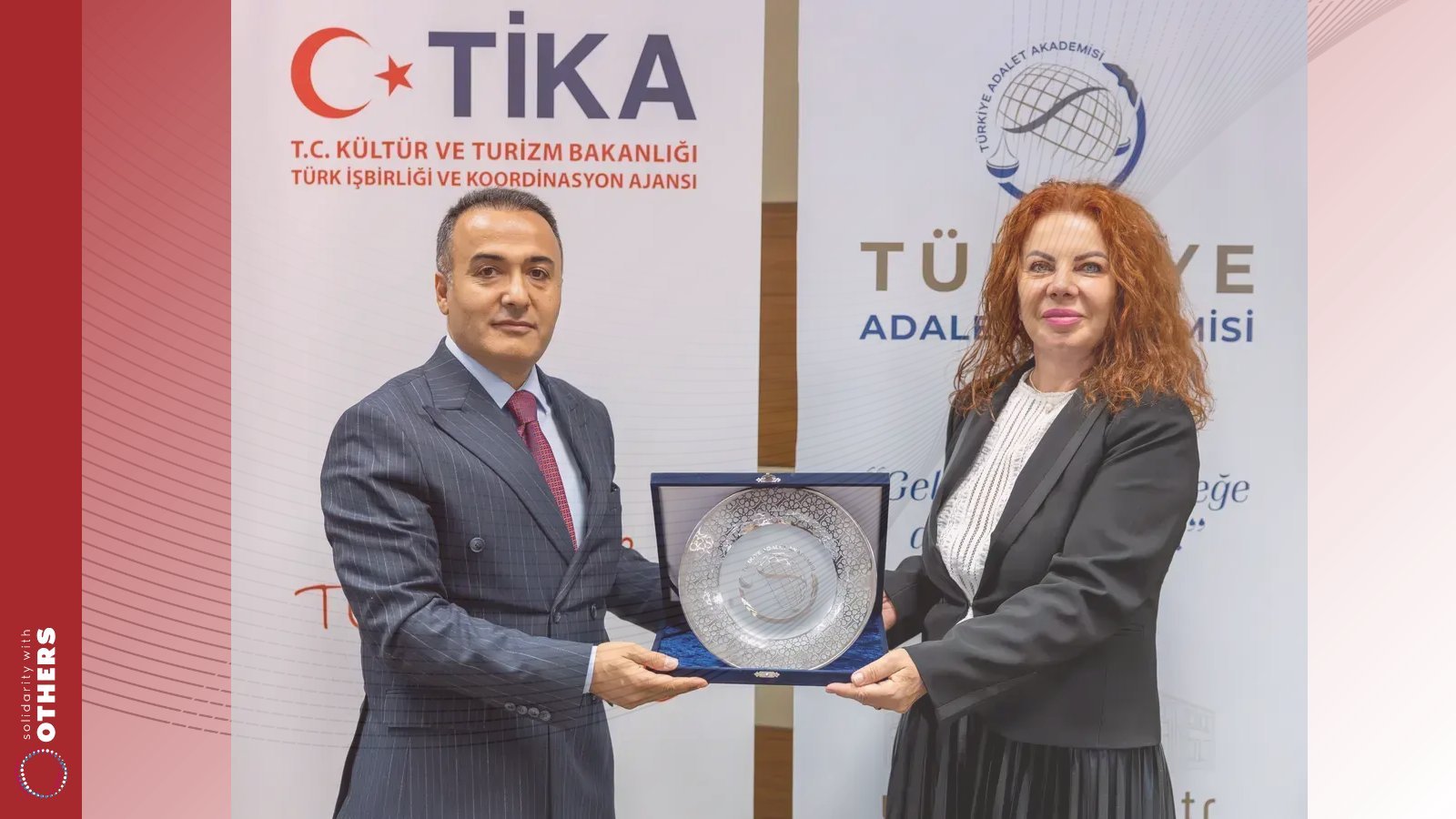
The Justice Academy of Turkey began a Human Rights Law Training programme on 7 September 2026 for the Director of Romania’s National Institute of Magistracy, members of Romania’s Superior Council of Magistracy, and Romanian trainee judges and prosecutors. It is run with the Turkish Cooperation and Coordination Agency (TİKA).
According to the Academy, the programme covers the UN human rights system, the European Convention on Human Rights, the right to a fair trial, the right to life, liberty and security of person, respect for private life, freedom of expression and the right to property. Participants will visit the Ankara West Courthouse, the Council of Judges and Prosecutors, the Court of Cassation and the Constitutional Court. Academy President Metin Yıldırım said protecting these rights is among the most important responsibilities of an independent and impartial judiciary.
The comparative record of the two judiciaries is documented.
Currently, 56,500 applications were pending before the European Court of Human Rights. Turkey accounted for 22,600 of them, the largest number of any state. Romania accounted for 2,100. Turkey also received the most new applications in 2025, at 6,743, a rate of 0.79 per 10,000 inhabitants against a European average of 0.38.
In 2025 the Court delivered 74 judgments concerning Turkey and found at least one violation in 66 of them. Lawyer Ufuk Yeşil, writing on X, puts the corresponding Romanian figures at 33 judgments with violations found in 20, and notes that the Turkish judgments cover far larger numbers of applicants because the Court joins post-2016 dismissal cases. On 16 December 2025 alone, four Committee judgments concerning Turkey disposed of 2,420 applications, finding violations of Article 7 and Article 6(1) and criticising a blanket approach that fails to protect against arbitrary prosecution and punishment.
On implementation, the Committee of Ministers’ 2025 annual report records that Romania achieved the largest reduction of any member state in cases pending full implementation, 124 in total and 27 leading cases, and identifies Romania as a positive example of a state building domestic capacity to implement the Court’s rulings. Yeşil puts Romania’s leading-judgment implementation rate at 77 per cent against Turkey’s 68 per cent, with an EU average of 81 per cent.
The Council of Judges and Prosecutors, which the Romanian delegation will visit, has been suspended from observer status at the European Network of Councils for the Judiciary since 8 December 2016, on the ground that it is no longer independent of the executive and legislature. In 2020 the ENCJ stated that the situation had deteriorated further and described the body as a council in name only. The suspension remains in place.
The Court of Cassation and the Constitutional Court, also on the itinerary, are the courts whose approach to evidence and intent in Gülen-related prosecutions the Grand Chamber found to disclose a systemic problem in Yalçınkaya in 2023 and again in Yasak in May 2026.
On 25 August 2026 the Grand Chamber ruled for the third time in the case of Osman Kavala, ordering his release at the earliest possible date, holding his conviction null and void, and identifying structural shortcomings undermining the independence and impartiality of the Turkish judiciary. He remains in prison. Selahattin Demirtaş also remains in prison despite Grand Chamber judgments of 2018 and 2020.
The Academy states that the partnership with Romania’s National Institute of Magistracy is being placed on an institutional footing through the Erasmus+ programme, with mobility for trainee judges and prosecutors and jointly developed teaching materials.
On every published measure, the training relationship runs in the opposite direction to the record.
Sources:
1- Justice Academy of Türkiye, 7 Sept 2026: https://taa.gov.tr/haber/turkiye-adalet-akademisinden-romanya-yargi-mensuplarina-egitim
2- Ufuk Yeşil on X: https://x.com/DrUfukYesil33/status/2099148153324802502
4- https://echrblog.com/new-judgment-implementation-report/
5-
ENCJ on the HSYK: https://encj.eu/node/449 and https://encj.eu/node/578