

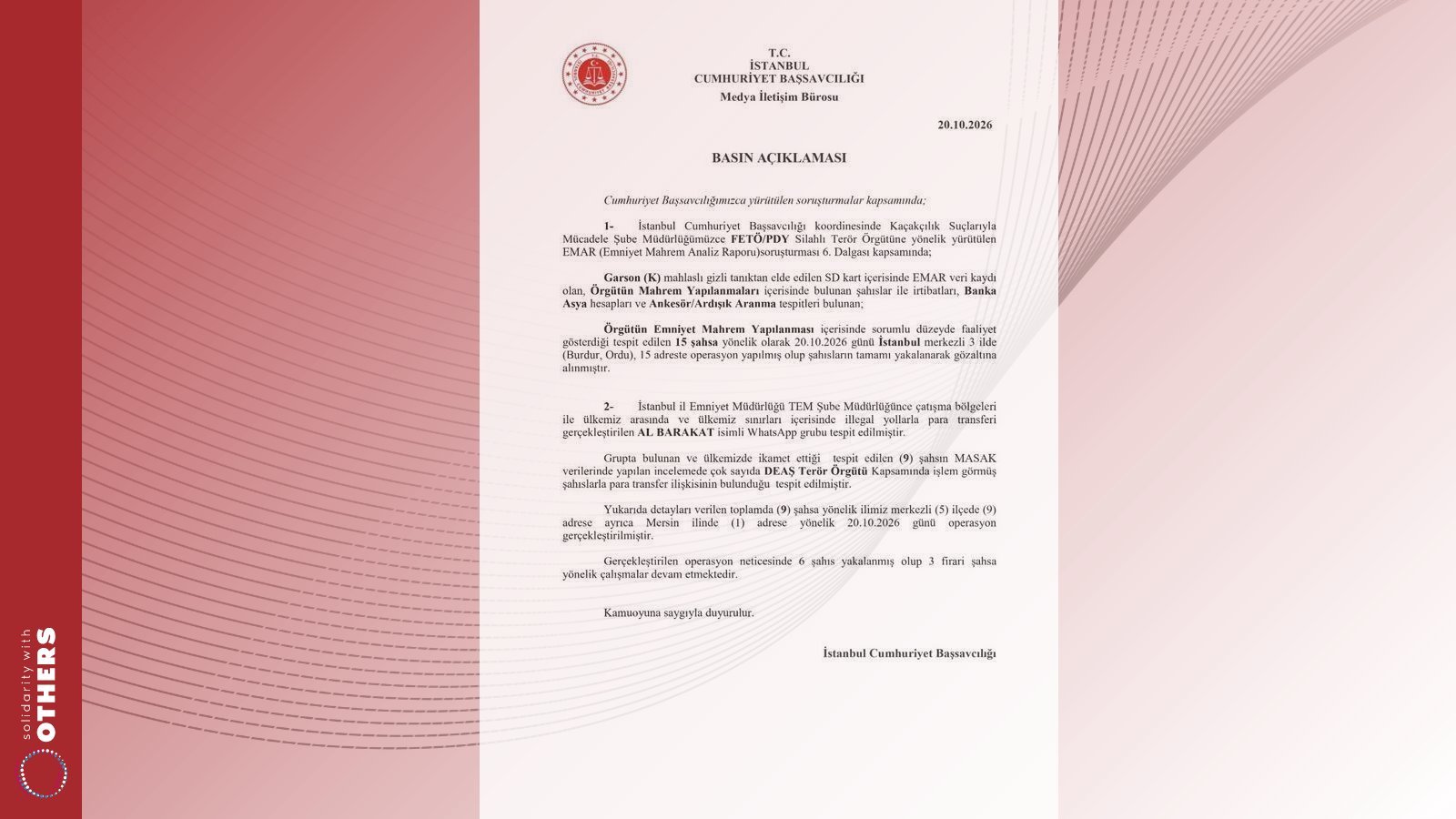
The İstanbul Chief Public Prosecutor’s Office announced on Tuesday that fifteen people had been detained at fifteen addresses in İstanbul, Burdur and Ordu. It is the sixth wave of what the office calls the EMAR investigation, after the Turkish initials for “Police Covert Analysis Report”.
The charge in cases of this kind is membership of an armed terrorist organisation under Article 314 § 2 of the Criminal Code. The statement does not cite it.
What the statement does set out is where the case comes from. The evidence is an SD card obtained from a secret witness codenamed “Garson” — Waiter — containing EMAR data records. Those detained are described as people who appear in that data, who had contacts with persons said to be inside the organisation’s covert structures, who held Bank Asya accounts, and against whom payphone and consecutive-call findings exist. The statement says they were determined to have operated at a responsible level within the police covert structure.
That is the whole of it. A memory card, a bank account, and a pattern of telephone calls.
Note what the prosecution’s own theory requires. These are said to be mahrem structures — covert ones, whose members were handled outside the organisation’s ordinary channels precisely so as to leave no trace. A theory of concealment produces, by its own logic, a case that can never rest on anything direct. What fills the gap is a third party’s record of who someone is said to be, a bank where hundreds of thousands of people held accounts, and the fact that two telephones were called from the same payphone in sequence.
Each of those three has been ruled on.
On the data, the Grand Chamber held in Yüksel Yalçınkaya v. Türkiye on 26 September 2023 that Türkiye violated Article 6 § 1 by convicting a man on material he was never given and whose reliability his objections were never allowed to test, and violated Article 7 by treating a single evidential category as conclusive proof of every element of the offence. The Court found the problem systemic and indicated general measures under Article 46. It has decided the same question since in judgments covering 2,420 applicants in December 2025, 893 in June 2026 and 947 in September 2026.
On Bank Asya, the same judgment held that treating a lawful bank account and lawful association memberships as indications of criminal conduct violated Article 11. The bank was a publicly traded institution regulated by the Turkish state, and holding an account in it was not an offence at the time.
On call records, the Grand Chamber held in Yasak v. Türkiye on 5 May 2026 that a conviction under Article 314 § 2 violates Article 7 where the domestic courts list items of evidence and move directly to a conclusion that criminal intent was present, without individualised reasoning. Telecommunications traffic records were among the material in that case. The Court held that membership requires proof of a personal, functional or hierarchical link to the organisation, and that intent cannot be inferred from participation in economic or civic life that was lawful when it took place. The Turkish Government accepted in those proceedings that none of the acts imputed to the applicant had been prohibited at the material time.
And on the witness, the Court held in Selahattin Demirtaş v. Türkiye (no. 4) in July 2025 that statements by anonymous witnesses must be corroborated by objective elements, and that allegations expressed in abstract terms, without detail of any concrete activity, cannot found a reasonable suspicion. It applied that standard against Türkiye again on 13 October this year in Kaya v. Türkiye.
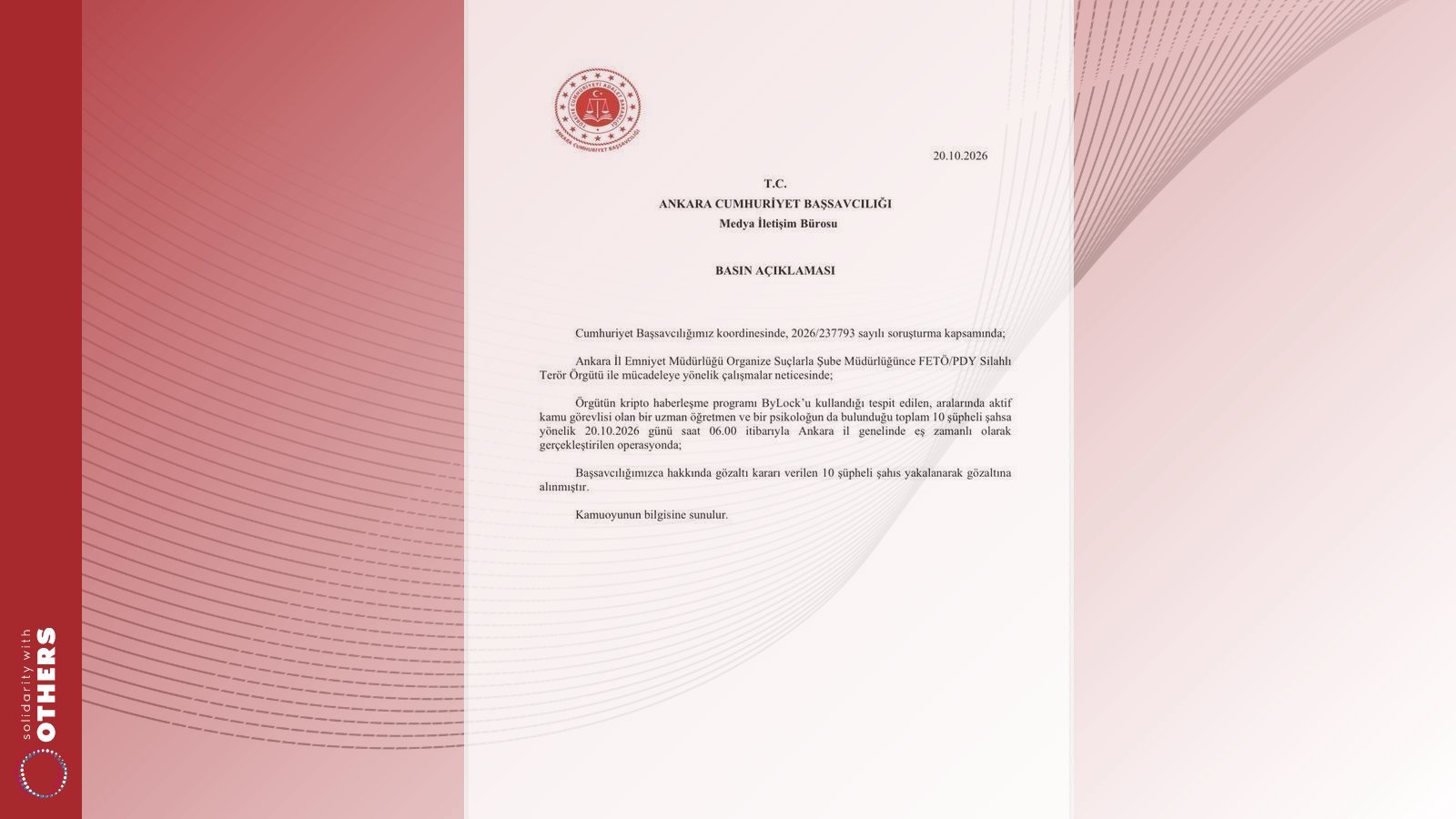
Nothing has been said publicly about how the SD card was obtained, who compiled the records on it, when, on what basis, or whether any defence lawyer has been permitted to examine the raw data. Nothing has been said about who “Garson” is or whether his account has ever been tested in adversarial proceedings.
The fifth wave was eighteen days earlier. On 2 October twenty people were detained across six provinces. Fourteen were remanded and six released under judicial control. The same memory card, the same witness, the same sentence about operating at a responsible level. Pro-government newspapers reported that the card had been “decoded”. Nothing has been published about the first four waves: not how many were taken, not how many were charged, not how many were convicted or acquitted.
The unit conducting the operation is the Anti-Smuggling Crimes Branch.
The same announcement reported a second, unrelated operation against nine people over alleged ISIS financing through a WhatsApp group, based on financial-intelligence records of transfers with people previously processed in connection with that organisation. Six were detained and three are being sought. That case names a group, a dataset and a type of transaction. The comparison is instructive.
“FETÖ/PDY” and “DEAŞ” are the Turkish authorities’ designations and are used here as quotation only. This organisation does not adopt them.
Nobody detained on Tuesday has been charged, brought before a judge or convicted. Three years after Strasbourg described the evidential architecture of these cases as a systemic problem, the architecture is unchanged and the waves continue, at intervals of a few weeks, from a single memory card.
Source:
İstanbul Cumhuriyet Başsavcılığı, Medya İletişim Bürosu, Basın Açıklaması, 20 October 2026: https://x.com/istanbulCBS/status/2112445595998617676