

*This is the first article in a series examining the legal framework, political history, and gendered effects of strip searches in Türkiye.
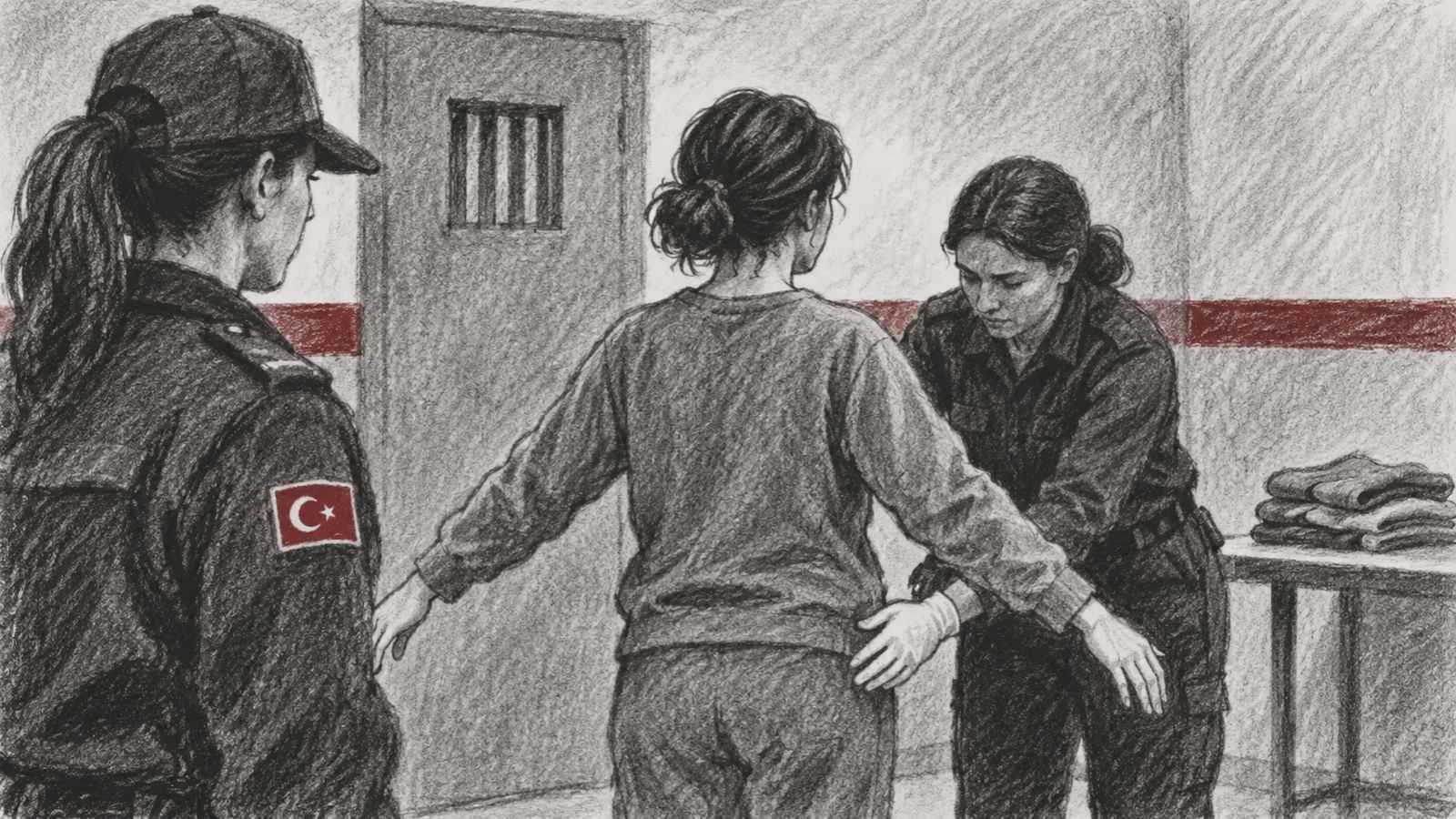
A strip search involves the removal or rearrangement of some or all clothing to permit the visual inspection of private areas, including the breasts, genitals, buttocks, or underwear. It differs from a search conducted over clothing and from a body-cavity search, which involves the physical inspection of genital or anal regions. The distinction is important because these practices represent different degrees of interference with bodily integrity and privacy (United Nations General Assembly, 2010).
The terminology used by public institutions does not determine the legal nature of the procedure. An instruction to lower underwear, expose intimate areas, squat, or repeatedly sit and stand may constitute a strip search even when it is officially described as a “detailed search.” The assessment must focus on what happened to the person’s body rather than on the administrative label assigned to the procedure.
Legality and Legitimacy
International standards do not prohibit strip searches in all circumstances. They do, however, establish a high threshold. Rules 50-52 of the Nelson Mandela Rules provide that searches must comply with legality, necessity, and proportionality and must respect the dignity and privacy of the person concerned. Intrusive searches may be conducted only when absolutely necessary. They must take place in private, be performed by trained personnel of the same sex, and be properly recorded. Authorities should use less intrusive alternatives whenever possible (United Nations General Assembly, 2015).
The Bangkok Rules introduce additional gender-specific safeguards. Searches of women must be conducted by properly trained women staff, while scanning technologies and other screening methods should be developed to replace strip and invasive searches because of their potential psychological and physical effects (United Nations General Assembly, 2010).
Turkish prison law provides a general authorization for searches. Article 36 of Law No. 5275 permits unannounced searches of prisoners, their belongings, and prison premises (Türkiye, 2004). The specific conditions for strip searches are principally found in Article 34 of the 2020 Regulation on the Administration of Penitentiary Institutions. The regulation permits a strip or body-cavity search where there are “reasonable and serious indications” that a prisoner possesses a prohibited item and the institution’s highest authority considers the procedure necessary. It also prescribes privacy, same-gender staff, minimum duration, and documentation (Türkiye, 2020).
The Directorate General of Prisons has stated that ordinary screening should normally be sufficient and that a “detailed search” is an exceptional procedure requiring reasonable and serious suspicion. It has also maintained that the person should not be left entirely naked during the procedure (Directorate General of Prisons and Detention Houses, 2020).
This framework raises two legal concerns. First, the power to conduct one of the most intrusive forms of bodily search is defined primarily in secondary legislation rather than in a sufficiently detailed parliamentary statute. Aras (2022) argues that this is difficult to reconcile with the constitutional requirement that restrictions on fundamental rights be prescribed by law. Second, rules governing penal institutions do not automatically provide legal authority for strip searches in police stations. The legality of a search conducted in police custody must therefore be assessed separately.
Formal authorization is also insufficient to establish legitimacy. A search may follow certain procedural requirements and still constitute degrading treatment if it is routine, punitive, discriminatory, or unsupported by individualized suspicion. A credible assessment requires authorities to explain the specific risk, the evidence supporting it, the alternatives considered, the official who authorized the procedure, and its result. Without such information, references to security remain too general to justify compelled exposure.
The Body as an Object of Security
Foucault’s account of disciplinary power provides a useful framework for examining strip searches. In Discipline and Punish, modern institutional power operates through observation, classification, examination, and normalization rather than through punishment alone (Foucault, 1977). The body becomes an object of administrative knowledge and intervention.
A strip search follows this logic. The detained person is required to expose specified areas of the body and perform movements according to an institutional sequence. Intimate anatomy is transformed into a field of security inspection. Compliance demonstrates institutional control, while refusal may be interpreted as resistance or evidence of concealment.
The distinction between “strip search” and “detailed search” is relevant in this context. The former describes the procedure from the perspective of bodily exposure. The latter represents the institutional perspective and frames the same intervention as a technical security measure. Administrative language can therefore narrow public discussion by removing coercion and humiliation from the description of the act.
Foucault’s concept of normalization also helps explain how an exceptional measure may become routine. Individualized suspicion can gradually be replaced by categorical assumptions about particular populations. A person’s identification as a Kurdish political activist, a Gezi protester, or an alleged member of the Gülen movement may begin to function as a generalized marker of risk.
A feminist and intersectional approach adds an element that is less developed in Foucault’s work. Bodies enter custody within existing relations of gender, ethnicity, religion, class, and political status. The effects of compelled nudity are shaped by these relations. Hughes-Stanley (2021), writing about women’s prisons in England, conceptualizes body searching as a possible mechanism of state-inflicted patriarchal sexual violence and gendered control. Although that study arises from a different institutional context, its central observation is relevant: the language of security may administratively desexualize practices that detained women experience as coercive and sexually intrusive.
The distribution of visibility is also unequal. The detained person’s body is made visible while the institutional decision often remains opaque. The person may not know what evidence justified the search, whether less intrusive alternatives were attempted, or whether the procedure was documented. Accountability requires reversing this imbalance by making the state’s decision open to independent examination.
Historical Continuity Before and After 2013
The history of sexualized custodial violence in Türkiye predates the current controversy. During the 1990s and 2000s, Kurdish women reported rape, forced nudity, sexual assault, and invasive examinations in custody. In Aydın v. Turkey, the European Court of Human Rights held that the rape and ill-treatment of a 17-year-old Kurdish girl in state custody amounted to torture (Aydın v. Turkey, 1997).
Amnesty International documented the 1999 detention of two Kurdish girls who reported being forced to strip and remain naked, placed in stress positions, and subjected to sexualized violence. According to Amnesty, no police officers were prosecuted (Amnesty International, 2000). Göksel and Morse (2022) place such cases within the longer legal mobilization of Kurdish women against sexual violence and torture in custody, using the concept of “legal exhaustion” to describe the personal and political costs of pursuing remedies through institutions that repeatedly delay or restrict accountability.
Forced nudity, rape, and an administratively regulated strip search are not legally identical. They differ in severity and classification. Their historical relationship lies in a recurring institutional pattern: political designation increases official control over intimate bodily boundaries, while closed custodial environments make verification and accountability difficult.
This pattern became visible to a wider public during the Gezi protests. On 8 July 2013, Taksim Solidarity spokesperson Mücella Yapıcı and her daughter Cansu Yapıcı were detained and held at Istanbul Police Headquarters. They reported being required to remove all their clothing. An indictment was issued seven years later.
In October 2024, the Istanbul 11th Assize Court found that two women police officers had conducted the search. The court nevertheless classified the conduct as misconduct in public office rather than torture. It imposed five-month prison sentences and deferred their announcement; a third officer was acquitted (Sonbahar, 2024).
The judgment formally recognized that the search occurred. Its timing and legal classification also illustrate the limitations of accountability. After eleven years, an allegation originally prosecuted under the framework of torture was resolved as a comparatively minor abuse of official duty.
Uşak and the Politics of Credibility
Following the attempted coup of July 2016, allegations of strip searches were increasingly reported by women detained or imprisoned for alleged links to the Gülen movement. The Uşak case brought these accounts into national political debate.
In 2020, HDP member of parliament Ömer Faruk Gergerlioğlu stated that approximately 30 women, many of them university students, had been strip-searched following a police operation in Uşak on 31 August. He later told parliament that the women had been ordered to lower their underwear and repeatedly squat. The figure of 30 derives from Gergerlioğlu’s account and has not been independently established (T24, 2020).
The official response focused substantially on the credibility and political affiliations of those communicating the allegations. Uşak Governor Funda Kocabıyık denied the claims and characterized their circulation as cooperation between “FETÖ” and the PKK. Police personnel filed a criminal complaint against Gergerlioğlu (Euronews, 2020).
AKP parliamentary group deputy chair Özlem Zengin initially stated that she did not believe strip searches occurred in Türkiye and accused Gergerlioğlu of “terrorizing parliament.” In February 2021, she argued that an “honourable” or “moral” woman would not wait a year before disclosing such an experience. She subsequently qualified her position, stating that she was not claiming such searches never occurred but that their existence did not in itself establish a human-rights violation (BBC News Türkçe, 2021; bianet, 2021).
The timing of disclosure is not a reliable measure of credibility. Shame, trauma, fear of retaliation, continuing prosecution, family pressure, and distrust of official complaint mechanisms may delay reporting. Where complainants risk moral condemnation or counter-investigation, the absence of an immediate complaint provides limited evidence about whether abuse occurred.
The Uşak debate also shows how gender protection may operate conditionally. Conservative or religious identity did not insulate women accused of links to the Gülen movement from suspicion. Once they were classified as members of a security threat, their claims to privacy and credibility became more precarious. Gender, religion, and political designation operated together rather than independently.
The available evidence does not prove the existence of a single centralized policy ordering strip searches against all political opponents. It does indicate institutional continuity across changing target groups: similar allegations have arisen among Kurdish women, Gezi protesters, and women accused of Gülen affiliation and ongoing main opposition party CHP investigations; official responses have often combined denial, legal justification, terminological revision, and challenges to complainants’ credibility; and judicial accountability has generally been delayed or limited.
Security considerations may justify an intrusive search under narrowly defined and independently reviewable conditions. They do not create a general authority over the bodies of detained persons. The burden should remain with the state to demonstrate individualized necessity, legal authorization, proportionality, proper documentation, and access to an effective remedy.
References
Amnesty International. (2000, February 2). Turkey: Women’s Rights Action 2000 – Young women raped and sexually assaulted in custody. https://www.amnesty.org/en/documents/eur44/004/2000/en/
Aras, B. (2022). Uluslararası belge ve raporlar ışığında cezaevlerindeki arama usulüne ilişkin temel esaslar [Fundamental principles of search procedures in prisons in light of international documents and reports]. Yeditepe Üniversitesi Hukuk Fakültesi Dergisi, 19(2), 501-571. https://dergipark.org.tr/en/download/article-file/2654077
Aydın v. Turkey, Application No. 23178/94 (European Court of Human Rights, September 25, 1997). https://hudoc.echr.coe.int/eng?i=001-58371
BBC News Türkçe. (2021, February 19). Özlem Zengin: AKP Grup Başkanvekili “çıplak arama” sözleriyle neden tepki çekti, eleştirilere ne yanıt verdi? https://www.bbc.com/turkce/haberler-turkiye-56127241
bianet. (2021, March 13). Özlem Zengin: Çıplak arama hiç yoktur demiyorum. https://bianet.org/haber/ozlem-zengin-ciplak-arama-hic-yoktur-demiyorum-240752
Directorate General of Prisons and Detention Houses. (2020, December 21). Ceza infaz kurumlarında uygulanan arama prosedürüne ilişkin basın açıklaması [Press statement on search procedures applied in penal institutions]. Ministry of Justice, Republic of Türkiye. https://cte.adalet.gov.tr/Home/SayfaDetay/ceza-infaz-kurumlarinda-uygulanan-arama-prosedurune-iliskin-basin-aciklamasi21122020050818
Euronews. (2020, December 18). Çıplak arama iddialarının hedefi olan Uşak Emniyeti’nden Gergerlioğlu hakkında suç duyurusu. https://tr.euronews.com/2020/12/18/c-plak-arama-iddialar-n-n-hedefi-olan-usak-emniyeti-nden-gergerlioglu-hakk-nda-suc-duyurus
Foucault, M. (1977). Discipline and punish: The birth of the prison (A. Sheridan, Trans.). Pantheon Books. (Original work published 1975)
Göksel, N., & Morse, J. (2022). “Legal exhaustion” and the crisis of human rights: Tracing legal mobilization against sexual violence and torture of Kurdish women in state custody in Turkey since the 1990s. Journal of Human Rights, 21(2), 174-190. https://doi.org/10.1080/14754835.2022.2030206
Hughes-Stanley, A. (2021). A radical feminist analysis of women’s experiences of body-searching in prisons in England [Doctoral dissertation, University of Liverpool]. University of Liverpool Repository. https://livrepository.liverpool.ac.uk/3129315/
Sonbahar, E. (2024, October 17). Çıplak arama davası: İki polise “görevi kötüye kullanmak”tan 5 ay hapis cezası. Media and Law Studies Association. https://www.mlsaturkey.com/tr/ciplak-arama-davasi-iki-polise-gorevi-kotuye-kullanmaktan-5-ay-hapis-cezasi
T24. (2020, December 12). Gergerlioğlu bu kez Meclis kürsüsünden hatırlattı: Uşak’ta gözaltına alınan 30 kadın çıplak aramaya maruz tutuldu. https://t24.com.tr/video/gergerlioglu-bu-kez-meclis-kursusunden-hatirlatti-usak-ta-gozaltina-alinan-30-kadin-ciplak-aramaya-maruz-tutuldu,34672
Türkiye. (2004). Ceza ve Güvenlik Tedbirlerinin İnfazı Hakkında Kanun [Law on the Execution of Sentences and Security Measures], Law No. 5275. Resmî Gazete, 25685. https://narmancik.adalet.gov.tr/ceza-ve-guvenlik-tedbirlerinin-infazi-hakkinda-kanun
Türkiye. (2020). Ceza infaz kurumlarının yönetimi ile ceza ve güvenlik tedbirlerinin infazı hakkında yönetmelik [Regulation on the administration of penitentiary institutions and the execution of sentences and security measures], Presidential Decision No. 2324. Resmî Gazete, 31083. https://www.mevzuat.gov.tr/mevzuat?MevzuatNo=2324&MevzuatTur=21&MevzuatTertip=5
United Nations Committee Against Torture. (2024). Concluding observations on the fifth periodic report of Türkiye (CAT/C/TUR/CO/5). United Nations. https://digitallibrary.un.org/record/4059747
United Nations General Assembly. (2010). United Nations Rules for the Treatment of Women Prisoners and Non-custodial Measures for Women Offenders (the Bangkok Rules) (A/RES/65/229). United Nations. https://www.unodc.org/documents/justice-and-prison-reform/Bangkok_Rules_ENG_22032015.pdf
United Nations General Assembly. (2015). United Nations Standard Minimum Rules for the Treatment of Prisoners (the Nelson Mandela Rules) (A/RES/70/175). United Nations. https://www.unodc.org/documents/justice-and-prison-reform/Nelson_Mandela_Rules-E-ebook.pdf