

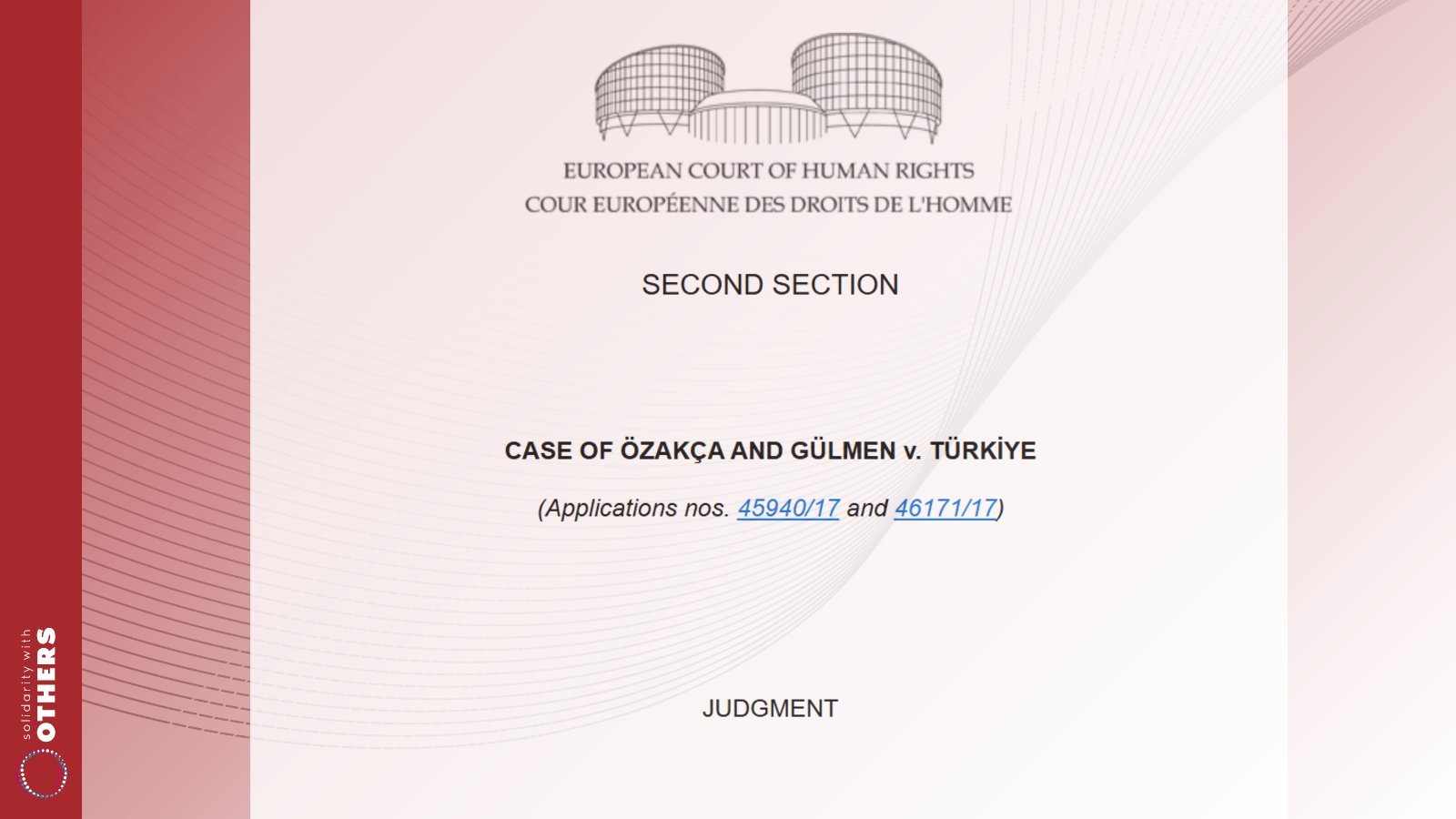
The European Court of Human Rights held on 24 November 2026 that Türkiye violated Article 5 §§ 1 and 3 of the Convention in detaining the dismissed teacher Semih Özakça and the dismissed academic Nuriye Gülmen in 2017, and that the conditions in which Gülmen was held in an Ankara hospital amounted to inhuman and degrading treatment contrary to Article 3. Every finding was unanimous. The Court awarded 12,500 euros to Özakça and 16,300 euros to Gülmen. The judgment is a Chamber judgment and is not yet final: either party may ask for it to be referred to the Grand Chamber within three months.
Gülmen is in Silivri Prison. This morning at ten o’clock (at the time of this post), at the Çağlayan courthouse in Istanbul, a court was due to deliver its verdict in a different case, the one she has been held in since August 2020.
The case decided in Strasbourg began with two decrees. Özakça was dismissed from the civil service by Decree-Law no. 675 in October 2016, Gülmen by Decree-Law no. 679 in January 2017. The same decrees revoked their passports. On 9 November 2016 Gülmen began sitting each day in front of the human rights monument in Ankara; Özakça joined her a fortnight later. Over the months that followed the two were taken into police custody about thirty times. None of those detentions produced a conviction. On 9 March 2017 they began a hunger strike, which they said would end when they got their jobs back.
On 14 March 2017 a magistrate found a strong suspicion that they were members of a terrorist organisation, but decided that detention was not necessary, and ordered them instead to report to a police station once a week. They reported every week. They were arrested again three days later and released again, because the supervision measure was already in place. On 23 May 2017, on the same facts and the same protest, they were ordered into pre-trial detention.
The Court could find nothing in the domestic decisions explaining what had changed. By then the two were attending their own protest less and less because they were too weak, and the protest went on without them. The only new evidence in the detention order was material they had posted on social media and did not deny posting; the prosecutor filed the indictment the day after they were detained, having needed nothing further. The risk of absconding was first invoked five weeks later, without a single concrete fact, and no court explained why two people whose passports the state had already cancelled, and who could barely walk, might flee. At the sixth hearing the prosecutor asked for Gülmen to be released. The trial court did not discuss it. When the case reached the Constitutional Court in 2021, that court relied on the severity of the possible sentence and went no further.
One paragraph of the judgment sets out what the domestic courts did not explain. A third defendant, charged with membership of the same organisation and propaganda on its behalf for taking part in the same sit-in, was never detained. It was argued before the Turkish courts that the difference was that he was not on hunger strike — which, in the Court’s words, “reinforced the suspicion that the real aim behind the detention of the applicants was to put an end to their hunger strike.”
The Court declined to find that the second investigation had been opened for ulterior motives, saying it could not establish that with certainty. It found instead that the domestic courts had failed in their duty, under Turkish law as much as under the Convention, to ensure that the detention was necessary and proportionate, and so to dispel fears as to its arbitrariness. The state of emergency did not save it: Articles 100 and 101 of the Code of Criminal Procedure, which require courts to give reasons for detention and to explain why lesser measures would not do, were never amended during the emergency.
The Article 3 finding concerns two rooms. Gülmen spent fourteen days in an intensive care unit, where there was no lavatory and she was given a commode chair beside her bed, at first in full view; a screen was brought only after she asked for one, and it did not hide her. She could not wash or change her clothes. The door stayed open and gendarmerie officers watched without interruption. She was not allowed outside, and was not allowed to move about the room — the officers, on an account the Government never contradicted, told her they would handcuff her to the bed if she tried. She was then held for some two months in a basement room on the hospital’s prison ward, with no natural light, where she could not tell day from night, and with the artificial light left on permanently. The Court asked the Government for photographs or any other material about those rooms. The Government provided none. Türkiye’s own national human rights institution had reported a year earlier that the ventilation and lighting on that ward were highly inadequate and that patients could not benefit from daylight or fresh air. By the time she was moved there, Gülmen was on the two hundred and fourteenth day of her hunger strike.
The Court found no violation in respect of the medical care given to either applicant, and none in respect of Özakça at all, or of the conditions at Sincan. What it condemned was not the treatment of an illness but the conditions in which a critically ill woman was kept while it was treated.
On 1 December 2017 the Ankara 19th Assize Court acquitted Özakça and convicted Gülmen, sentencing her to six years and three months and releasing her under a travel ban. The appeal court upheld both judgments in June 2020. According to the Turkish Government’s own submission to Strasbourg, dated 15 April 2026, that case was still pending before the Court of Cassation.
The case she is in prison for today is a different one. The Istanbul 28th Assize Court sentenced her and Yasemin Karadağ to ten years each for membership of the DHKP/C. The Court of Cassation quashed both convictions this year for incomplete investigation, finding among other things that the statements of two co-defendants had been used against them without the defence ever being able to question them. Neither woman was released. The retrial is where today’s verdict falls due.
Strasbourg has now held that the state detained Nuriye Gülmen unlawfully in 2017, and kept her in conditions that degraded her. It took nine years and five months to say so, in a judgment that is not yet final, about a case that is still before the Turkish Court of Cassation. She has been in prison throughout, in another one.
Sources:
Özakça and Gülmen v. Türkiye, nos. 45940/17 and 46171/17, Second Section Chamber, judgment of 24 November 2026 (not final).
Ufuk Yeşil (@DrUfukYesil033), thread of 24 November 2026.
Tercan v. Turkey, no. 6158/18, 29 June 2021, § 188.
Court of Cassation decision quashing the Istanbul 28th Assize Court’s judgment against Nuriye Gülmen and Yasemin Karadağ, as reported 2 April 2026.
Solidarity with Others, “Nuriye Gülmen’s father died six hours after their prison phone call; her request to attend the funeral went unanswered”, 24 November 2026.