

Camilla Portinaro *
Chronological Background and Timeline
The legislative path toward the March 2026 plenary vote reflects a broader transformation in EU return policy, moving from a system based on minimum standards toward a more unified and enforcement-oriented framework. Since 2008, return procedures have been governed by the Return Directive (2008/115/EC), which established common rules but allowed for significant variation in national implementation.
In 2018, the European Commission proposed a recast of the Directive to improve return efficiency, but negotiations stalled within the European Parliament. By October 2024, persistent shortcomings, particularly the fact that only around 20% of return orders resulted in actual departures, prompted the European Council to call for a new proposal “as a matter of urgency.”
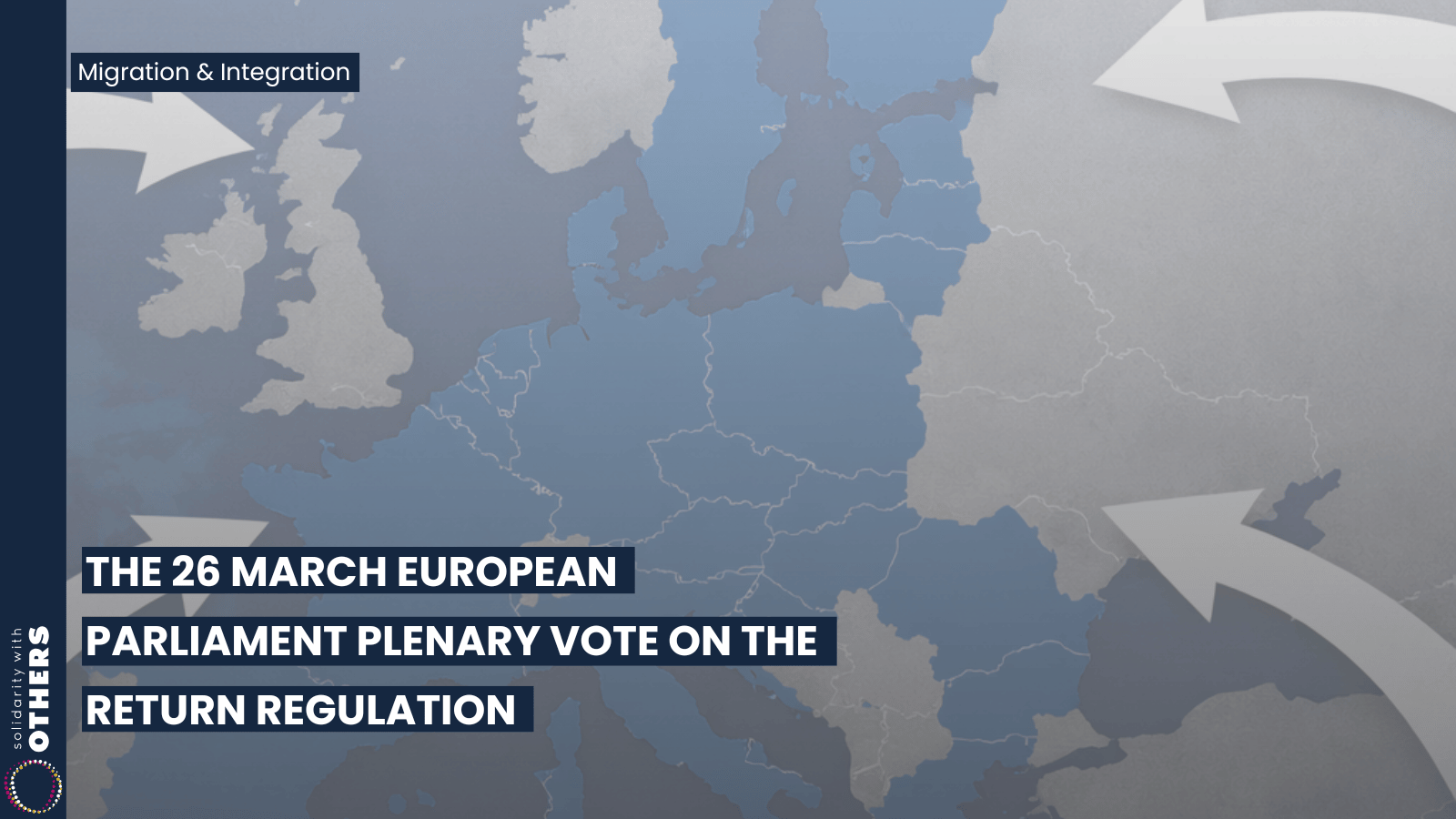
On 11 March 2025, the Commission responded by presenting the “New Common European System for Returns,” centred on a Regulation designed to repeal the 2008 Directive and introduce directly applicable rules across all Member States. The proposal quickly generated significant opposition: on 15 September 2025, more than 200 civil society organisations issued a joint statement calling for its rejection, citing concerns over inhumane measures. The legislative process nonetheless advanced, with the Civil Liberties Committee (LIBE) adopting its position on 9 March 2026 by 41 votes to 32. This led to the 26 March 2026 plenary vote, in which the Parliament endorsed the opening of trilogue negotiations with the Council.
The 26 March 2026 Plenary Vote
On 26 March 2026, the European Parliament approved the mandate to enter interinstitutional negotiations with 389 votes in favour, 206 against, and 32 abstentions. The vote followed procedural challenges by the S&D, Greens/EFA, and The Left groups, which opposed the committee’s position. The outcome highlighted shifting political dynamics within the Parliament. A majority of members from the European People’s Party supported the mandate, voting alongside right-wing and far-right groups. Critics described this alignment as a departure from the traditional “cordon sanitaire,” pointing to a broader reconfiguration of political coalitions around migration and enforcement policies.
Key Changes Introduced by the Return Regulation
According to the Commission, the proposed Regulation represents a fundamental departure from the 2008 framework, replacing a system of minimum standards with a uniform and more enforcement-driven approach. A central change lies in the legal instrument itself: unlike the Directive, which required transposition into national law, the Regulation would be directly applicable in all Member States. This shift is intended to eliminate the current “patchwork”[1] of national systems, which the Commission argues
contributes to secondary movements and weakens return effectiveness.
Another major innovation is the introduction of a European Return Order (ERO), a standardised decision recorded in the Schengen Information System.[2] Under this mechanism, return decisions issued by one Member State must be recognised and enforced by all others, removing the need for new administrative procedures and effectively mutualising enforcement across the EU.[3] In practice, this system forces a Member State to deport an individual based on the first state’s decision.
The Regulation also significantly expands the use of detention. The maximum detention period would increase from 18 to 24 months,[4] while the criteria for establishing a risk of absconding are broadened to include factors such as the absence of a fixed address.[5] The framework explicitly allows for the detention of families and, as a measure of last resort, unaccompanied minors.[6] These aspects risk leading to widespread detention and lacks in safeguards.
A further departure from the 2008 rules is the creation of a legal basis for so-called “return hubs” in third countries.[7] This would allow Member States to deport individuals to countries with which they have no prior personal or transit connection, provided that an agreement is in place. At the same time, the Regulation weakens procedural safeguards by removing the automatic suspensive effect of appeals.[8] Individuals would need to request suspension of their removal, with courts expected to decide within 48 hours,[9] increasing the likelihood of deportation before legal claims are fully assessed.
The Regulation also shifts the balance from voluntary to forced return. While the 2008 Directive prioritised voluntary departure and guaranteed a minimum seven-day period, the new framework removes this requirement, allowing for immediate removal in certain circumstances.[10] This is complemented by expanded obligations on individuals to cooperate with authorities throughout the return process.[11] Failure to comply may result in sanctions, including financial penalties, reduced access to social benefits, extended entry bans, or even criminal penalties.[12] This essentially means that the use of forced removal is significantly expanded.
Entry bans themselves become stricter and more systematic, generally applying for up to ten years and potentially indefinitely in cases involving perceived security risks.[13] The Regulation also introduces specific procedures for individuals considered a threat to public policy or national security, including expedited removal and the possibility of detention in prison facilities under certain conditions.[14] In the words of Colombi (CEPS), these measures will “ICE-ify” EU migration policy.
General Climate of the Pact on Migration and Asylum
The proposed Regulation forms a central component of the EU’s 2024 Pact on Migration and Asylum. Within this framework, the Regulation is presented as a tool to address the enforcement gap in return procedures, ensuring that rejected asylum applicants are returned quickly in order to prevent pressure on national systems. To this end, the Regulation aligns its provisions with other legislative instruments under the Pact, including rules on screening, security checks, and age assessment. This procedural integration is intended to ensure that a negative asylum decision is immediately followed by a return decision, thereby accelerating the overall process. At the same time, the Regulation reflects a broader strategy of externalisation, whereby responsibility for migration management is increasingly shifted to third countries. Critics argue that this approach prioritises deterrence and control over protection, contributing to what some describe as a more coercive and punitive migration regime. The political context surrounding the vote, including cooperation between mainstream and far-right parties, has further reinforced perceptions of a shift toward stricter enforcement models.
Potential Impacts on Migrants
The Regulation is likely to have significant consequences for migrants subject to return procedures. The expansion of detention, including for families and minors, combined with longer maximum detention periods, may lead to increased deprivation of liberty. The introduction of return hubs raises additional concerns, particularly where individuals may be sent to countries with which they have no meaningful connection. The shift toward forced return as the default option, alongside stricter cooperation requirements and punitive sanctions, further increases the coercive nature of the system. At the same time, the removal of the automatic suspensive effect of appeals heightens the risk of wrongful removals and potential violations of the principle of non-refoulement. Additional concerns relate to increased surveillance and detection measures, which may encourage discriminatory practices such as racial profiling. Provisions allowing derogations from detention safeguards in situations of “unforeseen heavy burdens”[15] also raise questions about the consistency of fundamental rights protections across Member States.
Potential Impacts on NGO Volunteers and Civil Society
The proposed framework also has important implications for civil society actors, particularly NGOs and volunteers providing humanitarian assistance. Provisions allowing authorities to search “all relevant premises”,[16]
could potentially extend to shelters, community centres, and places of worship, raising concerns about the protection of humanitarian spaces. Increased enforcement measures, including the potential normalisation of home searches, may contribute to a climate of fear within affected communities. This environment could expose individuals and organisations offering support to legal or administrative risks, while also discouraging migrants from seeking essential services such as healthcare or legal assistance. Taken together, these developments point toward a possible criminalisation of solidarity, in which humanitarian action becomes increasingly constrained within an enforcement-driven system. This shift may have far-reaching consequences not only for migrants, but also for the broader role of civil society in the EU’s migration landscape.
REFERENCES
Amnesty International, ‘More than 200 Organisations: Inhumane Deportation Rules Should be Rejected’, 15 Septemeber 2025, https://www.amnesty.eu/news/deportation-rules-should-be-rejected/
Bornemann, J. ‘Efficiency, but at What Cost The Commission’s Proposal for a Common European System for Returns’, Verfassungsblog 21 March 2025, https://verfassungsblog.de/eu-return-directive/
CARITAS, ‘Return at what cost?’, 26 March 2026, https://www.caritas.eu/return-at-what-cost/
CEPS, ‘The Return Regulation will ‘ICE-ify’ the EU’s migration policy’, 26 March 2026 https://www.ceps.eu/the-return-regulation-will-ice-ify-the-eus-migration-policy/
Council of the European Union, Brussels, 5 December 2025 (OR. en) 16521/25, Interinstitutional File: 2025/0059 (COD), MIGR 464, JAI 1871, COMIX 437, RELEX 1642, CODEC 2047, CH, IS, LI, NO.
ECRE, ‘ECRE Statement: European Parliament Vote on the Return Regulation’, 26 March 2026 https://ecre.org/ecre-statement-european-parliament-vote-on-the-return-regulation/
ECRE, ‘Proposal for an EU Return Regulation’, 13 March 2025, https://ecre.org/proposal-for-an-eu-return-regulation/
Egmond Institute, ‘An Outlook on the EU’s New Approach on Return’, 27 march 2026 https://egmontinstitute.be/events/an-outlook-on-the-eus-new-approach-on-returns/
EU Official website, ‘Pact of Migration and Asylum. A common EU system to manage migration’, 21 May 2024, https://home-affairs.ec.europa.eu/policies/migration-and-asylum/pact-migration-and-asylum_en
European Commission, Strasbourg, 11.3.2025 COM(2025) 101 final 2025/0059 (COD), Proposal for a REGULATION OF THE EUROPEAN PARLIAMENT AND OF THE COUNCIL establishing a common system for the return of third-country nationals staying illegally in the Union, and repealing Directive 2008/115/EC of the European Parliament and the Council, Council Directive 2001/40/EC and Council Decision 2004/191/EC https://eur-lex.europa.eu/legal-content/EN/TXT/?uri=celex:52025PC0101
European Parliament, REPORT on the proposal for a regulation of the European Parliament and of the Council establishing a common system for the return of third-country nationals staying illegally in the Union, and repealing Directive 2008/115/EC of the European Parliament and the Council, Council Directive 2001/40/EC and Council Decision 2004/191/EC, https://www.europarl.europa.eu/doceo/document/A-10-2026-0048_EN.html
European Parliament Press Release, ‘Returns regulation: MEPs ready to start negotiations’, 26 March 2026, https://www.europarl.europa.eu/news/en/press-room/20260324IPR38908/returns-regulation-meps-ready-to-start-negotiations
European Parliamnet Press Release, ‘Migration: the Civil Liberties Committee adopts a reform of EU return rules’, 9 march 2026, https://www.europarl.europa.eu/news/en/press-room/20260309IPR37702/migration-the-civil-liberties-committee-adopts-a-reform-of-eu-return-rules
IRC EU, ‘IRC responds to European Parliament vote to move ahead with Return Regulation’, 26 March 2026, https://www.rescue.org/eu/press-release/irc-responds-european-parliament-vote-move-ahead-return-regulation
IRC EU, ‘What is the EU Pact on Migration and Asylum?’, 23 July 2024, https://www.rescue.org/eu/article/what-eu-pact-migration-and-asylum
Migration Policy Group (MPG), ‘EU Parliament adopts new Return Regulation: MPG warns of widening human rights gaps’, 26 March 2026, https://www.migpolgroup.com/index.php/2026/03/26/eu-return-regulation-ep-vote/
We Move Europe, ‘Say No to Mass Deportations in Europe’, 26 March 2026, https://action.wemove.eu/sign/2025-12-no-deportation-petition-EN/
_______
[1] European Commission, COM(2025) 101 final 2025/0059 (COD), Proposal for a REGULATION OF THE EUROPEAN PARLIAMENT AND OF THE COUNCIL establishing a common system for the return of third-country nationals staying illegally in the Union, and repealing Directive 2008/115/EC of the European Parliament and the Council, Council Directive 2001/40/EC and Council Decision 2004/191/EC, p. 1.
[2] European Commission, COM(2025) 101 final (n. 1), Art. 7(7).
[3] Ibid., Art. 9.
[4] Ibid., Art. 32(3).
[5] Ibid., Art. 30.
[6] Ibid., Art. 35.
[7] Ibid., Art. 17.
[8] Ibid., Art. 28(2).
[9] Ibid., Art. 28(4).
[10] Ibid., Art. 13.
[11] Ibid., Art. 21
[12] Ibid., Art 22.
[13] Ibid., Art 10(6).
[14] Ibid., Art. 16.
[15] European Commission, COM(2025) 101 final, Art. 47.
[16] Council of the European Union, Brussels, 5 December 2025 (OR. en) 16521/25, Interinstitutional File: 2025/0059 (COD), MIGR 464, JAI 1871, COMIX 437, RELEX 1642, CODEC 2047, CH, IS, LI, NO. Article 23, Investigative measures.