


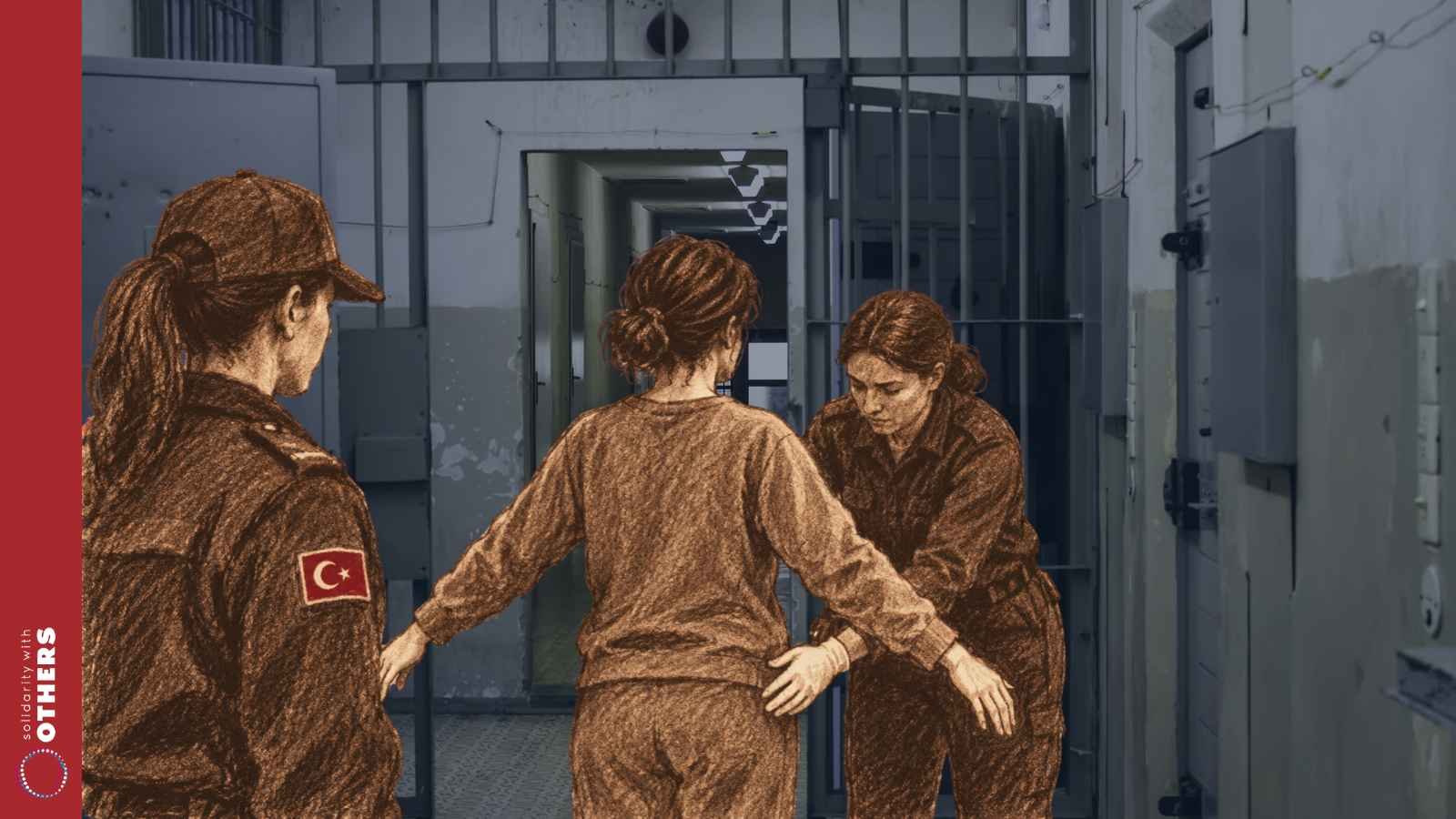
*This is the third article in a series examining the legal framework, political history, and gendered effects of strip searches in Türkiye.
Türkiye’s 2021 prison regulation established a higher threshold for what it renamed a “detailed search.” By 2024, the government was presenting that amendment before the UN Committee Against Torture as evidence that strip searches had been discontinued. Allegations nevertheless continued, first from women imprisoned for alleged links to the Gülen movement and later from a municipal executive detained in a politically prominent investigation.
The resulting record contains regulations, official denials, parliamentary questions, survivor testimony, administrative inquiries, and proceedings before the European Court of Human Rights. What remains absent is a transparent system capable of showing how often intrusive searches occur, why they are authorized, what they produce, and whether complaints lead to sanctions.
That absence affects both sides of the debate. It prevents allegations from being assessed through institutional evidence and prevents the state from substantiating its claim that intrusive searches are exceptional. Accountability cannot depend on the political visibility of an individual complainant.
Şakran: An Allegation and an Institutional History
In September 2025, DEM Party deputy Ömer Faruk Gergerlioğlu reported that approximately 20 young women had been subjected to strip searches upon arrival at Şakran Women’s Prison in İzmir. He said that he obtained the information during meetings with prisoners and identified 24-year-old university student Süeda Güngör as one of the women affected. The women had reportedly been imprisoned following investigations into alleged links with the Gülen movement (Prison Insider, 2025; Stockholm Center for Freedom, 2025).
These claims have not been established by a judicial decision or an independently published investigation. The reported number originates from Gergerlioğlu’s account, while much of the subsequent coverage appeared in advocacy media associated with people prosecuted for alleged Gülen links. The evidence therefore supports describing the incident as a serious and corroboration-worthy allegation, not as a concluded fact.
Source caution, however, cannot end the inquiry. Şakran already had a documented history of similar complaints. A 2013 report by a parliamentary monitoring delegation stated that strip-search concerns persisted at the prison after the Gezi protests. Elif Kaya later brought her treatment at Şakran before domestic authorities and the European Court of Human Rights. In 2014, the justice minister stated that eight of nine investigations concerning alleged strip searches at the institution had ended in decisions not to prosecute (Bianet, 2013; T24, 2014).
Institutional history does not prove a new allegation. It changes the questions an effective investigation should ask. Investigators should examine whether comparable complaints recur in the same location, whether the same spaces or procedures are involved, and whether earlier decisions not to prosecute resulted in operational reform. Treating every complaint as a wholly isolated event prevents institutions from identifying patterns.
No official response or independent investigation addressing the reported 2025 searches was located in the sources reviewed. The evidentiary record therefore remains asymmetrical: prisoners and a parliamentarian supplied accounts, while the institution did not publish the documentation that could confirm or contest them.
Fatoş Pınar Türker and the Unequal Speed of Recognition
The political reach of the issue expanded further in June 2026. Fatoş Pınar Türker, general manager of Istanbul municipality-owned Medya A.Ş. and a defendant in proceedings concerning the Istanbul Metropolitan Municipality, told the court that she had been subjected to an intrusive search at Istanbul Police Headquarters on Vatan Avenue after her detention on 19 March.
According to Türker’s testimony, a police officer instructed her to remove her clothes and underwear, expose her genital area, turn around, and bend over. She also alleged that she was subjected to psychological pressure and threatened with the possibility of losing her children (BBC News Türkçe, 2026).
The allegation concerned police custody. This point became obscured when the Bakırköy Chief Public Prosecutor’s Office recirculated an earlier statement denying that Türker had been strip-searched during admission to prison. A denial concerning prison admission does not answer an allegation concerning a police station. Effective scrutiny requires institutions to distinguish between arrest, police detention, transfer, medical examination, courthouse custody, and prison admission. Each stage involves different personnel, records, and legal authority.
Istanbul police stated that the procedures had complied with the law and rejected Türker’s account. On 12 June, the Ministry of Interior announced that a civil inspector and a police inspector had been appointed to examine the allegation from legal, administrative, and technical perspectives (Bianet, 2026a).
The investigation represented a more substantive response than categorical denial. Yet by 20 August, Interior Minister Mustafa Çiftçi’s publicly reported answer to parliamentary questions stated only that a chief inspector had been appointed. It did not disclose whether the officers had been identified, whether they remained on duty, which records had been secured, or when the inquiry would conclude. No final finding was publicly located as of 2 October 2026 (T24, 2026a).
An investigation’s existence should not be confused with its effectiveness. Under human-rights standards, an inquiry into possible ill-treatment must be independent, prompt, thorough, capable of identifying responsibility, and subject to sufficient public scrutiny. Appointment of an inspector begins that process; it does not complete it.
What a Record Can Establish
An intrusive search generates information that should be preserved at the moment of authorization. The 2021 prison amendment requires documentation of detailed searches. The state told the UN Committee Against Torture that reasonable suspicion must be documented (OHCHR, 2024). A review should therefore be able to establish:
- the individualized facts that produced suspicion;
- the official who authorized the procedure;
- the alternatives attempted and why they were inadequate;
- the identities and training of participating personnel;
- the room, time, duration, and method of the search;
- whether clothing was removed fully or in stages;
- whether physical contact occurred;
- what prohibited item, if any, was recovered;
- whether the searched person received and signed the record;
- whether surveillance footage exists outside the private search area; and
- whether medical or psychological support was offered after a complaint.
Equivalent safeguards are less clearly articulated for police detention. That gap becomes especially significant in the Türker case, the Uşak allegations, and earlier accounts from Kurdish women. Prison regulation cannot function as a substitute for a precise statutory framework governing police strip searches.
Public reporting has not identified comprehensive official statistics covering either setting. There is no readily accessible annual account of the number of detailed searches, their stated grounds, contraband recovery rates, complaints, investigations, or sanctions. In these conditions, the word “exceptional” operates as an institutional assertion rather than an empirically testable description.
The European Court and a Developing Group of Cases
The lack of domestic clarity has increasingly transferred the issue to Strasbourg. On 3 July 2025, the European Court of Human Rights communicated Aydın v. Türkiye and six other applications to the Turkish government. All seven applicants alleged that prison authorities had conducted strip searches without identifying a legitimate purpose. Six relied on Article 3 of the European Convention, while the seventh relied on Articles 3 and 8 (European Court of Human Rights, 2025).
Communication is not a judgment. It means that the Court has notified the government and asked it to respond to the legal and factual questions raised. The cases were still pending in the material reviewed for this article as of 2 October 2026.
Their collective examination is important. Strip-search litigation is often fragmented into individual complaints, allowing authorities to characterize each case as an isolated disagreement about procedure. Grouping applications may make recurring questions more visible: whether individualized reasons were recorded, whether domestic remedies examined necessity, and whether prison administrations treated intrusive searches as routine.
The Human Rights Foundation of Türkiye reached a related conclusion in its review of 18 European Court applications involving strip searches between 2018 and 2022. It reported substantive or procedural Article 3 violations in 14 cases and identified inadequate forensic documentation and failure to establish necessity as recurring concerns (Human Rights Foundation of Türkiye [HRFT], 2022).
The legal question is consequently broader than whether officials used excessive physical force. Forced exposure can engage Article 3 because of its purpose, manner, psychological consequences, and surrounding conditions. It can also engage Article 8 as an unjustified intrusion into bodily privacy. A deficient investigation may itself violate the Convention.
From Testimony to Data
Civil-society documentation provides evidence that official statistics do not. The Istanbul branch of the Human Rights Association reported that, among 98 women and trans women who approached it in 2025, 74 said they had experienced strip searching. This is not a prevalence survey of all detainees: it is a service-based figure drawn from a self-selecting group that had reason and opportunity to contact the organization. It cannot establish how common the practice is nationally. It does, however, identify a substantial caseload requiring investigation and shows that the affected population is not limited to cisgender women (Ekmek ve Gül, 2026).
This distinction between administrative data, clinical documentation, survivor accounts, and representative research is essential. Each answers a different question.
Survivor testimony describes the method, context, and effects of an alleged search. Medical documentation can assess whether psychological and physical findings are consistent with the account. Administrative records show what officials authorized. Independent monitoring can identify recurring institutional practices. Representative research is needed to estimate scale and disparities.
Turkey currently relies heavily on the first category while withholding or failing to generate enough of the others. The person deprived of liberty must reconstruct an event controlled and recorded by the state. The authority retains the documents and then evaluates whether her account is sufficiently substantiated.
This is a form of institutional opacity. Spokes et al. (2022) argue that testimonial injustice can arise when vulnerable individuals encounter institutions whose credibility rules, records, and reasoning are inaccessible. The problem is not only that an official may disbelieve a complainant. It is that the institution organizes the conditions under which her account becomes difficult to prove.
Identity Should Not Determine the Standard of Proof
The chronology of strip-search allegations in Türkiye reveals unequal patterns of political attention. Kurdish women reported sexualized custodial abuse during the 1990s and 2000s. Gezi protesters brought new cases into public view after 2013. Women accused of Gülen affiliation generated a national controversy in 2020 but frequently encountered disbelief shaped by counterterrorism discourse. Fatoş Türker’s account received more rapid attention because it emerged from a prominent case involving Istanbul’s opposition-led municipality.
The difference in visibility should not become a difference in legal protection. Nor should cross-group solidarity depend on ignoring political history. Some institutions and movements now facing rights violations previously failed to recognize comparable violations against other communities. That record requires acknowledgement. It does not justify withholding protection from their members.
An intersectional standard asks how political designation combines with gender, ethnicity, religion, class, sexuality, and access to public platforms. It also requires attention to people who remain outside organized political constituencies: migrants, refugees, sex workers, trans detainees, disabled people, children, and those accused of ordinary criminal offences. Their complaints may be least likely to reach parliament or national media.
A rights-based framework begins from institutional duties rather than the perceived respectability of the complainant. The same evidence-preservation rules, necessity test, and investigative standards must apply whether the person is a Kurdish activist, an alleged Gülen affiliate, a municipal official, or someone without any political network.
A Public Accountability Framework
The next stage of reform should move from procedural language to measurable implementation. At minimum, Türkiye should publish annual, anonymized data for prisons and police custody separately. The data should include the number of intrusive searches, authorization grounds, demographic information, alternatives attempted, items recovered, complaints filed, investigation outcomes, and sanctions imposed.
Every complaint should trigger immediate preservation of relevant documentation and external surveillance footage. The searched person and her lawyer should receive the search record. Investigations should be institutionally independent of the implicated unit and should comply with the Istanbul Protocol where torture or ill-treatment is alleged.
Parliamentary and civilian monitoring bodies need access to places of detention, records, staff, and complainants without institutional interference. Findings should be published with only those redactions necessary to protect privacy and ongoing proceedings.
The Ministry of Interior’s inquiry into Türker’s allegation offers a current test. A public outcome explaining the evidence reviewed, legal standard applied, and reasons for the conclusion would help establish confidence even if the allegation is not substantiated. Silence, indefinite review, or an unexplained result would reproduce the opacity that has shaped earlier cases.
Türkiye has already changed the regulation and its vocabulary. The unresolved task is to make the exercise of intrusive power auditable. A state that regards detailed searches as rare and necessary should be able to demonstrate their rarity and necessity. Until that evidence is available, the burden of uncertainty will continue to fall on the person whose body was placed under institutional control.
References
BBC News Türkçe. (2026, June 12). İBB davasında tutuklu Pınar Türker’in “çıplak arama” iddiasına soruşturma. https://www.bbc.com/turkce/articles/cwyk1lpyz92o
Bianet. (2013, August 19). “Şakran’da çıplak arama sorunu devam ediyor”. https://bianet.org/haber/sakran-da-ciplak-arama-sorunu-devam-ediyor-149268
Bianet. (2026a, June 12). Fatoş Pınar Türker’in “çıplak arama” açıklamaları sonrası soruşturma başlatıldı. https://bianet.org/haber/fatos-pinar-turkerin-ciplak-arama-aciklamalari-sonrasi-sorusturma-baslatildi-320474
Ekmek ve Gül. (2026, June 13). Fatoş Pınar Türker’in savunması sonrası çıplak arama gündemde: “Çıplak arama bir sindirme politikası, bir işkence türüdür”. https://ekmekvegul.net/gundem/fatos-pinar-turkerin-savunmasi-sonrasi-ciplak-arama-gundemde-ciplak-arama-bir-sindirme-politikasi-bir-iskence-turudur
European Court of Human Rights. (2025, July 3). Aydın v. Türkiye and six other applications (Application No. 54634/20 and six others) [Communicated case]. https://hudoc.echr.coe.int/eng?i=001-244433
Human Rights Foundation of Türkiye. (2022). Strip search in prisons and detention centers in the light of ECtHR decisions. https://en.tihv.org.tr/scientific-studies/strip-search-in-prisons-and-detention-centers-in-the-light-of-echr-decisions-2022
Office of the United Nations High Commissioner for Human Rights. (2024, July 18). Experts of the Committee against Torture commend Türkiye on its strong commitment to fight violence against women, ask about life sentences in prison and the communication of detainees with family members. https://www.ohchr.org/en/meeting-summaries/2024/07/experts-committee-against-torture-commend-turkiye-its-strong-commitment
Prison Insider. (2025, September 15). Türkiye: 20 young women strip-searched at Şakran prison, lawmaker says. https://www.prison-insider.com/en/articles/turkiye-20-young-women-strip-searched-at-sakran-prison-lawmaker-says
Spokes, M., Hothersall, S. J., & Brown, R. J. (2022). Institutional opacity, epistemic vulnerability, and institutional testimonial justice. International Journal of Philosophical Studies, 29(4), 473-496. https://doi.org/10.1080/09672559.2021.1997393
Stockholm Center for Freedom. (2025, September 15). 20 young women strip-searched at Şakran prison, lawmaker says. https://stockholmcf.org/20-young-women-strip-searched-at-sakran-prison-lawmaker-says/
T24. (2014, October 15). Kadın hükümlüleri “çıplak arama”ya soruşturmaya gerek yok! https://t24.com.tr/gundem/kadin-hukumluleri-ciplak-aramaya-sorusturmaya-gerek-yok,273971
T24. (2026a, August 20). Fatoş Pınar Türker’in “çıplak arama ve tehdit” açıklamasına yönelik iki aydır ilerleme yok: Bakan Çiftçi “Başmüfettiş görevlendirildi” demekle yetindi. https://t24.com.tr/politika/fatos-pinar-turkerin-ciplak-arama-ve-tehdit-iddialarina-yonelik-iki-aydir-ilerleme-yok-bakan-ciftci-basmufettis-gorevlendirildi-demekle-yetindi,1342925
United Nations General Assembly. (2015). United Nations Standard Minimum Rules for the Treatment of Prisoners (the Nelson Mandela Rules) (A/RES/70/175). United Nations. https://www.unodc.org/documents/justice-and-prison-reform/Nelson_Mandela_Rules-E-ebook.pdf