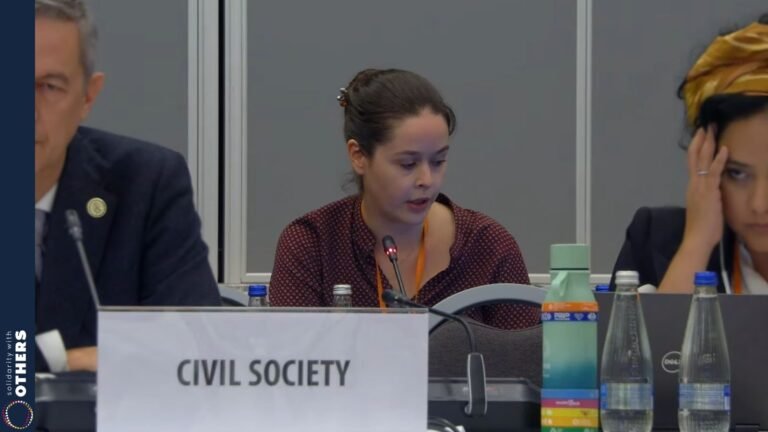



October 2026 saw significant developments in the fight against hate speech, racism and discrimination across Europe and internationally. At EU level, justice ministers called for stronger implementation of the 2026–2030 Anti-Racism Strategy, while Commissioner Hadja Lahbib emphasised tackling structural racism, improving enforcement and strengthening cooperation with civil society.
Council of Europe monitoring highlighted persistent challenges in Belgium and Czechia, including underreporting of hate crimes, inadequate police training, discrimination in schools and hostility towards minority communities.
Developments in France raised concerns about human rights protection and democratic freedoms. These included reports of excessive police force against student protesters, discussions on forced returns to Taliban-controlled Afghanistan, allegations of online harassment targeting European political leaders, and the influence of discriminatory media narratives following a racially motivated shooting in Trappes.
At the international level, the United Nations highlighted growing anti-Muslim hatred and announced plans for a new Action Plan to Combat Islamophobia in 2027, alongside a potential global monitoring mechanism.
Overall, this month’s developments demonstrate the continuing gap between political commitments and effective protection against discrimination, particularly in law enforcement, education, digital platforms and the treatment of vulnerable communities.
EU ministers adopt conclusions on combating racism and hatred
2 October 2026
On 2 October, EU justice ministers adopted Council conclusions on combating racism and related forms of hatred and discrimination. The text states that racism goes against the EU’s fundamental values and weakens social cohesion, equality and people’s ability to take part fully in society. It also looks at the harm that racism and hatred cause to individuals and communities, and at how to respond.
The conclusions call on member states to put the EU Anti-Racism Strategy 2026-2030 into practice. They highlight education, awareness-raising and prevention, the fight against hatred online and offline, and the need to strengthen democratic resilience.
Ministers then held an exchange of views on the existing EU toolbox against racism, discrimination and hatred. They agreed that the priority is to implement the measure already in place.
https://www.consilium.europa.eu/en/meetings/jha/2026/10/02/
France in dialogue with Taliban on forced returns
13 October 2026
France has confirmed that it has opened a “technical dialogue” with the Taliban authorities about forced returns to Afghanistan. This followed after a delegation visit of the Taliban to Brussels in June where among other topics, migration, displaced persons and return policies were discussed.
At this stage France has only opened talks. Human Rights Watch (HRW) does not report any French deportations to Afghanistan, whereas Germany has already deportéd 263 Arghands since last year.
The delegation visit and “technical dialogues” come as a particularly significant shock following the arrest warrants of Taliban Supreme Leader Haibatullah Akhundzada and three other senior officials for the crime against humanity of persecution on gender and political grounds issued by the International Criminal Court in 2025 and announced publicly earlier this month.
Human Rights Watch warned that this is a dangerous shift in policy that could expose Afghans in France to persecution, torture, and other grave abuses. It adds that French officials have not set out any guarantees for those particular risks, including women.
https://www.hrw.org/news/2026/10/13/france-shouldnt-return-afghans-to-taliban-rule?
French High School Student Protests Met with Excessive Force
14 October 2026
Young people, including high school students, have marched the streets across France protesting against the overcrowding of schools, shortages of teachers and lack of infrastructure in the education system.
According to the Human Rights Watch, while dispersing the protests, police officers detained more than 6800 people with 86 percent of them being children. The police reportedly used tear gas, rubber bullets, batons and stun grenades against protesting children which has raised concern around the world. These techniques resulted in horrific injuries such as the jaw of a 14 year old boy shattering after a tear gas canister went off in close range or when a 15 year old boy lost a hand due to a stun grenade exploding.
The government announced a temporary suspension of the use of stun grenades, and authorities have reportedly opened 36 investigations into alleged police misconduct. HRW stresses, however, that internal reviews in France rarely lead to real accountability, and calls on the authorities to investigate all incidents promptly and thoroughly.
HRW also criticises the government for seeking to strengthen the powers of law enforcement instead of addressing persistent problems of excessive force. A bill under consideration since early 2026 would grant officers a “presumption of legality” when using their firearms. Rights groups warn that it could lower the threshold for the use of firearms and shield police from judicial scrutiny.
https://www.hrw.org/news/2026/10/14/french-high-school-student-protests-met-with-excessive-force?
French minister accuses Elon Musk of ‘online harassment campaigns’ against European leaders
14 October 2026
France’s foreign minister has accused Elon Musk of using his social media platform to orchestrate “massive online harassment campaigns” against European leaders as he took aim at foreign efforts to destabilize the country before next year’s presidential elections.
`He pointed to the role that social media had come to play in the global battle over democracy. The “forces seeking to undermine democracy now dominate the information landscape, where they employ tactics designed to polarise public debate”.
“There are massive online harassment campaigns launched by Elon Musk against European leaders in order to influence debates by exploiting the virality of his social media platform”.
ECRI calls for police training on hate speech and hate crime in Belgium
20 October 2026.
The European Commission against Racism and Intolerance (ECRI), has published its latest report on Belgium. It makes two priority recommendations, which Belgium should implement within 18 months and which ECRI will follow up:
- Provide practical, targeted training on hate crime, both in the initial and ongoing training of police officers.
- Move towards legislation that specifically protects the right of intersex persons to physical integrity.
The Report welcomes progress made since the previous report notably better police and prosecution date collection on hate speech and hate crime, and changes to anti-discrimination legislation, including the Brussels Equality Code.
Despite this progress, ECRI says several issues ramin of concern. It found an increase in hate speech and stigmatising language, especially online and in politics, the media and football. Underreporting of hate speech, and hate crime is still a key issue in Belgium, and police officers are not sufficiently aware of the need to prevent and combat it.
- Remarks by Miguel Ángel Moratinos at the 52nd OIC Council of Foreign Ministers
16 October 2026
Addressing the 52nd OIC Council of Foreign Ministers, Miguel Angela Moratinos, N special Envoy to combat Islamophobia and High Representative of the UN Alliance of civilizations, said anti-Muslim hatred is increasingly normalised and “amplified online and offline”. He listed hate speech, harassment, scapegoating and dehumanization of Muslims, attacks on visibility Muslim women in mosques, and desecration of Quran, alongside institutional discrimination.
He announced two main initiatives :
- A UN Action Plan to Combat Islamophobia, to be launched in 2027. It is grounded in international human rights law and takes a “whole-of-society” approach. It will address states, UN bodies, civil society, schools, media, tech companies and religious leaders.
- A global Monitoring Mechanisms for Islamophobia, still under consideration, to provide reliable data, early warning, prevention and accountability.
He stressed that hated “never stops with one community” and that human rights principles must apply “without double standards”. He also called for countering hatred with knowledge, facts and human connection.
The action Plan and monitoring mechanisms point to a more systemic UN approach to anti-Muslim hatred, including its online dimension. The speech gives no concrete measures on online hate speech or platform regulation, so the substance depends on the 2027 Plan.
https://www.unaoc.org/2026/10/remarks-52nd-oic-cfm/
Hate Speech concerns remain against LGBT and Roma people in Czech schools despite government efforts
27 October 2026
Council of Europe’s anti-racism commission reports numerous cases of hateful and racist remarks against Roma, LGBT, Ukrainian and Jewish people in schools in the Czech republic. According to the reporting, the government of Czechia has made considerable efforts to combat hate speech and racism, such as the creation of the Government Commissioner for Roma minority affairs, training police officers on hate crime, racism and related matters, amending the Criminal Code to strengthen the fight against hate crime.
However, ECRI highlights that these hateful remarks and aggression rooted in racism, antigypsyism and antisemitism persist through severe bullying and segregation.
ECRI presents a number of recommendations to the Czech authorities such as the review of psychological approaches and methodology used in schools, providing sufficient funding to schools to support victims of hate crime, independent evaluation of hate crime training of police officers and prosecutors or the adoption of the national strategy for LGBT people.
Trappes racist shooting: Mediapart examines hate speech on French news channels
28 October 2026
On October 23, a lone gunman killed one person and seriously injured five others in a drive-by shooting in Trappes, near Paris. He told investigators he targeted “blacks” and “Arabs”. Messages he sent on Facebook Messenger, revealed by Mediapart, show prejudice against immigrants and “Islamists” admiration for Marine Le Pen.
Mediapart’s investigation documents hate speech broadcast on French news channels throughout October and says the stigmatisation of Trappes is not limited to one channel or commentator. It argues that these channels give airtime to all opinions with almost no moderation, and that existing regulatory and judicial responses have failed to deter such commentary.
Trappes’ mayor, Ali Rabeh, called on TV channels to stop giving a platform to promoters of the “Great Replacement” theory, asking how one can believe such talk will never have an effect in real life.
Speech by Commissioner Lahbib at the UNESCO Global Forum against Racism and Discrimination.
29 October 2026.
Speaking at the UNESCO Global Forum against racism and Discrimination, Commissioner Hadja Lahbib presented the EU’s first-ever Anti-Racism Strategy, adopted earlier this year. She said it aims to move from tackling individual prejudice to dismantling the barriers built into systems. 15 member states now have their own national action plan against racism, twice as many as in 2020, and the Commission wants all 27 to have one.
She focused on four priorities :
- Seeing the system clearly: Developing a working definition of structural racism with members states, and preparing a Recommendation on equality data.
- Partnerships: The joint project with the Netherlands and UNESCO, “Addressing Racism in and through Education” helps teachers spot and respond to stereotypes.
- Enforcement: Only 5% to 11% of people facing discrimination report it. The Commission is closing gaps in the Racial Equality Directive and stepping up action against hate speech and hate crime, including with platforms under the Digital Service Act.
- Civil society: The Anti-Racism Civil Society forum links decisions made in Brussels to what happens in communities, particularly as civic space is shrinking.
https://ec.europa.eu/commission/presscorner/detail/en/speech_26_2286