

Weronika Pilsniak *
“Violence against women means any act of gender-based violence that is rooted in discrimination, unequal power relations, gender stereotypes and harmful social norms that results in, or is likely to result in, physical, sexual, psychological, social or economic harm or suffering to women and girls, including threats of such acts, neglect, coercion or arbitrary deprivation of liberty, whether occurring in the public or private spheres, including in intimate relations, in digital contexts, in care institutions, in the world of work, in health facilities and in educational settings.”[1] Violence against women is a widespread form of discrimination that intensifies the feminization of poverty, undermines human dignity and aggravates the risk of women and girls suffering from all forms of violence. It is important that we raise awareness to these issues and hold states accountable for their lack of action.
Results of War
The impacts of armed conflict on women and girls continue to escalate worldwide. In 2024, 61 armed conflicts involving States were recorded, up from 59 in 2023 displacing
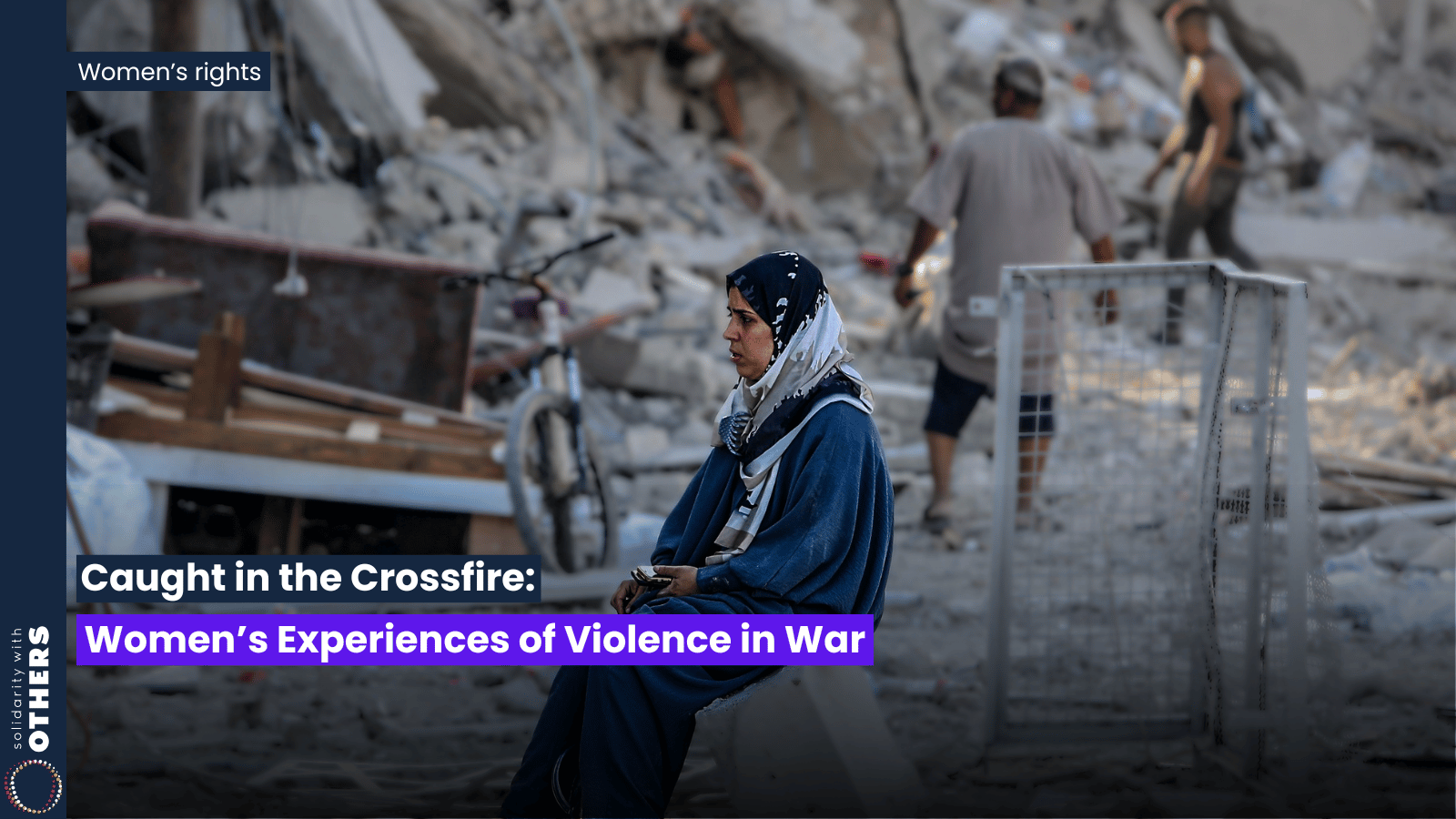
123.2 million people, seven million more than the previous year. Approximately 676 million women lived within 50 kilometres of deadly conflict, the highest number since the 1990s.[2] Ongoing conflicts, including in Gaza, Sudan, and Ukraine, continue to demonstrate the devastating and gendered consequences of war, where civilian populations, in particular women bear the brunt of violence and displacement.[3] In Ukraine, women have faced increased risks of sexual and domestic violence, disruption of essential services, and displacement both within the country and as refugees abroad.[4]
The human cost has been staggering, with women disproportionately affected: 7 in 10 female casualties occurred in Gaza alone. Verified reports of sexual violence in conflict zones rose by 25 percent compared to the previous year, with women and girls representing 92 percent of victims.[5] In the Lake Chad Basin, terrorist groups committed 60 percent more verified violations against girls than boys, highlighting the gendered nature of modern warfare.
As the distinction between combatants and civilians is increasingly ignored, women face deliberate targeting, including arbitrary killings, torture, sexual assault, and forced marriage.[6] Sexual violence is often deployed as a tactic of war, as seen in Sudan, where rape has been widely documented in Darfur and Khartoum since 2023. Wartime conditions also disrupt access to essential services: food, safe drinking water, healthcare, and education are severely restricted, compounding women’s and girls’ vulnerabilities.
Despite contributing least to conflict, women bear its greatest costs. Globally, military spending reached $2.7 trillion in 2024, yet women account for a disproportionate share of deaths, displacement, and statelessness. Women comprise 53 percent of internally displaced populations and are overrepresented among the stateless. These realities intensify insecurity, limit access to protection, and leave women and girls on the frontlines of humanitarian and gender-based crises.
Lack of funding
Global priorities remain starkly imbalanced. In 2023, military spending reached a record
$2.44 trillion, while funding for women’s rights organisations averaged just 0.3 per cent of total aid, with even less reaching those in conflict zones.[7] Investments in preventing and responding to gender-based violence account for under one per cent of all humanitarian spending. Despite the disproportionate impact of conflict on women and girls, the women, peace and security agenda remains critically underfunded.
Yet the evidence is clear: when women participate, peace is more effective and sustainable. In Mali and Niger, raising women’s involvement in local conflict prevention from 5 to 25 per cent between 2020 and 2022 helped resolve more than 100 disputes over natural resources. Still, women in conflict-affected countries remain underrepresented, with parliamentary participation seven points below the global average of 27 per cent, and their presence as negotiators, mediators, and signatories in peace processes far short of the UN’s one-third target.
Healthcare
“Every day, 500 women and girls in conflict-affected countries die from complications related to pregnancy and childbirth. By the end of 2023, 180 women were giving birth every day in war-torn Gaza, most without necessities or medical care.”[8] Access to essential services such as health care, including sexual and reproductive health services can be disrupted, with women and girls being at a greater risk of unplanned pregnancy, sexual and reproductive injuries and contracting sexually transmitted infections, as a result of conflict-related sexual violence.
Continuous lack of support
CEDAW has found Nigeria responsible for serious, systematic violations of women’s and girls’ rights amid years of mass abductions. A decade after the Chibok kidnapping, 91 girls remain missing, and many survivors continue to face trauma, stigma, and inadequate support.[9] Over 1,400 students have been abducted since, often for ransom, forced marriage, trafficking, or prisoner exchanges.
Support for those who returned has been inconsistent. Many received little or no rehabilitation, education, or psychological care, and some cannot return home due to stigma.[10] Even girls in government programs report harsh conditions, limited necessities, and restricted freedom, revealing that they were failed both before and after abduction.
Globally, the scale of conflict is rising. In 2024, 61 armed conflicts displaced 123.2 million people, with 676 million women living near deadly conflict zones. Sexual violence increased by 25 percent, with women and girls comprising 92 percent of victims. In the Lake Chad Basin, girls were 60 percent more likely than boys to be targeted.
On the 25th anniversary of UN Security Council Resolution 1325, women’s participation in peacebuilding and post-conflict recovery remains vital. National Action Plans (NAPs) offer a framework, yet only 28 percent of the 113 countries with plans as of June 2025 have increased funding. States and international actors must ensure survivor-centered justice, invest in education, healthcare, and livelihoods, and fully integrate women in peace and security decision-making to build resilient, equitable societies.
Call to Action
Women and girls are not only victims of conflict, they are also active agents of change, serving as combatants, human rights defenders, community leaders, and contributors to peacebuilding and recovery. The Human Rights Council recognizes their vital role in preventing and resolving conflicts and urges stronger integration of women’s rights into post-conflict efforts.[11] The ICRC stresses that better prevention and strict adherence to international humanitarian law are essential to protect women and girls and reduce conflict-related violence.
Ending violence against women in conflict zones requires more than awareness; it demands decisive global action. Governments, international organizations, and civil society must work together to protect, support, and empower women and girls before, during, and after conflict. Funding for women’s rights organizations, shelters, and frontline responders remains critically insufficient, and meaningful change is impossible without sustained investment in protection services. States must investigate and prosecute conflict-related sexual violence, ensuring survivor-centered justice that upholds safety and dignity.
Women must also be fully included in peace processes and recovery efforts, as their leadership is crucial for building lasting, equitable peace. Above all, the international community must strengthen its commitment to enforcing humanitarian and human rights law, ensuring that women and girls are protected not only in principle, but in practice.
[1] Violence against women and girls: EU guidelines | EUR-Lex —
[2] PROGRESS ON THE SUSTAINABLE DEVELOPMENT GOALS: THE GENDER SNAPSHOT 2025 | UN
Women, https://www.unwomen.org.
[3] Ibid.
[4] UN Women / UN News reporting on the gendered impact of the Ukraine conflict, https://news.un.org/en/story/2025/11/1166327.
[5] War on women – Proportion of women killed in armed conflicts doubles in 2023 | UN Women – Headquarters, https://www.unwomen.org.
[6] Violence against women in conflict | ICRC, https://www.icrc.org/en/document/violence-against-women.
[7] PROGRESS ON THE SUSTAINABLE DEVELOPMENT GOALS: THE GENDER SNAPSHOT 2025 | UN
Women, https://www.unwomen.org.
[8] UN Women, reports on gender equality in conflict-affected settings (2023–2024).
[9] Nigeria: UN committee finds grave and systematic violations persist after Chibok mass abduction of schoolgirls | OHCHR, https://www.ohchr.org.
[10] Ibid.
[11] UN Human Rights Council Resolution 59/20, https://docs.un.org/A/HRC/RES/59/20.