


EXECUTIVE SUMMARY
This report comprehensively analyses the process of appointing trustees to thousands of companies in Turkey on the grounds that they are affiliated with the Gülen movement and the legal, economic, political and social impacts of this process. Since the 1970s, the Gülen movement has been prominent in Turkey and the world for its educational, social and cultural activities emphasising universal values such as democracy, human rights and the rule of law. However, the Turkish government led by President Erdoğan, especially after the 17/25 December 2013 corruption operations and the 15 July 2016 coup attempt, designated the Gülen movement as a “terrorist organisation” and launched a comprehensive crackdown against individuals and institutions allegedly linked to the movement. An important tool in this process has been the appointment of trustees (kayyım) to company managements and assets.
This practice, which was first regulated in the Turkish legal system under Article 133 of the Code of Criminal Procedure No. 5271 adopted in 2004, has been applied to a large number of companies since 2014 on the grounds that they are linked to the Gülen movement. In this process, thousands of companies were transferred to trustee management and their operational activities, financial status and commercial reputation were seriously adversely affected. In legal terms, trustee appointments constitute a violation of fundamental human rights, such as the right to property and a fair trial. This report analyses the legitimacy of the legal processes, the extent of the economic impact and the changes in the social structure caused by trustee appointments.
This report aims to help develop policy recommendations by assessing the various dimensions of trustee appointments. It also proposes changes in the appointment of trustees to companies, which started to be made after 2014 and underwent radical changes during the state of emergency in 2016, in accordance with universal principles of law. Legal reforms, economic and social measures, and future research will provide a better understanding of the legal, economic and social dimensions of trustee appointments process in Turkey for 10 ten years. These recommendations will contribute to taking the necessary measures to prevent similar problems in the future. The protection of fundamental principles such as the rule of law, the right to property and fair trial are indispensable elements of a democratic society and necessary steps should be taken to ensure that these values are not violated.
ECtHR European Court of Human Rights
ECHR European Convention on Human Rights
AKP Justice and Development Party
AYM Constitutional Court
BRSA/BDDK Banking Supervision and Regulation Agency
CHP Republican People’s Party
CMK/CPC Criminal Procedure Code
FETO/FETÖ Fetullahist Terrorist Organisation
KHK Emergency Decree Law
KOM General Directorate of Security, Department of Combating Criminal and Organised Crime
MIT National Intelligence Organisation
MASAK Financial Crimes Investigation Agency
MHP Nationalist Movement Party
OHAL/SoE State of Emergency
SCH Criminal Judgeships of Peace
SPK/CMB Capital Markets Board
TCK/TPC Turkish Penal Code
TMSF/SDIF Savings Deposit Insurance Fund
TMK Turkish Civil Code
TUGVA Turkish Youth Foundation
TÜRGEV Turkish Youth and Education Service Foundation
INTRODUCTION
The Gülen movement led by Fethullah Gülen, which is based in Turkey and operates educational institutions and non-governmental organisations around the world and advocates universal humanitarian and democratic values, has opposed the authoritarianism that started in Turkey under the leadership of Erdoğan after the 2010s.
The Gülen movement was declared a “terrorist organisation” by the Turkish government under President Erdoğan for its democratic opposition stance and a comprehensive state-led crackdown on individuals and institutions allegedly linked to the Gülen movement began.
The appointment of a trustee to the management of companies and their assets was first regulated in the Turkish legal system in the Code of Criminal Procedure No. 5271 adopted in 2004. Until 2015, the practice of appointing a trustee to the management of a company, which was almost never seen in practice until 2015, was suddenly on the agenda of the country in October 2015 with the appointment of trustees to some holdings and the management of the companies within these holdings in accordance with Article 133 of the Code of Criminal Procedure.
Especially within the scope of the investigations conducted against the Gülen movement, which was targeted after the 17/25 December 2013 corruption operations and the coup attempt on 15 July 2016, trustees were appointed to many companies pursuant to Article 133 of the Code of Criminal Procedure. Due to the trustee appointments, the operational activities, financial status and commercial reputation of these companies have been seriously adversely affected by the trustee decisions.
The importance of this research is to comprehensively analyse the legal, economic, political and social effects of trustee appointments and to reveal the problems created by this process, the consequences of trustee practices and possible solutions. In particular, it is critical to address issues such as whether the legal processes related to trustee appointments are fair or not, to what extent they have economic effects, and what kind of changes they cause in the social and legal structure in order to avoid similar situations in the future.
The main questions that this report aims to answer and the related findings are as follows:
- To what extent are trustee appointments legally valid?
o The process of appointing trustees to companies allegedly linked to the Gülen movement does not comply with national and international legal norms. These decisions were not based on objective legal rules, but on political motivations.
- What are the economic impacts of trustee appointments?
o Trustee appointments have negatively affected the financial performance and economic sustainability of companies. Thousands of companies with alleged links to the Gülen movement lost their economic value after the trustee administrations, were closed down or their assets were sold at below-market prices.
- What are the national and international repercussions of trustee appointments?
o The trustee appointments have dealt a serious blow to the rule of law in Turkey and demonstrated that fundamental human rights such as the right to property are not secured. This shows that the property rights of ordinary citizens are not legally secure. Moreover, despite numerous international court judgements, notably by the ECtHR, which have shown that the Gülen movement is not involved in “terrorist” offences, the trustee decisions of the Erdoğan regime and the judicial bureaucracy under its control have tarnished Turkey’s image internationally. This is one of the most important reasons for mistrust in foreign investments in Turkey.
The methodology of this research consists of a comprehensive set of methods to understand and assess the legal, economic and social implications of the appointment of trustees to thousands of companies in Turkey on the grounds of links to the Gülen movement. The research will utilise a mixed methods approach, which is a combination of quantitative and qualitative methods. These methods will enable an in-depth and multidimensional examination of the issue. In this context, sources such as legal texts, court decisions, academic opinions, government reports and human rights reports will be analysed. This analysis will be used to examine the legal basis of trustee appointments and their compliance with international legal norms. The economic effects of trustee appointments will be analysed in the light of the developments and news about the companies to which trustees are appointed. In addition, in order to reveal the specific effects of the trusteeship practice and how these processes are managed, the process of Kaynak Holding, which was appointed a trustee in November 2015 on the grounds that it was affiliated with the Gülen movement, is discussed as a case study.
All these data will be analysed together and a global assessment will be made. This will allow for a more comprehensive and balanced conclusion by utilising the strengths of both types of data. This methodological framework aims to provide a multidimensional and in-depth analysis, which is necessary for the research to achieve its objective. The findings will help to comprehensively assess the various dimensions of trustee appointments and develop policy recommendations.
Following the introduction, this report continues with five main chapters and concludes with a conclusion/recommendations section.
Chapter 1: The Right to Property and the Legal Framework of Trusteeship as an Intervention in the Right to Property: In this chapter, the protection of the right to property in Turkey and in international legal norms is discussed and the legal framework of the appointment of trustees is detailed. Whether the right to property is violated or not and the legal grounds for the appointment of a trustee are emphasised.
Chapter 2: Appointment Of Trustees to Companies and Personal Assets on the Grounds of Links with the Gülen Movement: This chapter analyses the process of appointing trustees to companies and personal assets on the grounds that they are linked to the Gülen movement. The trustee appointment practices in the 2014-2016 period and the trustee practices after the state of emergency (the last state of emergency period 2016-2018) are discussed. The seizure of Bank Asya and the appointment of the SDIF as trustee is also included in this section.
Chapter 3: Legal Assessment of the Appointment of Trustees to Companies on the Grounds of Being Associated with the Gülen Movement: In this section, the legal validity and legal grounds of trustee appointments are analysed. The effects of trustee appointments on property rights and the fairness of legal processes are discussed.
Chapter 4: Assessment of the Practice of Appointing Trustees to Companies from Company Management and Economic Perspectives and Irregularities Experienced: In this chapter, the economic effects of trustee appointments and irregularities in this process are addressed. The financial performance, economic sustainability and changes in the market values of companies are analysed.
Chapter 5: The Case of Appointment of Trustees to Companies as a Tool of Unlawful Seizure: Kaynak Holding
In this section, the process of unlawful seizure and trustee appointment is detailed through the case of Kaynak Holding. The consequences of the appointment of a trustee to Kaynak Holding and the legal processes were analysed.
Conclusion and Recommendations: This chapter summarises the main findings of the research and presents policy recommendations. Legal reforms, economic and social measures and recommended future research are elaborated in this part.
Chapter 1: The Right to Property and the Legal Framework of Trusteeship as an Intervention to the Right to Property
The right to property refers to the full and absolute right of individuals over their assets. The right to property is protected by various regulations both in Turkey and in international universal law. These regulations aim to secure the right to property and protect it against any unjust interference.
1.1. Protection of Property Rights in Turkey
The protection of property rights in Turkey is guaranteed by the Constitution, the Turkish Civil Code and other relevant laws. Article 35 of the Turkish Constitution states that everyone has the right to property and inheritance and that these rights can only be restricted by law in the public interest. This article of the Constitution recognises the right to property as a fundamental right and provides a legal framework to prevent violations of this right. The Turkish Civil Code (TCC) regulates the right to property in more detail; Article 683 of the TCC defines the right to property and determines the scope of this right, while Article 705 regulates the acquisition and loss of property. Furthermore, the Expropriation Law (Law No. 2942) regulates in detail the process of expropriation of privately owned immovable property when public interest requires it and the compensation to be paid to the owner in this process. The Zoning Law and other relevant legislation also contribute to the protection of the right to property. All these regulations create a legal basis for the protection of individuals’ property rights and the defence of these rights against unjust interventions. Courts are authorised to evaluate the applications of individuals against violations of property rights and to protect their rights. In this context, higher judicial bodies such as the Constitutional Court, the Council of State and the Court of Cassation play an important role in the protection of the right to property.
1.2 International Protection of Property Rights
Under universal law, the protection of the right to property is guaranteed by various international treaties and instruments. These regulations recognise the property rights of individuals and ensure the protection of these rights. Major regulations are set out below.
Universal Declaration of Human Rights (UDHR)
The Universal Declaration of Human Rights was adopted by the United Nations General Assembly on 10 December 1948. Article 17 of the Declaration states that everyone has the right to property and that no one shall be arbitrarily deprived of his property. This declaration aims to recognise and protect the right to property as a universal human right.
European Convention on Human Rights (ECHR)
The European Convention on Human Rights was signed by the Council of Europe on 4 November 1950 and entered into force on 3 September 1953. Article 1 of Additional Protocol 1 to the Convention states that the property of every natural and legal person shall be respected. This article guarantees that states may not deprive anyone of his property except in the public interest and in accordance with the law.
International Covenant on Economic, Social and Cultural Rights (ICESCR)
The International Covenant on Economic, Social and Cultural Rights was adopted by the United Nations on 16 December 1966 and entered into force on 3 January 1976. Article 11 of the Covenant regulates the right of everyone to an adequate standard of living, including the right to housing. This article aims to raise the standard of living and secure property by indirectly protecting the property rights of individuals.
1.3 The concept and types of trustees
A trustee is a real/legal person appointed by the guardianship authority (the courts) to perform certain tasks or manage the assets of a person. As a matter of fact, Article 403/II of the Turkish Civil Code (“TCC”) states: “A trustee is appointed to perform certain tasks or manage assets”.
According to the nature of the reasons requiring the appointment of a trustee, there are two types of trusteeship: ‘representation trusteeship’ and ‘management trusteeship’. If the trustee is appointed to fulfil a certain task of a person, this is called ‘representation trusteeship’ (Art. 426 of the TCC). If a trustee is appointed not for the person but for the management of the assets, it is referred to as ‘management trusteeship’. Management trusteeship is not for the purpose of representing the person to whom the trustee is appointed, but for the management of an asset or a legal entity.
In the doctrine, it is stated that the trustee should be selected from real persons in terms of accountability. The duty of the management trustee is to manage the affairs of the asset or entity to which he is appointed in an orderly and lawful manner. Management trustees are generally appointed in the following cases
- To take over the management of a company in case of bankruptcy.
- To protect the assets of a party in legal proceedings.
- To manage assets in the context of combating the financing of terrorism, proceeds of crime and terrorism.
- In family law, to manage the assets of persons under guardianship.
In Turkish Law, apart from the guardianship in private law, there is also administrative guardianship in administrative law, which is a tool that the central administration has over the local administrations and which enables the establishment of a link between the central administration and local administrations through supervision arising from Article 127/5 of the Constitution. However, administrative tutelage serves the purpose of protecting the interests of the society and in this respect, it differs from tutelage in the sense of private law, which serves the purpose of protecting the rights and interests of individuals.
Decree Law No. 674, which entered into force on 01.09.2016, added a paragraph to Article 45 of the Municipality Law No. 5393, authorising the central administration to replace the elected bodies of municipalities, which are local administrations, by the Ministry of Interior or governorships, which are administrative tutelage authorities, under certain conditions. Although the wording of the article does not explicitly include the terms “trustee” and “trusteeship”, this regulation, which is referred to as “appointment of trustees to municipalities” in practice, has paved the way for the appointment of trustees to municipalities that have links and connections with terrorist organisations.
1.4 Appointment of a trustee for company management or for shares of the company
As an intervention against the right to property, a trustee may be appointed to the management of the company or the shares of the company owned by individuals. The legal sources of this practice, which is categorised as management trusteeship, and its comparison with similar measures are further detailed below.
In order to determine whether the appointment of a trustee results in a violation of the right to property, it is necessary to first determine whether the intervention in question is implemented in compliance with the principle of legality, then whether the intervention is made in accordance with the limitation criteria, that is, the principle of legitimate purpose, and finally, whether the intervention is implemented in compliance with the principles of proportionality.
1.4.1 Legal framework of the practice of appointing trustees to companies
While Article 35 of the Turkish Constitution guarantees the rights to property and inheritance, it states that these rights only may be restricted by law and for the purpose of public interest. Various regulations have been made in Turkish law in accordance with the criteria of public interest and limitation by law. Article 125 of the Execution and Bankruptcy Law (EBL) regulates the appointment of a trustee for persons who are bankrupt or unable to manage their assets. This is done in order to prevent the misuse of assets and to protect the value of property. Article 427 of the Turkish Civil Code (TCC) regulates the appointment of a trustee. According to the TCC, a trustee may be appointed in cases where assets need to be protected or managed. This practice is envisaged as a mechanism for the protection of the right to property.
In cases where companies, which are legal entities, are used as a tool in the commission of a crime, a regulation is needed to determine whether a crime has been committed within the framework of their activities, to prevent the commission of a crime by supervising their activities during the trial and to ensure that they are not exposed to significant economic losses in this process. In this context, Article 133 of the Code of Criminal Procedure (CPC) regulates the appointment of a trustee for company management.
Article 133 of the Code of Criminal Procedure regulates the appointment of a trustee for the management of a company, which was introduced to Turkish legal system as a protection measure by the Criminal Procedure Code numbered 5271, in five paragraphs.
Article 133 of the Code of Criminal Procedure:”(1) In the event that there are strong grounds of suspicion that the offence is being committed within the framework of the activities of a company and it is necessary for the discovery of the material truth; during the investigation and prosecution process, the judge or court may appoint a trustee for the conduct of the company’s affairs. In the appointment decision, it shall be clearly stated that the validity of the decisions and transactions of the management body is made subject to the approval of the trustee or that the powers of the management body together with the powers of the management body and the powers to administer partnership shares or securities are fully vested in the trustee. The decision on the appointment of a trustee shall be announced in the trade registry gazette and by other appropriate means.
In order for the measure of appointment of a trustee for company management regulated under Article 133 of the Code of Criminal Procedure to be applied, for the measure to be in accordance with the law, and for the evidence obtained as a result of this measure to be used in criminal proceedings, certain conditions must exist. In order for the measure of appointing a trustee for company management to be applied;
- The crime subject to investigation or prosecution is one of the crimes in the catalogue,
- The offence is committed within the framework of the activity of a company,
- The existence of strong grounds of suspicion that the offence is committed within the framework of the activities of a company,
- It is necessary to resort to this measure in order to establish the material truth,
- The application of the measure must be decided by a judge or a court.
Appointment of a trustee for company management, which is a special type of seizure, is a protection measure that can be applied for the purpose of obtaining evidence, is directed towards assets and can only be applied based on a judge or court decision.
The appointment of a trustee for the management of the company can be applied for the purposes of revealing the material truth regarding the crime subject to investigation or prosecution, preventing the commission of a crime within the framework of the company’s activities and enabling the execution of a possible confiscation decision.
The appointment of a trustee for company management regulated under Article 133 of the Code of Criminal Procedure is a protection measure. Protection measures are criminal proceedings that are necessary to be applied in order to ensure that the criminal proceedings are carried out, that the decision rendered as a result of the judgement is not left on paper and that the material truth is revealed, that can be applied based on the decision given by the competent authorities, that are applied temporarily and that result in the restriction of fundamental rights and freedoms before the judgement. These actions aim to obtain evidence directly or indirectly.
All protection measures constitute interference with fundamental rights and freedoms due to their nature. The measure of appointing a trustee for the management of the company also constitutes an interference with the right to property regulated under Article 35 of the Constitution and the freedom of labour and contract regulated under Article 48, and the property is restricted by the application of the measure.
According to its purpose, the measure of appointment of a trustee for the management of the company is essentially a measure to prevent the loss of evidence. With the application of the measure, the evidence is prevented from being obscured and access to the evidence is ensured. In this respect, the appointment of a trustee for the management of the company serves the purpose of obtaining evidence as a special type of seizure, like the classical seizure measure. On the other hand, since the assets of the company are placed under the control and supervision of the trustee, the execution of the possible confiscation decision to be made as a result of the trial is also made possible. Therefore, the measure of appointing a trustee for the management of the company is a measure to ensure the enforcement of the decisions as well as serving the purpose of obtaining evidence.
1.4.2 Comparison of appointment of a trustee to the company management and confiscation
While the appointment of a trustee for company management is regulated in the Criminal Procedure Code as a protection measure, confiscation is regulated in the Turkish Criminal Code (TCK) as a security measure. In this respect, while the appointment of a trustee for company management restricts fundamental rights and freedoms before the judgement, confiscation can only be applied after the judgement is finalised.
Confiscation is a sanction that results in the transfer of the ownership of something to the state. As a result of the confiscation decision, the ownership of the property is transferred to the state, whereas in the appointment of a trustee for the management of the company, the ownership of the company is not transferred to the state, but only the authority to dispose of the company management is limited. In other words, while the property right of the previous owner is terminated with confiscation, the appointment of a trustee for the management of the company does not prejudice the rights of the shareholders, but only restricts the power of disposition of the company management.
The measure of appointment of a trustee for the management of the company is temporary like all protection measures. It can be applied until the finalisation of the judgement at the latest. Confiscation, on the other hand, is not temporary, but permanent, as the property is transferred to the State.
1.4.3 Comparison of seizure of immovables, entitlements and receivables and appointment of trustees to companies
“Seizure of Immovables, Entitlements and Receivables” as a protection measure is regulated under Article 128 in the first book of the Criminal Procedure Code titled “General Provisions”. In the seizure measure, the objectives of enabling the confiscation of immovable property, entitlements and receivables and combating crime come to the fore. In the measure of appointing a trustee for the management of the company regulated under Article 133 of the Code of Criminal Procedure, the aim of revealing the material truth by obtaining information from within the company comes to the fore.
Seizure of immovables, entitlements and receivables includes immovables, land, sea or air transport vehicles, all kinds of accounts in banks or other financial institutions, all kinds of rights and receivables before real or legal persons, negotiable instruments, company partnership shares, safe deposit boxes and other assets. The scope of the measure of appointment of a trustee for company management includes the management of all types of companies that can be established according to Turkish Law.
In terms of the measure of seizure of immovables, entitlements and receivables, the catalogue crime application has also been adopted. In this respect, as in the measure of appointment of a trustee for company management, the crime subject to investigation or prosecution must be one of the crimes in the catalogue.
In order for the measure of seizure of immovables, entitlements and receivables to be applied, the asset values subject to the measure must be obtained due to the commission of an offence. In other words, the source of the asset value subject to the measure is the “offence”. In order to apply the measure of appointing a trustee for the management of the company, the company to which the measure is applied does not need to be established with the benefits obtained from the offence. What is of importance is that the offence is committed within the framework of the company’s activities, and it is not important that the company obtains any benefit.
In order to apply the measure of seizure of immovables, entitlements and receivables, there must be strong grounds of suspicion based on concrete evidence that the offence subject to investigation or prosecution has been committed and that the immovables, entitlements and receivables to be seized have been obtained from these offences. In terms of the measure of appointing a trustee for the management of a company, there must be strong grounds of suspicion that the offence subject to investigation or prosecution is committed within the framework of the activities of a company.
In order to take a decision to seize immovables, entitlements and receivables, a report on the value obtained from the offence must be obtained from the BRSA, CMB, MASAK, Undersecretariat of Treasury and Public Oversight, Accounting and Auditing Standards Authority. There is no similar regulation in terms of the measure of appointing a trustee for the management of the company.
The measure of seizure of immovables, entitlements and receivables must be decided by the judge or the court, as in the measure of appointment of a trustee for company management. There is no exception for the measure of appointment of a trustee for company management. However, there are provisions in special laws that constitute an exception to the decision of the judge or court in the seizure of immovables, entitlements and receivables (cases of delay, etc.).
The addressee of the measure of seizure of immovables, rights and receivables is the suspect or defendant who has committed at least one of the crimes listed in the catalogue and who has strong grounds for suspicion that he/she obtained the assets in question from these crimes or crimes. The addressee of the measure of appointing a trustee for the management of the company is the company that has strong grounds for suspicion that an offence has been committed directly within the framework of its activities.
1.4.4. Comparison of seizure for coercive purposes and appointment of trustees to companies
While the measure of appointing a trustee for the management of a company is regulated under Article 133 of the Code of Criminal Procedure, coercive seizure is regulated in Article 248 under the first part titled “Trial of Fugitives and Fugitives, Representation of Legal Persons in Investigation and Prosecution, Procedure for Certain Crimes” of the second section titled “Trial of Fugitives” in the fifth book titled “Special Trial Procedures” of the Code of Criminal Procedure.
Coercive seizure is a special type of seizure, such as the measure of appointing a trustee for company management. The addressee of the measure is fugitives. The addressee of the measure of appointment of a trustee for company management is the companies in the framework of whose activities the offence is committed.
While Article 133 of the Code of Criminal Procedure states that the measure of appointment of a trustee for the management of a company can be applied mainly for the purpose of revealing the material truth, Article 248 of the Code of Criminal Procedure states that coercive seizure can be applied in order to ensure that the fugitive applies to the public prosecutor’s office or comes to the hearing.
The scope of the coercive seizure measure includes the fugitive’s property, entitlements and receivables in Turkey. The measure of appointing a trustee for the management of a company includes the management of all types of companies that can be established according to Turkish Law.
Like the measure of appointing a trustee for the management of the company, the measure of seizure for coercive purposes is not a measure that can be applied for all offences. Catalogue crime practice has also been adopted in terms of coercive seizure measure.
It is not necessary that the assets seized for coercive seizure have any connection with the offence. This is because the aim is to ensure that the fugitive applies to the Public Prosecutor’s Office or comes to the hearing. In order for the measure of appointing a trustee for the management of the company to be applied, the company to which a trustee is appointed must be a company within the framework of whose activities an offence is being committed.
In terms of coercive seizure, strong grounds of suspicion are not required as in the appointment of a trustee for company management. In order to apply the coercive seizure measure, it is necessary and sufficient to have reasonable grounds of suspicion that the crimes in the catalogue have been committed by the fugitive.
As with the measure of appointing a trustee for the management of the company, a judge or court decision is required for the application of the coercive seizure measure. It is also possible for the judge to decide to appoint a trustee for the administration of the assets seized for coercive seizure, as in Article 133 of the Criminal Procedure Code. In this case, the discretion is at the discretion of the judge or the court, and in cases where it is judged that a trustee is needed for the administration of the assets, this will be resorted to.
1.5 Appointment of trustees for the assets (immovable property, entitlements and receivables) of individuals and company shares
Article 128 of the Criminal Procedure Code regulates the measure of seizure of immovables, entitlements and receivables. Seizure of immovables, rights and receivables includes immovables, land, sea or air transport vehicles, all kinds of accounts in banks or other financial institutions, all kinds of entitlements and receivables before real or legal persons, negotiable instruments, company partnership shares, safe deposit boxes and other assets. The purpose of the confiscation measure under this article is to enable the confiscation of immovable property, rights and receivables and to fight against crime.
Article 128 of the Criminal Procedure Code generally regulates the seizure of immovable property, entitlements and receivables for completed offences. Instead of appointing a trustee for the management of the company in completed crimes, the legislator has accepted the seizure of the partnership shares and all kinds of assets in the company in which the perpetrators are shareholders, but for this, the crime in the catalogue must be committed by the shareholder himself. In this case, the measure applies only to the confiscated shares, not to the entire company, as in the measure of appointment of a trustee for the management of the company.
With the tenth paragraph added to Article 128 of the Code of Criminal Procedure with the Decree Law No. 674 issued during the state of emergency (State of Emergency) and Article 13 of the Law No. 6758 enacting this Decree Law, it has been regulated that a trustee will be appointed for the administration of the seized immovables, entitlements and receivables, if necessary, and in this case, the provisions of Article 133 of the Code of Criminal Procedure will be applied by analogy.
1.6 Qualifications of the Trustee
The Criminal Procedure Code does not include the principles regarding the appointment of a trustee for company management. In this case, the principles regarding the appointment of a trustee in the field of private law must be applied by analogy to the extent appropriate.
Conditions Regarding the Person of the Trustee
In the first version of the Code of Criminal Procedure, Article 133 reads as follows: “….may appoint a trustee for the management of the affairs of the company” and the characteristics of the trustee to be appointed are not specified. The conditions sought for the appointment of a trustee for company management regulated in Article 133 of the Code of Criminal Procedure are quite strict. For this reason, the trustee must be selected from among persons who have sufficient knowledge, experience and skills, who have foresight, who can act as a prudent businessman, and who do not have a relationship and/or conflict of interest between the parties, taking into account the characteristics and requirements of the task to which the trustee is appointed. The appointed trustee must have the necessary knowledge and experience in terms of the branch of activity of the complaint against which the measure will be applied. This situation arises from the purpose of maintaining the company’s activities throughout the judgement process and to minimise the damage to other persons working in the company from the application of the measure.
The trustee to be appointed must be impartial and independent
The impartiality of the trustee is important for the implementation of the measure of appointment of a trustee for the management of the company. In this respect, the trustee should not have any relationship with the prosecution and defence authorities. If the trustee has a relationship with the company that may damage his/her impartiality, or if there are concrete facts that may give rise to such an impression, it should not be possible to appoint the person in question as a trustee. As a consequence of the trustee’s impartiality, it should also be accepted that the trustee has the right to refuse and withdraw from the duty.
The trustee committee should act in accordance with the following principles while performing its duties [1]:
- Protect the interests of the shareholders.
- The trustee must perform its duties “with the care of a prudent manager”, and therefore, due to the reference in this article, in compliance with the rules of honesty stipulated in Article 2 of the Civil Code.
- The trustee is deemed to be a “public official” according to Article 6/1-c of the Turkish Criminal Code titled “definitions”. These explanations are also valid for the management trustee. The management trustee must take all necessary measures to prevent the company from incurring losses.[2]
1.7 Appointment of trustees by the Savings Deposit Insurance Fund (SDIF) during the State of Emergency (SoE)
Article 133 of the Code of Criminal Procedure No. 5271 titled “Appointment of a trustee for company management” regulates the conditions under which a trustee may be appointed in criminal investigations and prosecutions, and the matter of the Savings Deposit Insurance Fund (SDIF) acting as a trustee in companies is regulated in Articles 19 and 20 of the Decree Law No. 674 dated 01.09.2016 and the Law No. 6758 enacting this Decree Law.
Article 19 titled “Transfer of trusteeship authority and liquidation” stipulates that; (1) The powers of the trustees serving in the companies for which it has been decided to appoint a trustee pursuant to Article 133 of the Criminal Procedure Law No. 5271 dated 4/12/2004 due to their affiliation, association or contact with terrorist organisations before the effective date of this article shall be transferred to the Savings Deposit Insurance Fund (TMSF) by the judge or the court, and the duties of the trustees shall be terminated upon the transfer. (2) After the effective date of this article and during the continuation of the state of emergency, if it is decided to appoint a trustee for companies pursuant to Article 133 of the Code of Criminal Procedure and for assets pursuant to Article 13 of this Decree Law due to their “affiliation, association or contact with terrorist organisations, the Savings Deposit Insurance Fund shall be appointed as the trustee”. With these regulations, a new era has started in terms of the trusteeship institution in criminal proceedings. These provisions also authorise the SDIF, in the presence of certain conditions, to take and implement sale and liquidation decisions regarding the companies it manages as a trustee (Articles 19 and 20).
Chapter 2: Appointment of trustees to companies and personal assets on the grounds of links to the Gülen movement
In a country where law prevails and human rights are respected, the right to property is sacred and should not be violated arbitrarily. Seizing the assets of companies and appointing trustees to their management without concrete grounds is a violation of the right to property. Such practices jeopardise the right of individuals and companies to safely own property and engage in economic activity.
In Turkey, the practice of appointing trustees, which is used to liquidate individuals/groups opposed to the Erdoğan regime, has been intensively applied against the Gülen movement. Since the post-2014 period, trustees have been appointed by the courts to a large number of companies. The practice of appointing trustees to companies and personal assets has become one of the most important tools of the Erdoğan regime’s unlawful actions against the Gülen movement after the state of emergency (OHAL) declared in 2016.
2.1 How are trustees appointed to companies on the grounds of their links with the Gülen Movement?
1- The first step in the process of appointing a trustee to a company on the grounds of its links with the Gülen movement is the profiling of companies. Within this framework, police and intelligence units use various data to tag individuals and companies. They identify people who have committed actions that are completely legal and not criminalised by law. Some of the data used for labelling are listed below:
- Subscriptions to Bugün newspaper, Zaman newspaper, Aksiyon and Sızıntı journals, which are media organisations established and operated in accordance with the law by people close to the Gülen movement;
- Having an account in Bank Asya, which was established by individuals close to the Gülen movement with the permission granted by law and is under the supervision of state institutions;
- Sending their children to private schools, kindergartens, and tutoring centres opened by the Gülen movement within the framework of the law and affiliated to the Ministry of National Education;
- Being a member of non-governmental organisations founded by people close to the Gülen movement, such as the Aktif Eğitimciler Sendikası (Active Educators’ Union), which was established with the permission of the Ministry of Interior in accordance with the trade union laws in Turkey;
- Downloading the messaging application called Bylock, which can be downloaded from Google Play, on your mobile phone;
- Donating money to a humanitarian aid organisation such as Kimse Yok Mu, which operates legally.
2- Investigations are opened by law enforcement units (police and prosecutor’s offices) against persons whose legal activities are considered criminal, with allegations such as “membership of a terrorist organisation”, “aiding a terrorist organisation”, etc. for the actions listed above.
3- Persons against whom investigations are opened are detained and arrested by prosecutor’s offices.

4- Without concrete evidence of strong suspicion of crime, the prosecutor’s offices request the appointment of a trustee to the companies owned or partnered by individuals who have been investigated for activities such as depositing money in a bank, using a messaging programme, being a member of legal trade unions and associations, which are declared by the ECtHR and UN bodies to be incompatible with universal principles of law, on the grounds of “financing of terrorism”, “liaison with structures that pose a threat to national security”, etc. based on Article 133 of the Criminal Procedure Code.
5- There is ample evidence that the Criminal Judgeships of Peace were established to combat the Gülen movement. One of these is the answer given by the then Prime Minister Erdoğanon 22 June 2014 to the journalists‘ question ’Whether there will be an operation against the parallel structure (before 15 July 2016 Erdoğan had defined the Gülen Movement as Parallel State Structure -PDY- with the decision of the National Security Council)‘. Erdoğan replied: ‘The steps taken by the executive branch are blocked by the parallel judiciary. Some of our legislative activities are before Mr President (Abdullah Gül). After his approval, steps will be taken swiftly.” In the same speech, referring to the operations to be launched especially against police officers, he said, ‘We are making a project. We are preparing the infrastructure for this. [4]’, referring to the Criminal Judgeships of Peace.
6- Within the scope of the regulations initiated during the state of emergency and subsequently made permanent by laws, the SDIF is appointed as a trustee to the companies in question, for which a decision to appoint a trustee has been taken.
7- The SDIF management appoints people close to the Erdoğan government as trustees to the companies.
8- Some of the companies under the administration of trustees are sold and liquidated by the SDIF thanks to the legal arrangements made before the final judgement is rendered against them.
9- The companies that are not sold are subject to confiscation (Article 256 of the Criminal Procedure Code) by the heavy criminal courts. The ownership of the companies subject to a confiscation decision is transferred to the state treasury upon the approval of this decision by the Court of Cassation.
Either through resale or confiscation, people’s assets and the companies they own are forcibly taken away from them by the public power for actions that are not criminalised by law, and their property rights are clearly violated.
2.2 Trustee appointment practices in the period between 2014 and 2016 in the appointment of trustees to companies on the grounds of being in contact with the Gülen movement
After the 2010 constitutional amendment, President Erdoğan started to change the balance of separation of powers in Turkey in his favour and started to move away from universal legal and democratic values. In the post-2010 period, the Gülen movement, which opposed the increasing authoritarianism under Erdoğan’s leadership, therefore became a target.
Reflecting the massive corruption investigation into ministers in the Erdoğan government and their family members in December 2013 as a “judicial coup” against his rule, President Erdoğan and state institutions under his leadership have since launched police operations against all members/sympathisers of the Gülen movement who support the corruption operations and want those involved in corruption to be held accountable.
The first instances of the practice of appointing trustees to firms, companies and large conglomerates on the grounds of being in contact with the Gülen movement occurred in this period.
As already mentioned, the procedure of appointing trustees to companies, which entered the Turkish legal system with Article 133 of the Code of Criminal Procedure No. 5271 adopted in 2004, was not a widely used method. The practice of appointing trustees to companies on the basis of Article 133 of the Criminal Procedure Code has started to be widely used within the scope of the Erdoğan regime’s fight against the Gülen movement, which it perceives as its rivals.
In the post-2014 period, when the practice of appointing trustees to companies belonging to/close to the Gülen movement became widespread and it was revealed that the appointed trustees received separate salaries from each company they were appointed to, this situation caused great public debate. At that time, searches such as “trusteeship” and “how to become a trustee” [3] became quite popular on search engines like Google. This situation showed that the trustee appointments made against the Gülen movement were not legal and were carried out with the revenge of the Erdoğan government. It has been shown that even ordinary people see the appointment of trustees to companies as an opportunity for enrichment.
According to the data from the trade registry gazette and the open sources gathered, the appointment of a trustee to a company based on Article 133 of the Criminal Procedure Code on the grounds that it was in contact with the Gülen movement took place on 10 March 2015. With the decision of Ankara Batı 2nd Criminal Judgeship of Peace dated 10.03.2015 and numbered 2015/764, a person named Süphi Aslanoğlu was appointed as a trustee to Culture Sincan Education Construction Architecture Industry and Trade Limited Company. After this first identifiable decision, the appointment of trustees to companies on the grounds of being in contact with the Gülen movement accelerated.
According to figures obtained from trade registry gazette data and other sources, in the 2014-2016 period, the courts appointed trustees to 116 companies on the grounds of being in contact with the Gülen movement. In 2016, during and after the state of emergency, the number of companies to which trustees were appointed increased to 1371.
Some highlights stand out in the trustee appointments made between 2014 and 2016:
1- Six months after the 17/25 December 2013 corruption operations, Criminal Courts of Peace (SCM) were replaced by Criminal Judgeships of Peace (SCH) with the Law No. 6545 enacted on 28 June 2014. These judgeships, which initially emerged with the aim of neutralising those close to the Gülen Movement, have become one of the main tools to intimidate social opposition by guaranteeing the appointment of names close to the Erdoğan government and authorising them to make important decisions such as all arrests, evaluating objections to arrests or banning access to the internet.
There is ample evidence that the Criminal Judgeships of Peace were established to combat the Gülen Movement. One of these is the answer given by the then Prime Minister Erdoğan on 22 June 2014 to the journalists’ question “Whether there will be an operation against the parallel structure (before 15 July 2016 Erdoğan had defined the Gülen Movement as Parallel State Structure -PDY- with the decision of the National Security Council)”. Erdoğan replied: “The steps taken by the executive branch are blocked by the parallel judiciary. Some of our legislative activities are before Mr President (Abdullah Gül). After his approval, steps will be taken swiftly.” In the same speech, referring to the operations to be launched especially against police officers, he said, “We are making a project. We are preparing the infrastructure for this. [4]”, referring to the Criminal Judgeships of Peace.
The fact that the Criminal Judgeships of Peace are not independent from the government has also been mentioned by the Venice Commission [5], the Council of Europe Commissioner for Human Rights [6], the UN High Commissioner for Human Rights [7] and the International Commission of Jurists [8].
The Criminal Judges of Peace, selected by the government-controlled Council of Judges and Prosecutors (HSK) from members of the judiciary who can make decisions in the directions favoured by the Erdogan government, have easily taken decisions to seize the assets of individuals and organisations allegedly linked to the Gülen Movement and appointed trustees to their companies.
2- Having targeted the Gülen movement for its support to the corruption operations, the Erdoğan government has preferred to silence the Gülen movement’s means of reaching the public opinion. This shows that the appointment of trustees in the fight against the Gülen movement is not based on legal grounds but in line with the current policies of the Erdoğan government. Before the 7 November 2015 elections, trustees were appointed to influential opposition TV outlets to prevent independent and impartial broadcasting and to prevent the public from being informed about corruption allegations against the Erdoğan government.
The media outlets that were deprived of the opportunity to broadcast impartially by the appointment of trustees in this period are as follows:
- Bugün TV, Kanaltürk, Bugün and Millet newspapers owned by Koza İpek Holding (26 October 2015)
- Zaman Newspaper of Feza Journalism Inc. (4 March 2016)
- Cihan News Agency affiliated to Cihan News Agency and Advertising A.Ş. (8 March 2016)
- Samanyolu TV under Işık Media Planning Advertising and Filming Industry and Trade A.Ş. (12 April 2016)
3- With the decision of Ankara 5th Criminal Judgeship of Peace dated 26.10.2015 and numbered 2015/4104, trustees were appointed to Koza-İpek Holding, one of the largest holdings in Turkey, which includes media outlets such as Kanaltürk television and Bugün newspaper, and its 22 affiliated companies.
After the appointment of trustees to Koza-İpek Holding and the media outlets within the holding, Cem Küçük, the columnist of Star Newspaper close to the Erdoğan government, who targeted journalists working in these media outlets and resisting the decision to appoint trustees, announced in his programme on Kanal 24 that ‘trustees’ would soon be appointed to Samanyolu Television and Zaman Newspaper. Cem Küçük said in his speech: “Samanyolu and Zaman will soon be gone. They will soon go into trusteeship. I announce it from here. I don’t know if the friends working there will resist or find a new job. It is their last days.” [9].
Cem Küçük, a columnist close to Erdoğan’s government, also made statements on his TV programme on 05 November 2015 regarding the liquidation of the Gülen movement, saying “All their financial legs will be collapsed, all their legs will be finished, and this will happen within 100 days”[10].
Indeed, a few months after Cem Küçük’s statements, trustees were appointed to Zaman Newspaper on 4 March 2016, Cihan News Agency on 8 March 2016 and Samanyolu TV on 12 April 2016.
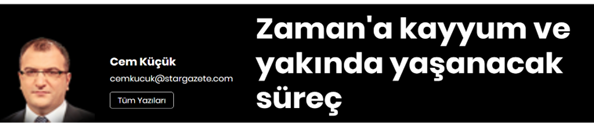
Title of Star Newspaper Columnist Cem Küçük’s Article dated 05 March 2016: “Trustee to ZAMAN and the processes to follow”
The announcement by a newspaper close to the government that trustees would be appointed to Samanyolu TV and Zaman Newspaper, which are media organs allegedly close to the Gülen movement, months before [11], and the mention of a planned timetable that the financial resources of the Gülen movement would be collapsed within 100 days, show that the court decisions in the appointment of trustees are not based on legal facts, and that they are part of a large liquidation plan prepared by the Erdoğan government against the Gülen movement, which it has targeted.
4- During this period, the Criminal Judgeships of Peace have targeted holdings and companies that are publicly known to be close to the Gülen movement. Important companies to which trustees were appointed in this context are as follows:
On 27 October 2015, Ankara 5th Criminal Judgeship of Peace appointed trustees to 22 companies belonging to Koza-İpek Holding, one of the largest companies in Turkey, which also includes Kanaltürk television and Bugün newspaper.
1- Koza İpek Holding Corporation
2- Koza Gold Enterprises Inc.
3- Koza Anadolu Metal Mining Inc.
4- Özdemir Antimuan Mining Inc.
5- İpek Natural Energy Resources Research and Production Inc.
6- Eastern Anatolia Mineral Exploration and Drilling Inc.
7- Konaklı Metal Mining and Industry Inc.
8- Bugün TV, Radio Production Inc.
9- Yaşam TV and Broadcasting Services Inc.
10- Koza Production and Trade Inc.
11- Rek-tur Advertising and Marketing Trade Company
12- Ipek Online Informatics Services Limited Company
13- Koza İpek Supply Consultancy Car Rental Trade Inc.
14- Az Ipek Consultancy Project Advertising and Organisation Works Trade Inc.
15- BBB İpek Consultancy Advertising and Organisation Services Trade Inc.
16- ATP Construction and Trade Inc.
17- Koza İpek Press and Press Industry Trade Inc.
18- ATP Koza Food, Agriculture and Livestock Inc.
19- ATP Koza Tourism and Travel Trade Inc.
20- ATP Aviation and Trade Inc.
21- Koza İpek Insurance Services Brokerage Inc.
22- Atlantik Education Publication Stone Computer Trade Inc.
Based on the State of Emergency Decree Law No. 674, the Ankara 24th High Criminal Court issued a confiscation decision regarding Koza İpek Holding companies, whose trusteeship powers were transferred to the SDIF as of 22 November 2016, and after the confiscation decision of the Ankara 24th High Criminal Court was approved by the 3rd Criminal Chamber of the Court of Cassation (with the decision dated 14.04.2023, 2022/18087 Esas, 2023/2215), the ownership of the holding and affiliated companies was transferred to the state treasury.
On 18 November 2015, Istanbul Anadolu 10th Criminal Judge of Peace Ali Arslan Giritli appointed a trustee committee of 7 people to Kaynak Holding and 19 affiliated companies, 1 foundation and association.
1- Kaynak Holding Inc.
2- Sürat Insurance Brokerage Services Limited Company
3- Kaynak Foreign Trade Inc.
4- Sürat Tourism Organisation Services and Trade Inc.
5- Nuance Tourism Promotion and Advertising Inc.
6- Çağlayan Printing, Publishing, Distribution, Packaging Industry and Trade Inc.
7- Işık Publishing Trade Inc.
8- N- Book Stationery Stationary Office Supplies Marketing and Tourism Trade Inc.
9- Sürat Education Tools and Office Furniture Systems Inc.
10- Sürat Printing, Publishing, Advertising and Educational Tools Industry Trade Inc.
11- UTT Publishing and Education Equipment Trade Inc.
12- Gökkuşağı Marketing Distribution and Trade Inc.
13- Sürat Cargo Logistics and Distribution Services Inc.
14- Sürat Logistics Inc.
15- Sentries Copyright Licence Inc.
16- Sürat Information Technologies Industry and Trade Inc.
17- Venero Informatics Industry and Trade Limited Company
18- İtina Food Beverage and Cleaning Materials Industry Trade and Marketing Inc.
19- Baran Agriculture and Livestock Industry Trade Inc.
20- Kaynak Foundation
21- Kaynak Education Association
2.3 Seizure of Bank Asya and appointment of the SDIF as trustee
Bank Asya, one of Turkey’s largest participation banks, became a target of the Erdoğan government after the 17-25 December corruption investigations that began in 2013 on the grounds that it was linked to the Gülen movement. In a press conference on 16 September 2014, Erdoğan explicitly directed the Banking Regulation and Supervision Agency (BRSA) on the Bank Asya issue, saying “There are steps that the BRSA should take. I don’t know which article it will apply, but for the unity and stability of my country, I have to follow the matter to a certain extent and get the necessary information. We are following it. The BRSA should make a decision and take steps accordingly. Otherwise, the BRSA will be responsible for this” [12].
The bank lost a significant number of deposits in this process. Following Erdoğan’s statements, the Banking Regulation and Supervision Agency (BRSA) started to monitor Bank Asya, citing the financial situation of the bank. With its decision dated 03.02.2015 and numbered 6187, the Banking Regulation and Supervision Agency, citing Article 18 of the Banking Law on Asya Participation Bank Inc. (the Bank) under the Banking Law No. 5411, decided that the shareholding rights other than dividends related to the shares (63%) of the aforementioned shareholders would be exercised by the Savings Deposit Insurance Fund (SDIF).
The process regarding Bank Asya, which started in February 2015 with the transfer of the management of some of the shares to the SDIF, continued with the transfer of the entire Bank Asya to the Savings Deposit Insurance Fund with the BRSA Decision dated 29/05/2015 and numbered 6318, citing Article 71 of the Banking Law No. 5411. Subsequently, upon the request of the SDIF, Bank Asya’s operating licence was revoked with the decision dated 22.07.2016 and numbered 6947 taken by the BRSA. Following the cancellation of the banking licence, the SDIF started to sell the Bank’s immovable properties and other assets. According to the balance sheet data dated 31.12.2014, the asset size of Bank Asya, which was unlawfully transferred to the SDIF and whose assets were sold, was $5 billion 947 million before the bankruptcy process.
2.4 Trustee practices during and after the State of Emergency (2016-2018)
President Erdoğan made statements linking the coup attempt of 15 July 2016 to the Gülen movement within hours of the events, without any concrete legal evidence. He also described the failed coup attempt as a “blessing of God”. A state of emergency (SoE) was declared in Turkey on 20 July 2016, 4 days after the coup attempt. The state of emergency lasted for approximately 2 years. During the state of emergency, 34 State of Emergency Decree Laws (SoE Decree Laws) were issued by the Council of Ministers chaired by President Erdoğan.
Transfer of trusteeship powers to the SDIF
The trustee practices under Article 128 and Article 133 of the Code of Criminal Procedure have been rearranged in the Decree Law No. 674 and Articles 19 and 20 of the Law No. 6758, which enacted this Decree Law.
With the regulation in Article 19 titled “Transfer of trusteeship authority and liquidation”; (1) The authorities of the trustees serving in the companies for which it is decided to appoint a trustee pursuant to Article 133 of the Code of Criminal Procedure No. 5271 dated 4/12/2004 due to their affiliation, association or contact with terrorist organisations before the effective date of this article shall be transferred to the Savings Deposit Insurance Fund by the judge or court, and the duties of the trustees shall be terminated upon the transfer. (2) After the effective date of this article and during the continuation of the state of emergency, if it is decided to appoint a trustee for companies pursuant to Article 133 of the Code of Criminal Procedure and for assets pursuant to Article 13 of this Decree Law due to their affiliation, association or contact with terrorist organisations, the Savings Deposit Insurance Fund shall be appointed as the trustee.” These provisions also authorised the SDIF to take and implement sale and liquidation decisions on the companies it manages as a trustee in the presence of certain conditions (Articles 19 and 20).
The State of Emergency Decree Laws not only terminated the duties of the trustees appointed by the courts in the 2014-2016 period and transferred their trusteeship powers to the SDIF, but also introduced the obligation for the courts to designate the SDIF as the trustee in decisions to appoint trustees after the publication of the Decree Law.
Article 9 of the State of Emergency Decree Law No. 675 titled “Appointment of a trustee” stipulates that the Savings Deposit Insurance Fund will be appointed as a trustee by the competent judge or court pursuant to Article 133 of the Code of Criminal Procedure for the management and representation of these shares in companies in which real persons and legal entities that are affiliated, associated or connected to the Gülen movement hold less than fifty percent of the shares.
Article 13 of the State of Emergency Decree Law No. 674 Amended Article 128 of the Criminal Procedure Code, stipulating that a trustee may be appointed for the administration of immovable property, entitlements and receivables belonging to real persons seized pursuant to this article. Based on this regulation, the SDIF has since been appointed as a trustee for the personal assets of the shareholders of the companies to which a trustee was appointed on the grounds that they had links with the Gülen movement.
Emergency Decrees No. 667, 668, 675, 677, 679, 683, 689, 693, 695, 697, 697, 701 and Decree Laws No. 667, 668, 675, 677, 679, 683, 689, 693, 695, 697, 701 issued after the declaration of the state of emergency closed down around 4000 institutions, organisations, companies, associations and/or foundations in 81 provinces and transferred their assets to the treasury or the General Directorate of Foundations.
Article 19 of the Law No. 6758 enacting the emergency decrees:
1) Before the effective date of this article, the powers of the trustees working in the companies for which it is decided to appoint a trustee pursuant to Article 133 of the Code of Criminal Procedure No. 5271 dated 4/12/2004 due to their belonging, affiliation or connection to terrorist organisations shall be transferred to the Savings Deposit Insurance Fund by the judge or the court, and the duties of the trustees shall be terminated upon the transfer.
(2) After the effective date of this article and during the continuation of the state of emergency, if it is decided to appoint a trustee for companies pursuant to Article 133 of the Code of Criminal Procedure and for assets pursuant to Article 13 of this Law due to their affiliation, association or contact with terrorist organisations, the Savings Deposit Insurance Fund shall be appointed as the trustee.
(3) (Various: Emergency Decree 680 – 2/1/2017 Article 81) Except for the companies closed down and transferred to the General Directorate of Foundations or the Treasury pursuant to the decrees with the force of law enacted within the scope of the state of emergency declared nationwide by the Council of Ministers Decree dated 20/7/2016 and numbered 2016/9064, the companies within the scope of the first and second paragraphs shall, until the end of the investigation and prosecution, be managed by the managers appointed by the Minister to whom the Savings Deposit Insurance Fund is assigned, under the supervision of the Savings Deposit Insurance Fund, in accordance with commercial practices and like a prudent merchant. The managers of these companies are appointed and dismissed by the Minister to whom the Savings Deposit Insurance Fund is associated. In the event that it is determined that the current situation is not sustainable due to the financial status, shareholding structure, market conditions or other problems of these companies, the sale or dissolution and liquidation of the company or its assets or the asset values specified in the tenth paragraph of Article 128 of the Law No. 5271 may be decided by the Minister to whom the Savings Deposit Insurance Fund is related. The sale and liquidation procedures shall be carried out by the board of directors of the relevant company (Additional phrase: Executive Decree/696 – 20/11/2017 Article 123) “or the Savings Deposit Insurance Fund”. The procedures and principles regarding the implementation of this article shall be determined with the approval of the Minister to whom the Savings Deposit Insurance Fund is related.
(5) (Addition: Executive Decree 690 – 17/4/2017 Article 73) The consent of the minority shareholders shall not be sought in the sale and liquidation transactions carried out within the scope of the third paragraph.
Data on Companies to which Trustees were Appointed within the Scope of Investigations Against Gülen Movement
After 15 July 2016, trustee appointment decisions continued to be made by the courts within the scope of the intensive investigations against the Gülen movement. The number of companies to which trustees were appointed both before and after 2016 on the grounds of belonging to/close to the Gülen Movement and for which the SDIF was designated as a trustee was announced as 1371 [13]. Among the companies to which trustees were appointed are giant companies such as Boydak Holding (İstikbal Bellona), Koza-İpek Holding, Aydınlı Ready-to-Wear Clothing Group, Uğur Cooling, which are among the biggest brands in Turkey and the world.
Approximately 40 thousand people were employed in the companies to which trustees were appointed. These companies were operating in 40 different sectors [14]. In the report prepared by the CHP on the state of emergency process, it was stated that according to 2015 data; Boydak Holding operates in 8 sectors with 41 companies and 14 thousand employees; Kaynak Holding in 16 sectors with 31 companies and 10 thousand 304 employees; Koza-İpek Holding with 18 companies; Naksan Holding with 51 companies and 3 thousand 800 employees; Aydınlı Group with 3 thousand 800 employees [15].
Out of 1371 companies to which the SDIF was appointed as trustee, the trusteeship decisions of 643 companies were terminated due to reasons such as the sale, bankruptcy, liquidation or return of the companies to their owners. It was decided to initiate the preparatory procedures for the liquidation and cancellation from the trade registry and the preparation of the balance sheet of 97 companies for which the Fund was appointed as trustee, and the liquidation procedures of 34 companies were completed and they were removed from the trade registry.
Within this framework, the SDIF still continues to act as trustee in a total of 694 companies in 32 provinces in Turkey. In addition, the SDIF has been appointed as “share trustee” in 82 companies and as trustee of the assets of 93 real persons. Data on trustee appointments are shown in the table below:
|
Number of companies currently managed by the SDIF as trustee |
694 |
Number of companies to which the SDIF was appointed as “share trustee” (less than 50 per cent of the shares) |
82 |
|
Number of companies in the process of sale and liquidation |
34 |
Number of real persons to whose assets the SDIF appointed a trustee under Article 128 of the Code of Criminal Procedure |
93 |
|
Number of companies whose sale, liquidation and return procedures were completed |
643 |
|
|
|
Total number of companies to which the SDIF was appointed as trustee |
1371 |
|
|
The asset size of companies refers to the total value of assets owned by a company. This is an important indicator of a company’s financial status and strength.
According to the current data announced by the SDIF [16], the asset size of 694 companies managed by the SDIF as trustees was TL 146.5 billion in December 2023. The asset size of these companies as of the date of their transfer (the SDIF was authorised as trustee in September 2016) was calculated as TL 39.5 billion. Moreover, according to the data published on the website of the SDIF, the asset size of the 697 companies under trusteeship in October 2022 [17] was announced as TL 76.25 billion. Since the data announced by the SDIF is given in TL, it is presented without taking into account the depreciation of the TL in the last 10 years. Taking this into account, the values of the figures announced according to the USD/TL exchange rate of that period are shown in the table below.
|
Asset size of companies transferred to the SDIF within the scope of investigations against the Gülen Movement (USD) |
Date |
USD/TL exchange rate |
Asset size of companies |
|
September 2016
|
2.95 |
13 billion 380 million USD |
|
|
September 2021
|
8.82 |
8 billion 673 million USD |
|
|
December 2023 |
28 |
5 billion 210 million USD |
Currently, there are 694 companies under SDIF control. In September 2016, the number of companies to which trustees were appointed was around 950. In time, this number increased to 1371. These figures include large companies such as Boydak Holding and Koza-İpek Holding, which are still under the control of the SDIF, as well as a large number of small-scale sole proprietorships and limited liability companies. In this process, it was mostly small-scale companies that were sold, closed down for economic reasons or returned to their owners. The number of companies whose sale, liquidation and return procedures have been completed is 643. Currently, large companies such as Boydak Holding, Koza-İpek Holding and Aydınlı Group are managed under the control of the SDIF. Since large holdings and companies, which account for almost all of the value of their assets, remain under SDIF management, the data above for three different periods approximately reflect the actual figures.
When we evaluate this data, it is seen that the value of the companies to which trustees were appointed within the scope of the investigations against the Gülen movement was approximately $13 billion in 2016; 5 years later, the value of the companies decreased to $8 billion; companies lost 40% of their value in 5 years.
Asset values of companies continued to deteriorate during the years of management by the trustees. By the end of 2023, the value of companies decreased to $5 billion. In this case, companies under trusteeship lost 62% of their value in the 8 years from 2016 to 2024. This data reveals that companies have been largely volatilised under trustee management.
According to SDIF data, while the number of employees in these companies was 37,463 in September 2021, the number of employees has decreased to 26,914 due to the downsizing and deteriorating economic data.
The SDIF continues to act as trustee in a total of 694 companies from 32 provinces in Turkey. In addition, the Fund has been appointed as “share trustee” for 82 companies and as trustee for the assets of 93 real persons.
According to SDIF data, the number of companies whose shares were sold was 16 and a total sales revenue of 341 million TL was obtained from these sales. 38 commercial and economic integrations (TIB) were offered for sale at auctions with an estimated price of 12.87 billion liras and 3.5 million dollars. As a result of the tenders, a total of 14.66 billion liras (16.27 billion liras including VAT) and 7 million dollars in sales proceeds were obtained.
Confiscation decisions were issued by the heavy criminal courts for 94 of the companies of which the SDIF is the trustee, and these decisions were finalised and the sale and liquidation processes were initiated. Within the scope of sales tenders;
- Dogu Ev Textile Industry and Trade Inc., one of the Erciyes Anadolu Group companies, was sold and transferred to the buyer Anadolu Güçbirliği Holding Inc.
- HES Hacılar Electricity Industry and Trade Inc. and Erciyes Steel Rope Wire Industry and Trade Inc: The tender will be held on 28 August 2024. The estimated price is 22 billion liras.
- Bizim Stock Exchanges Inc. The tender will be held on 13 August 2024. The tender price is 380 million liras.
- RHG Enertürk Energy Production and Trade Inc: The tender will be held on 27 August 2024. The tender price is 6.2 billion liras.
- Sibelres Electricity Generation Inc: The tender will be held on 21 August 2024. The estimated price is 2.7 billion liras.
- Betim Energy Investment Production and Trade Inc: The tender will be held on 20 August 2024. The estimated price is 2.6 billion liras.
- Gün Solar Energy Electricity Generation Industry and Trade Inc: The tender will be held on 16 August 2024. The estimated price is 2 billion liras.
- Muradiye Electricity Generation Inc: The tender will be held on 14 August 2024. The estimated price is 2.1 billion liras.
According to these data, the tender values of the 8 companies put up for sale are 38 billion TL, approximately 1 billion 150 million USD. Only Boydak Holding, Koza-İpek Holding and Aydınlı Clothing Group have a total asset value of 6 billion USD [18].
|
|
BOYDAK HOLDING |
KOZA IPEK GROUP |
AYDINLI CLOTHING GROUP |
|
Company’s Asset Size |
$3.2 billion |
$1.9 billion |
$844 million |
|
Total Equity |
$2.45 billion |
$1.76 billion |
$245 million |
|
Revenue |
$3.7 billion |
$588 million |
$837 million |
|
Number of Employees |
12,292 |
2,438 |
4,822 |
Among the companies whose market values were destroyed by the appointment of trustees, Koza-İpek Holding’s total asset size in July 2016 was $1.9 billion [16], while today it has fallen to $569 million, i.e. 65 per cent to one third of its value.
Chapter 3: Legal assessment of the appointment of trustees to companies on the grounds of links to the Gülen Movement
Article 133/1 of the Code of Criminal Procedure stipulates that the judge or court may appoint a trustee for the management of the company’s affairs during the investigation and prosecution process, if there are strong grounds for suspicion that the offence is being committed within the framework of the activities of a company and it is necessary to reveal the material truth, and that the appointment of a trustee must be made by a judge or court decision. The purpose of the “Appointment of a Trustee for Company Management” measure introduced by the Criminal Procedure Code is to protect the rights of both the company, shareholders and third parties related to these persons, even if the company’s activities are intervened in cases where there is a possibility that a crime may have been committed within the framework of the activities of a company. Therefore, the appointment of a trustee is essentially a temporary protection measure.
According to this article, the following conditions must be met for the appointment of a trustee to a company.
- The offence must be committed within the framework of a company’s activity
- Committing the offence as a sequential or continuous offence
According to Article 133 of the Code of Criminal Procedure, in order for a trustee to be appointed to the management of a company, one or more of the offences listed in the article must be “committed” within the framework of the activities of the company in question. In the preamble of the article, it is clearly stated that“…a trustee cannot be appointed to the management of a company in relation to a completed offence, even if it is committed within the framework of the activities of a company.“, thus, it is stated that it is not possible to appoint a trustee for completed offences [19]. - At least one of the catalogue crimes listed in Article 133 of the Code of Criminal Procedure must be “being committed” within the scope of the company’s activities
- Strong suspicion that the offence is being committed
At the end of the judgement to be made according to the available evidence, if it is highly probable that the defendant will be convicted, the existence of strong suspicion is mentioned. In the condition stipulated in Article 133/1 of the Code of Criminal Procedure, concrete evidence showing that there are strong reasons for suspicion in the causal link between the offence and the company must be reached, and at least the existence of traces and signs for strong suspicion must be determined. If this condition is not met, it cannot be said that the prerequisite for the appointment of a trustee for the management of the company has already been fulfilled [20].
- Being necessary for the discovery of the material truth
In order to apply to the protection measure under Article 133 of the Criminal Procedure Code, in addition to the above-mentioned conditions, it is required that the application of this measure is “necessary for the discovery of the material truth” [21].
The following irregularities have been detected in the evaluation made by taking into account the legal legislation in question in the practices of appointing trustees to companies on the grounds that they are in contact with the Gülen movement.
- Considering the nature and requirements of the task to which the trustee is appointed, it is necessary to pay attention to the selection of the trustee from among the persons who have sufficient knowledge, experience and skills, who are farsighted, who can act as a prudent businessman, and who do not have a relationship of interest between the parties [22]. The trustees should fulfil their duties “with the care of a prudent manager” as stipulated in Article 369 of the Turkish Commercial Code, and therefore, due to the reference in this article, by complying with the rules of honesty in Article 2 of the Civil Code.
In the appointments of trustees to companies allegedly close to the Gülen movement, it is observed that the trustees do not meet the qualifications required of being trustees, they do not act impartially towards the companies in question and the Gülen movement, the appointed trustees are selected from certain persons, the same persons are appointed trustees to more than one company at the same time, the appointed trustees are bureaucrats, businessmen, ruling party AKP candidates, AKP deputies and relatives of AKP deputies working for the Erdoğan government.
For example, Yahya Üstün, who worked as the Press Counsellor of Turkish Airlines (THY), was appointed as trustee by the Savings Deposit Insurance Fund (SDIF) to 40 companies of Kaynak Holding such as Kaynak Media, Işık Publishing, Gökkuşağı Marketing, Kaynak Paper, Erguvan Corporate Support Services, Ney Publishing, Anadolu Fen Education Enterprises, Feta Textile [23].
It has been reported that Yahya Üstün was a classmate of President Erdoğan’s son Bilal Erdoğan from Kartal Imam Hatip High School, and that he was appointed as the Press Consultant of Turkish Airlines due to this close relationship. Yahya Üstün was also the European Editor-in-Chief of the TV channel ATV, which supports the Erdoğan government.
It is obvious that a person who is so close to the Erdoğan government and its policies cannot perform the trusteeship duty, which he is supposed to carry out impartially on behalf of the public as a “public official“, in accordance with these qualifications. In addition, Yahya Üstün, who has a degree in communication and experience in the media sector, was appointed as trustee to dozens of companies operating in completely different fields such as marketing, education, logistics, corporate support services and textiles at the same time. These and similar trustee appointments show that the trustee appointments made within the scope of the investigations against the Gülen movement were not made on the basis of merit in order to maintain the activities of the companies and to manage these companies according to market conditions.
|
Registry No |
First Name |
Last Name |
Position |
Title |
District |
Status |
|||
|
87426461 |
YAHYA |
ÜSTÜN |
Board Member |
KERVANSARAY TRAVEL ACCOMMODATION TOURISM AND ORGANIZATION SERVICES JOINT STOCK COMPANY |
ÜMRANİYE |
– |
|||
|
92426163 |
YAHYA |
ÜSTÜN |
Board Member |
SAKARYA RENEWABLE WIND ENERGY ELECTRICITY GENERATION INDUSTRY AND TRADE JOINT STOCK COMPANY |
BAĞCILAR |
– |
|||
|
92392330 |
YAHYA |
ÜSTÜN |
Board Member |
KIZILIRMAK RENEWABLE WIND ENERGY ELECTRICITY GENERATION INDUSTRY AND TRADE JOINT STOCK COMPANY |
BAĞCILAR |
– |
|||
|
92392331 |
YAHYA |
ÜSTÜN |
Board Member |
SEYHAN RENEWABLE WIND ENERGY ELECTRICITY GENERATION INDUSTRY AND TRADE JOINT STOCK COMPANY |
BAĞCILAR |
– |
|||
|
92392332 |
YAHYA |
ÜSTÜN |
Board Member |
GÖNEN RENEWABLE WIND ENERGY ELECTRICITY GENERATION INDUSTRY AND TRADE JOINT STOCK COMPANY |
BAĞCILAR |
– |
|||
|
92392333 |
YAHYA |
ÜSTÜN |
Board Member |
AYVACIK RENEWABLE WIND ENERGY ELECTRICITY GENERATION INDUSTRY AND TRADE JOINT STOCK COMPANY |
BAĞCILAR |
– |
|||
|
92392140 |
YAHYA |
ÜSTÜN |
Board Member |
SÜPER PUBLICATIONS AND EDUCATION EQUIPMENT TRADE JOINT STOCK COMPANY |
ÜMRANİYE |
– |
|||
|
92426460 |
YAHYA |
ÜSTÜN |
Board Member |
ŞİFRE PUBLISHING AND MEDIA SOFTWARE ADVERTISING CONSULTANCY AND TRADE JOINT STOCK COMPANY |
ÜMRANİYE |
– |
|||
|
92426459 |
YAHYA |
ÜSTÜN |
Board Member |
İŞIK MEDIA PLANNING ADVERTISING BROADCASTING CONSULTANCY SERVICE AND TRADE JOINT STOCK COMPANY |
ÜMRANİYE |
– |
|||
|
35149190 |
YAHYA |
ÜSTÜN |
Board Member |
ZAMBAK ARCHITECTURE ENGINEERING CONSTRUCTION INDUSTRY AND TRADE JOINT STOCK COMPANY |
BAĞCILAR |
– |
|||
|
36724560 |
YAHYA |
ÜSTÜN |
Board Member |
KAYNAK HOLDING JOINT STOCK COMPANY |
BAĞCILAR |
– |
|||
|
36724559 |
YAHYA |
ÜSTÜN |
Board Member |
KAYNAK MEDIA JOINT STOCK COMPANY |
ÜMRANİYE |
– |
|||
|
35149194 |
YAHYA |
ÜSTÜN |
Board Member |
SÜRAT EDUCATIONAL TOOLS AND OFFICE FURNITURE SYSTEMS JOINT STOCK COMPANY |
ÜMRANİYE |
– |
|||
|
35149196 |
YAHYA |
ÜSTÜN |
Board Member |
KAYNAK INDEPENDENT AUDIT AND CONSULTING JOINT STOCK COMPANY |
ÜMRANİYE |
– |
|||
|
35149193 |
YAHYA |
ÜSTÜN |
Board Member |
KAYNAK FOREIGN TRADE JOINT STOCK COMPANY |
ÜMRANİYE |
– |
|||
|
42224820 |
YAHYA |
ÜSTÜN |
Board Member |
NT BOOKSHOP STATIONERY OFFICE SUPPLIES MARKETING AND TOURISM TRADE JOINT STOCK COMPANY |
ÜMRANİYE |
– |
|||
|
42234833 |
YAHYA |
ÜSTÜN |
Board Member |
IŞIK PUBLISHING TRADE JOINT STOCK COMPANY |
ÜMRANİYE |
– |
|||
|
35149197 |
YAHYA |
ÜSTÜN |
Board Member |
GÖKKUŞAĞI MARKETING DISTRIBUTION AND TRADE JOINT STOCK COMPANY |
ÜMRANİYE |
– |
|||
|
35149195 |
YAHYA |
ÜSTÜN |
Board Member |
KAYNAK PAPER INDUSTRY AND TRADE JOINT STOCK COMPANY |
BAĞCILAR |
– |
|||
The records of Yahya Üstün’s simultaneous appointment as trustee to dozens of companies operating in completely different fields such as marketing, education, logistics, corporate support services, textiles, etc.
- The trustee to be appointed must be impartial and independent. According to the acceptance in the doctrine, the main duty of the SDIF according to the Banking Law is to protect the rights and interests of the depositors, and when evaluated in this context, it is stated that the appointment of the SDIF as a trustee will harm this principle since it is understood that the SDIF is not impartial due to being a party in favour of the depositors.
Furthermore, according to Article 162 of the Banking Law, it is clearly stated that if the Banking Regulation and Supervision Agency and the SDIF make an application in public lawsuits filed as a result of investigations conducted for the offence of embezzlement, they will acquire the status of “intervener” on the date of application. In this context, it is stated that it is not legally correct for the SDIF, which is both a party and an intervener in the public case, to be appointed as trustee to thousands of companies [24]. Nevertheless, the Erdoğan government, relying on the broad powers provided by the emergency laws, has made it compulsory for the courts to appoint the SDIF as a trustee.
In this case, although it is said to be based on the decision of the courts, the SDIF, which is a non-neutral, government-controlled public institution determined by the Erdoğan government’s Council of Ministers with the State of Emergency Decree Law, has been appointed as the trustee in the trustee appointments against the Gülen movement, not the persons determined by the courts.
- Yüksel Yalçınkaya, who was dismissed by a state of emergency decree while working as a teacher, was tried by the Kayseri Heavy Criminal Court on charges of “membership to a terrorist organisation” and sentenced to 6 years and 3 months in prison on the grounds of using ByLock, having an account in Bank Asya, and being a member of unions and associations allegedly linked to the Gülen movement, such as Aktif Eğitim-Sen and Kayseri Volunteer Educators Association. However, the European Court of Human Rights (ECtHR), in its judgment of 26 September 2023, stated that Yalçınkaya’s rights under the Right to a Fair Trial (Art. 6 ECHR), No Punishment Without Law (Art. 7 ECHR) and Freedom of Assembly and Association (Art. 11 ECHR) were violated and that Turkey had caused systematic violations of rights in the proceedings [25].
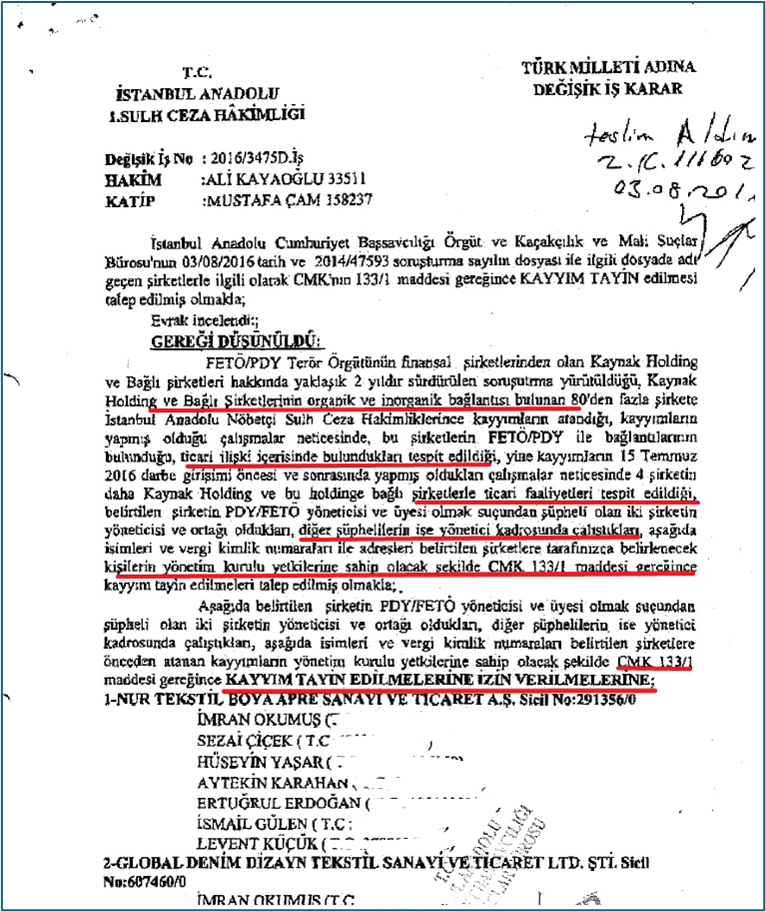 Despite the violation decision in Yalçınkaya case of the ECtHR’s, investigations were opened not only against individuals but also against companies and their executives on the grounds of “financing terrorism and aiding a terrorist organisation” for actions that were not criminal at the time, and trustees were appointed to companies on the grounds that they were close to the Gülen movement by the courts on the basis of these investigations.
Hearings, rumours, speculations, assumptions and suspicions are not evidence; there is no place for assumptions and reading intentions in criminal law. Criminal law punishes actions. Courts should act not on assumptions, but on material facts, concrete cases and evidence. Caution cannot be imposed on assets, a trustee cannot be appointed and confiscation cannot be decided by interpreting events and allegations, the realisation of which is doubtful and not fully clarified, against the defendant. “No judgement can be made on suspicion or assumption” and likewise no confiscation decision can be made [26]. Despite this fact, in the investigations against the Gülen movement in the post-2014 period, the courts did not rely on concrete cases and evidence, but on assumptions.
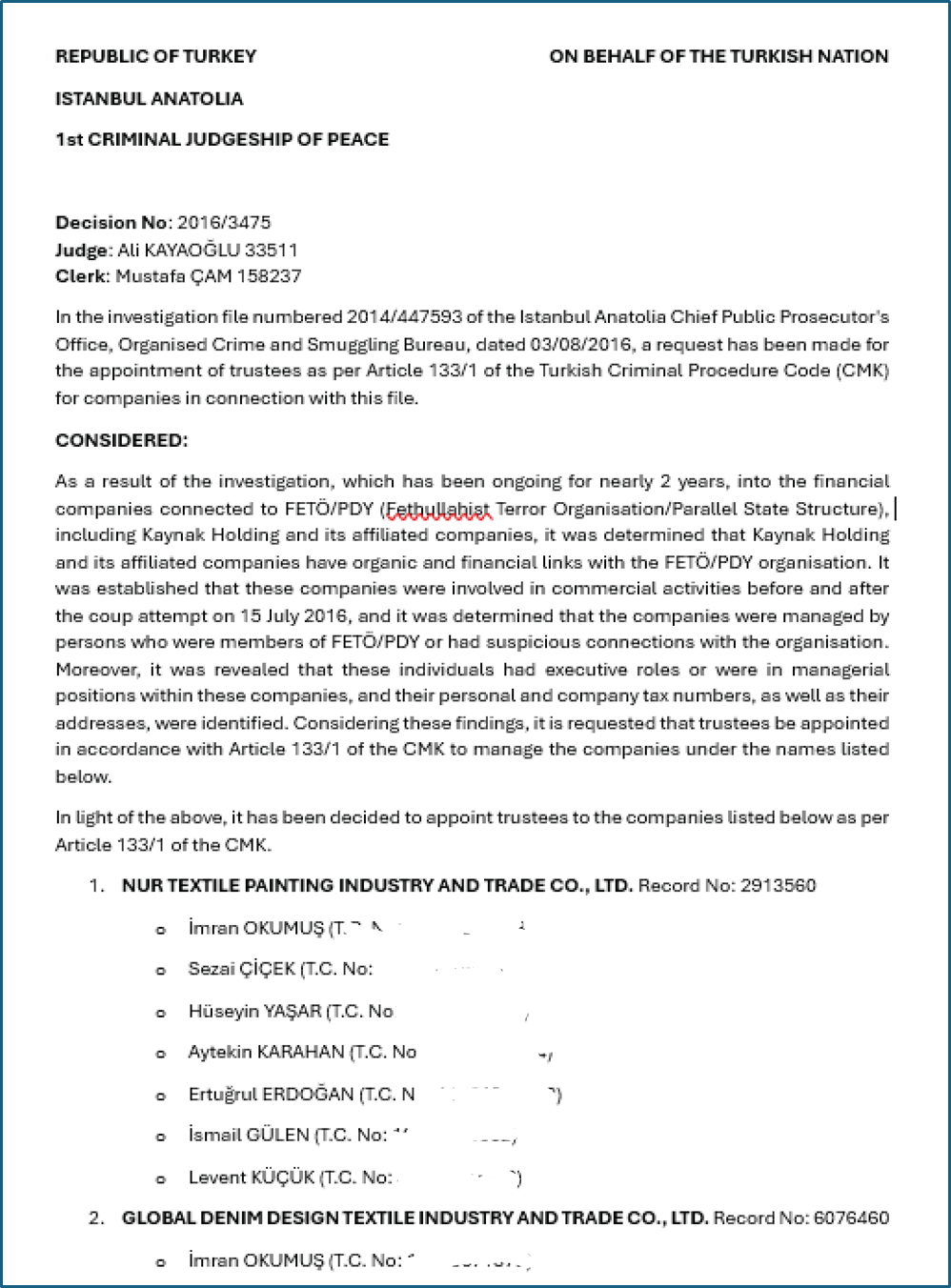
|
Unofficial translation of the court decision above |
For example, in the decision to appoint trustees to Nur Textile Dyeing Inc. and Global Denim Design Textile Industry Inc. by Istanbul Anatolian Anatolian 1st Criminal Judgeship of Peace, accusations such as ” having commercial relations with Kaynak Holding, which was appointed a trustee by another decision, having organic or inorganic connections with Kaynak Holding, and having connections with the “FETÖ” terrorist organisation due to their commercial relations ” were cited as grounds for the appointment of trustees to the companies. However, there are no crimes defined by law in the Turkish Penal Code such as having commercial relations with a company to which a trustee has been appointed, having organic or inorganic connections, or accepting commercial relations with a company to which a trustee has been appointed as a connection to a terrorist organisation.
The Istanbul 1st Criminal Judgeship of Peace, which is part of the criminal judgeship of peace system established by the Erdoğan government after the corruption operations in 2013 in order to fight against the Gülen movement, has made a completely unlawful decision in this trustee appointment decision, ignoring the principle of “no crime and punishment without law”. This unlawfulness has been repeated in all trustee decisions.
- “Non-retroactivity of offences and punishments” (prohibition of retroactive punishment) is one of the fundamental principles of criminal law. This principle states that a person cannot be punished for an act that is not considered an offence according to the laws in force at the time the offence was committed, by laws enacted later. In the decisions to appoint trustees to Nur Textile Dyeing Inc. and Global Denim Design Textile Industry Inc. mentioned above, accusations were made on the grounds that these companies had commercial relations with Kaynak Holding in the past, in the period before the appointment of the trustees (November 2015).
However, the appointment of a trustee to Kaynak Holding was made in November 2015. Even if it is assumed that its activities in the period after the appointment of the trustee would be considered a crime in the form of support for a terrorist organisation (as stated in the above-mentioned ECtHR/Yalçınkaya judgment, all the accusations against the Gülen movement are in fact the criminalisation of legal activities), before November 2015, Kaynak Holding was a company operating in accordance with the law, audited by the tax authority and operating in accordance with the law. In its decision dated August 2016, the Istanbul 1st Criminal Judgeship of Peace considered it a crime years later (after the coup attempt on 15 July 2016) to have a commercial relationship with a company that had operated in accordance with the law in the past, and used this as a justification for the appointment of trustees to the two companies in question. In many trustee appointment decisions such as this one, the principle of “no crime and punishment without law” as well as the principle of “non-retroactivity of crimes and punishments” have been ignored and companies and their owners have been blatantly victimised by criminalising their completely legal activities in the past.
- Article 38 of the Constitution defines general confiscation as a punishment by stating that “General confiscation cannot be imposed”. General confiscation is prohibited in Turkish criminal law. General confiscation is the transfer of all assets of the offender to the state.
According to the Constitutional Court decision, the fact that the confiscation is related to the offence or to the things whose existence constitutes the offence creates a justified situation. …, However, a general confiscation of all movable and immovable property that has nothing to do with the offence, up to the rights of the person, is unconstitutional [27].
In another decision of the Constitutional Court on the violation of the right to property [28], the Constitutional Court stated that “The security of the right to property, which is regulated in Article 35 of the Constitution and recognised as a fundamental right, is important. As an economic freedom, the freedom of labour and contract regulated in Article 48 of the Constitution, i.e. free enterprise and free market, also foresees stability and the security of entrepreneurs. Restrictions to be imposed by law on the right to property and private enterprise must be regulated in accordance with Article 13 of the Constitution and, therefore, those related to criminal proceedings must also be clarified, i.e. the reasons, conditions and rules of restriction must be prevented from being ambiguous and the decisions and disposals regarding the restriction must be open to control. Of course, in the face of an allegation that an offence has been committed, it is not possible to ignore the assets related to the offence being investigated, the suspect and the accused, and the companies, accounts, records and disposals that are found to have been committed within the framework of the activities of the alleged offence. However, in the application of this method, the guarantees provided to the person by the Constitution should be taken into account and it should not be forgotten that general seizure and confiscation of assets are prohibited, and that the trustee has responsibilities arising from management and supervision due to being a public official.”
In this framework, it is necessary, but not sufficient, that an offence has been committed in order to apply the sanction of confiscation. In addition, there must be a connection between the offence committed and the assets subject to confiscation. Assets that are not related to the offence committed cannot be confiscated. The confiscation of a person’s property, which has no connection with the offence committed as required by the law, constitutes a violation of the prohibition of general confiscation [29]. The “general prohibition of confiscation” in the Constitution should be understood not only as the prohibition of confiscation of all property values of the offender, but also as “any property value that is not related to the offence committed cannot be subject to confiscation“. In this respect, legal regulations or the practice developed that envisages the confiscation of a person’s assets just because he/she has committed an offence, even though no connection with the offence committed cannot be established, would be contrary to the general prohibition of confiscation in the Constitution.
Considering the aforementioned issues, it is seen that the decisions to appoint trustees in the investigations carried out against the Gülen movement are clearly contrary to the provisions of the Constitution, and despite the “prohibition of general confiscation”, both the companies and personal assets of persons close to the Gülen movement are subjected to general confiscation through “trustee practice”.
In the decisions to appoint trustees, it is seen that the legal activities of individuals and companies are accepted as criminal offences; in addition to this fundamental material error, trustees are also appointed to assets that are not related to the alleged offence; the appointed trustees manage the companies entrusted to them to manage “temporarily” without complying with the basic qualities such as “honesty”, “prudent merchant”, “impartiality”; the trustee practice is applied as a means of confiscating all assets by the state and unlawful confiscation against persons close to the Gülen movement.
- Interference with the right to property must aim at a legitimate limitation purpose. Whether there is a legitimate purpose in the intervention is determined by the limitation criteria. The term “limitation criterion” refers to the grounds that constitute the basis for the restriction or prohibition of the direct use of the right or freedom by the competent authorities. When restrictions are imposed on the exercise of rights and freedoms, basically, an attempt is made to balance and reconcile individual interests with the interests of society [30].
Interventions to the right to property are subjected to the test of legality/lawfulness, legitimate purpose, fair balance/ proportionality and the existence of a violation of rights is tested.
- a) In the first stage, whether the interference in question is foreseen by law/legislation;
- b) In the second stage, whether the interference is in accordance with the limitation criteria or, in other words, legitimate purposes
- c) in the third stage, it is examined whether the interference/limitation is proportionate or whether it touches the essence of the right.
In the doctrine, at the proportionality stage, it should be investigated whether a “fair balance” is established between the public interest/needs and the right/ benefit of the owner/individual [31]. The “fair balance” will be disrupted if the person whose property right is subjected to interference is put under an “extraordinary and excessive” burden.
In the decisions to appoint trustees to companies based on the laws enacted by the Erdoğan government within the scope of the fight against the Gülen movement, the “fair balance” has been disrupted against individuals and institutions allegedly belonging to/close to the Gülen movement. Trustees were appointed over all assets of these individuals and companies, regardless of whether they were related to the criminal offence or not, and confiscation orders were issued as a result of the proceedings. In this way, actions of individuals and companies that are not criminalised by law, as recognised in ECtHR judgments, have been criminalised by judicial bodies under the influence of the Erdoğan government, and the property rights of people close to the Gülen movement have been violated by deviating criminal laws and laws from their purpose and universal legal norms.
- In Turkey, the right to property is protected by Article 35 of the Constitution. Furthermore, Article 1 of Additional Protocol No. 1 to the European Convention on Human Rights (ECHR) also guarantees the right to property. Therefore, interference with the right to property must comply with the general principles of law, in particular the principles of foreseeability and certainty.
Foreseeability refers to the ability of individuals to reasonably anticipate how legal provisions will be applied to them. This principle is of great importance for legal security and stability. Measures that interfere with the right to property must not be applied arbitrarily or unpredictably. Otherwise, it would not be possible to protect the right to property effectively.
Article 19 of Law No. 6758, which enacted the State of Emergency Decree Law No. 674, stipulates that if it is determined that the current situation is not sustainable due to the financial situation, shareholding structure, market conditions or other problems of the companies, the Minister to whom the Savings Deposit Insurance Fund is related may decide on the sale of the company or its assets, assets values or its dissolution and liquidation.
“(3) …… In the event that it is determined that the current situation is not sustainable due to the financial status, shareholding structure, market conditions or other problems of these companies, the sale or dissolution and liquidation of the company or its assets or the asset values specified in the tenth paragraph of Article 128 of the Law No. 5271 may be decided by the Minister to whom the Savings Deposit Insurance Fund is associated. The sale and liquidation procedures shall be carried out by the board of directors of the relevant company or the Savings Deposit Insurance Fund. The procedures and principles regarding the implementation of this article shall be determined with the approval of the Minister to whom the Savings Deposit Insurance Fund is related.
(10) The Minister to whom the Savings Deposit Insurance Fund is associated may partially or wholly delegate his/her powers under this article to the Chairman of the Savings Deposit Insurance Fund or the Fund Board.”
With these provisions, the SDIF and the minister to whom it is associated have been granted a very wide discretionary power. In practice, it is observed that this wide discretionary power violates the principle of foreseeability for the owners of the company.
The appointment of a trustee is a temporary measure and aims to protect the company and its assets until the judicial process is completed. Transactions such as sale, liquidation and confiscation of the company and its assets can only be applied after the judicial process is completed. Indeed, the ECtHR, in Capital Bank A.D. v. Bulgaria (2005) [32], the ECtHR examined the case of the Bulgarian Central Bank’s revocation of Capital Bank’s banking licence, which led to the bank’s bankruptcy and liquidation, and stated that “the confiscation of the assets, entitlements and rights of the institutions, organisations and companies in question, without compensation, and the sale and liquidation of the assets of the companies – in the absence of adequate safeguards against the arbitrariness of such interventions – would constitute a violation of the right to property, unless the criminal acts of the institutions, organisations and companies in question have been proven through judicial proceedings.
Law No. 6758 authorised the SDIF and the minister to whom it reports to sell and liquidate companies or their assets before the completion of judicial processes and without any judicial decision such as confiscation. Based on this authorisation, the SDIF and the minister to whom it reports have decided to sell and liquidate hundreds of companies belonging to individuals close to the Gülen movement. Due to these regulations, the property rights of companies allegedly linked to the Gülen movement and their owners have been clearly violated.
For example, on 17 November 2015, Istanbul Anatolian Criminal Judgeship of Peace appointed trustees to Kaynak Holding and 19 of its companies on the grounds that they were linked to the Gülen movement. Within the scope of this decision, Sürat Cargo Logistics and Distribution Service Inc., which was managed by the trustees for about 5 years, was decided to be sold in 2020. The SDIF based its decision to sell Sürat Cargo, which has a market value of approximately $350 million [33], on a report dated 02.09.2019 prepared by Özgün Audit Independent Accounting and Financial Consultancy Inc. [34]. Based on the findings and assessments of the said report that the financial situation, liquidity, turnover and profitability of the company is “unsustainable” under the current conditions, the SDIF decided to put the goods, entitlements and assets of Sürat Cargo Logistics and Distribution Services Inc. up for sale.
It is legally inexplicable that the decision to sell a company and its assets, which may result in the violation of the right to property protected by the Constitution and international conventions, was taken on the basis of a determination and evaluation report prepared by an ordinary financial consultancy firm without any court decision, without going through the appeal process (appeal, cassation).
Furthermore, contrary to universal legal principles, Article 9 of the Decree Law No. 667 stipulates that “the persons who take decisions and fulfil duties within the scope of the Decree Law shall not be held legally, administratively, financially and criminally liable due to their duties“, Article 10 stipulates that “a stay of execution shall not be granted in lawsuits filed due to decisions taken and actions taken within the scope of this Decree Law“, and Article 38 of the Decree Law No. 668 stipulates that “the decisions and actions published during the state of emergency shall not be suspended”. Article 38 of the Decree Law No. 668 stipulates that ” no suspension of execution can be granted in lawsuits filed due to the decisions taken and actions taken within the scope of the decrees with the force of law issued during the state of emergency“, thus eliminating the possibility to stop the SDIF’s potentially unlawful decisions to sell or liquidate companies. The decree laws deliberately removed all mechanisms that could prevent the SDIF from selling companies based on a simple financial advisory firm report.
These practices and regulations show that the Erdoğan government has used its power to enact any article of law it wishes in the process of seizing companies belonging to the Gülen movement as a cover for its illegalities.
Utilising its majority in the legislative body, the Erdoğan government has instrumentalised laws, state of emergency conditions and powers to fight against the Gülen movement, as seen in the case of the sale of the companies and their assets to which trustees were appointed. In order to achieve this goal, a system of “seizure” has been established, which is not legal but based on the power of law-making. On the basis of a simple financial consultancy firm’s reports on multi-million-dollar companies, these companies and their assets were seized. All mechanisms that could have prevented the sale of these companies and their assets have been eliminated. In this way, the rules of law were circumvented and the results desired by the Erdoğan government were achieved.
- Article 37 of the Decree Law No. 668 (27/07/2016), which is the second State of Emergency Decree Law issued during the state of emergency declared on 21 July 2016 in Turkey, states that “Persons who take decisions, execute decisions or measures within the scope of the suppression of the coup attempt and terrorist acts carried out on 15/7/2016 and the acts that are the continuation of these acts, and those who take decisions and fulfil duties within the scope of all kinds of judicial and administrative measures , and those who take decisions and fulfil duties within the scope of the decrees with the force of law issued during the state of emergency, shall not be held legally, administratively, financially and criminally liable for these decisions, duties and acts.” With this statement, the administrative, financial and criminal responsibilities of the SDIF and the trustees appointed to the companies were abolished by the Erdoğan government with the force of law.

|
Article 37 of the Decree Law No. 668 |
|
Responsibility ARTICLE 9 – (1) Individuals who make decisions or perform duties within the scope of this Decree Law shall not incur legal, administrative, financial, or criminal liability for these decisions or duties. Suspension of Execution ARTICLE 10 – (1) No decision to suspend execution may be issued in lawsuits filed due to decisions made and actions taken within the scope of this Decree Law. |
Article 37 of the Decree Law No. 668, which eliminated the responsibility of those who took part in these processes and made decisions, was enacted into law with the Law No. 6755 on 24.11.2016 and the guarantee of irresponsibility granted to the trustees was made permanent. Not satisfied with this, the Erdoğan government, 4 years after the end of the state of emergency in 2018, on 26/5/2022, with Article 17 of the Law No. 7407, re-enacted the regulation that eliminates the legal, administrative, financial and criminal responsibilities of the trustees appointed to the companies belonging to / close to the Gülen movement and all public officials involved in these processes.

|
Article 17 of Law No. 7407 |
|
ARTICLE 17 – The first and second paragraphs of Article 20 of Law No. 6758 have been amended as follows: “(1) The management and supervision of the rights, excluding dividends and voting rights, of partnerships transferred to the Savings Deposit Insurance Fund (SDIF) on 19 October 2005 under the Banking Law No. 5411, as well as the management and representation of companies and their assets by the Fund, or by trustees appointed by the Fund, with or without seizure authority, in the context of protecting and managing these companies and assets, shall be carried out in accordance with the provisions of the Law. Whether the companies and their assets are transferred to the Fund shall not alter this duty. The individuals appointed or assigned in this context, who have the authority to manage or represent such assets and entities, shall be subject to the provisions of Article 37 of the Law No. 6755, dated 8 November 2016, regarding the amendment of the Decree Law on Measures to Be Taken Under the State of Emergency and the Regulation of Certain Institutions and Bodies, concerning the actions and activities conducted under these provisions.”
|
Article 11 of the Decree Law No. 675 stipulates that “Trustees appointed to institutions, organisations, private radios and televisions, newspapers, magazines, publishing houses, distribution channels and companies closed down due to their affiliation, association or contact with the Gülen movement, and managers and liquidators appointed by the relevant institutions in accordance with the legislation; cannot be held personally liable for the unpaid public debts, Social Security Institution debts, all kinds of labour receivables and debts arising from other legislation, arising or to arise from the public debts of the institutions, organisations, private radios and televisions, newspapers, magazines, publishing houses and distribution channels and companies to which they are appointed or assigned.”
The abolition of the personal, legal, administrative, financial and criminal responsibilities of the trustees by emergency decrees and laws encouraged the trustees appointed to the companies and their assets in their unlawful actions and gave them the confidence that the Erdoğan government would protect them in all kinds of unlawful acts. Furthermore, the Erdoğan government has introduced a succession of laws both during and after the end of the state of emergency in order to prevent accountability for the unlawful acts committed. These regulations show that the public officials and trustees who took part in the violations of property rights against the Gülen movement did so knowingly, that they asked the Erdoğan government for assurance that they would not be held accountable for their unlawful acts, and that the Erdoğan government protected the public officials and trustees with these regulations, which are contrary to universal law but based on the power of law.
- During the criminal proceedings, the owners of the company have the right to inspect whether their company is managed as a prudent merchant in an independent, impartial and transparent manner by exercising their personal rights [35]. Article 133/3 of the Code of Criminal Procedure No. 5271 stipulates that “those concerned may apply to the competent court against the actions of the appointed trustee in accordance with the provisions of the Turkish Civil Code No. 4721 and the Turkish Commercial Code No. 6762”. Each shareholder of the company may exercise his/her personal rights arising from the Civil Code, the Code of Obligations and the Turkish Commercial Code, in particular the right to participate in the general assembly of the company, to vote, to obtain information, to examine and to file an action for annulment regulated under the Turkish Commercial Code. The company owners have the right of control over the SDIF against the actions of the SDIF in its capacity as a trustee.
In both the investigation and prosecution phases, the company owners should be informed ex officio of any action taken by the management trustee, and at least their requests for information/documentation should be met and they should be given the opportunity to exercise their rights arising from the law. The trustees are not authorised to hide/conceal the information belonging to the companies, or to prevent the owners from accessing such information during the execution of the trusteeship duty granted as a temporary measure under the Criminal Procedure Code [36]. However, in practice, the information and document requests of the company owners from the SDIF and the courts regarding the management of their companies are either not responded to or not satisfactorily answered.
- The SDIF’s acting as a trustee in companies is regulated under Articles 19 and 20 of the Law No. 6758.
- Article 19 of the Law No. 6758 provides for the transfer of executive trusteeship to the SDIF, which is subject to political will,
- the fact that this regulation was enacted to apply only to the prosecution of the “Gülen movement”, which is seen by the Erdoğan government as a threat to national security,
- the lack of a mechanism to supervise the operations of the SDIF appointed as the managing trustee, (Article 133/3 of the Code of Criminal Procedure was not ex officio invoked by the courts),
- The SDIF’s failure to inform the courts and the parties about its operations, and the linking of the approval mechanism of the fund board decisions on the sale of companies under trustee management to the decision of the SDIF’s administrator (the minister), who has a political personality, instead of the courts that decide on the appointment of trustees,
- The authorisation given to the SDIF to allow the sale and liquidation of the assets of companies in cases where the confiscation decision has not yet been finalised, the application of the sale and liquidation to the entire company, like the execution of a general confiscation decision, and the failure to establish a fair balance to protect the right to property during these transactions are contrary to the Constitution and universal principles of law.
- With Emergency Decree Law No. 675 Article 9, it is stipulated that “ The Savings Deposit Insurance Fund shall be appointed as a trustee by the competent judge or court pursuant to Article 133 of the Criminal Procedure Law No. 5271 dated 4/12/2004 for the management and representation of these shares in companies in which real and legal persons who are affiliated, associated or connected to FETÖ/PDY terrorist organisation have less than fifty percent shareholding.” This Decree Law article was enacted into law with Law No. 7082 and made permanent, valid even after the state of emergency.
Making a special regulation by law against the Gülen movement, which is categorised by the Erdoğan government as a “structure posing a threat to national security” and declared a terrorist organisation without any judicial decision, is contrary to the principle of “formal legal equality” (Constitutional Court’s Decision No. 2017/124 Esas and 2018/9 Decision), which states that laws “must be general and abstract in nature, that is, equally applied to everyone they cover”. It is a violation of the prohibition of discrimination to make this regulation to cover only a certain formation or group [37].
- For certain offences under Article 133 of the Code of Criminal Procedure, a trustee is appointed by criminal judgeships of peace during the investigation phase and by the court where the criminal case is heard during the prosecution phase.
The objection against the decisions of criminal judges of peace to appoint a trustee is regulated under Article 268 of the Criminal Procedure Code. The objection to the trustee decision is made to the judge or court that issued the decision. If the judge or court that issued the decision deems the objection justified, it corrects its decision; otherwise, it sends the objection to a higher court. If the criminal judgeship of peace does not accept the objection, the objection file is sent to a higher court, namely the heavy criminal court. The heavy criminal court examines the objection and makes a decision. The decision of the heavy criminal court is final.
In the prosecution phase, decisions to appoint trustees are made by the heavy criminal courts. Turkish criminal procedure law does not provide for the right of appeal against court decisions on the appointment of a trustee for the management of the company at the prosecution stage. Therefore, it is possible to appeal against the decisions of the courts to appoint a trustee at the prosecution stage together with the judgement. Considering the length of the appeal process, this situation reveals that the decisions to appoint trustees to companies cannot be reviewed for years, even if only for show, in the legal order created by the Erdoğan government.
- With the Law dated 25/07/2018 and numbered 7145 published following the end of the State of Emergency, it was regulated that the provisions regarding the appointment of the SDIF as a trustee within the scope of Law No. 6758 will be applied for 3 more years. With the Law dated 18/07/2021 and numbered 7333, three more years were added to the three-year period and this period was increased to 6 years in total. 18 July 2024, the SDIF’s authority to appoint trustees to Gülen movement companies is included in the 9th judicial package currently being discussed in the Turkish Grand National Assembly and the SDIF’s trusteeship authority is extended for another 5 years [38].
In this case, the SDIF is still acting as a trustee for Gülen movement companies, 8 years after the state of emergency declared in July 2016 to combat the Gülen movement. The SDIF will be able to use this authorisation until 2029. In this case, the SDIF will continue to unlawfully manage Gülen movement companies under the state of emergency for another 11 years after the end of the state of emergency in 2018, for a total of 13 years.
The extension of the SDIF’s powers of trusteeship through new articles of law shows that the Erdoğan government uses the state of emergency conditions as an excuse and continues to legislate under state of emergency conditions based on its majority in parliament after the end of the state of emergency. It is obvious that this situation is contrary to the Constitution and universal principles of law.
Chapter 4: Assessment of the practice of appointing trustees to companies from company management and economic perspectives and irregularities experienced
In 2014, within the scope of the investigations launched against the Gülen movement, 1,371 companies were appointed as trustees by the courts and the SDIF fulfilled its trusteeship duty within a period of approximately 10 years. The trustee appointments have led to serious changes in the corporate governance, economic values and market values of these companies. In this context, the following issues stand out:
- According to the current data announced by the SDIF, the asset size of 694 companies managed by the SDIF as trustees was TL 146.5 billion in December 2023. The asset size of these companies as of the date of their transfer (the SDIF was authorised as trustee in September 2016) was calculated as TL 39.5 billion. Moreover, according to the data published on the website of the SDIF, the asset size of 697 companies under trusteeship in October 2022 was announced as TL 76.25 billion. Since the data announced by the SDIF is given in TL, it is presented without taking into account the depreciation of the TL in the last 10 years. Taking this into account, the values of the figures announced according to the USD/TL exchange rate of that period are shown in the table below.
|
Asset size of companies transferred to the SDIF within the scope of investigations against the Gülen Movement (USD) |
Date |
USD/TL exchange rate |
Asset size of companies |
|
September 2016
|
2.95 |
13 billion 380 million USD |
|
|
September 2021
|
8.82 |
8 billion 673 million USD |
|
|
December 2023 |
28 |
5 billion 210 million USD |
Currently, there are 694 companies under SDIF control. In September 2016, the number of companies to which trustees were appointed was around 950. In time, this number increased to 1371. These figures include large companies such as Boydak Holding and Koza-İpek Holding, which are still under the control of the SDIF, as well as a large number of small-scale sole proprietorships and limited liability companies. In this process, it was mostly small-scale companies that were sold, closed down for economic reasons or returned to their owners. However, large companies such as Boydak Holding, Koza-İpek Holding and Aydınlı Group continued to be managed under the control of the SDIF.
Since large conglomerates and companies, which account for almost all of the value of their assets, remained under the management of the SDIF, the data above for three different periods approximately reflect the actual figures.
When we evaluate this data, it is seen that the value of the asset size of the companies to which trustees were appointed within the scope of the investigations against the Gülen movement was approximately $ 13 billion in 2016, and 5 years later, the value of the companies decreased to $ 8 billion; companies lost 40% of their value in 5 years.
The asset values of companies continued to deteriorate during the years of management by the trustees. By the end of 2023, the asset size value of the companies decreased to $5 billion. In this case, companies under trusteeship lost 62% of their value in the 8 years from 2016 to 2024. This data reveals that companies have been largely volatilised under trustee management.
- According to the data obtained from the trade registry gazette and other sources, trustees were appointed to 116 firms between 2014-2016, the period when the SDIF was not yet authorised as a trustee. The number of trustees appointed to these companies is 29 in total. The trustee committees appointed to 116 firms consisted of these 29 people.
In the period starting in 2016 with the declaration of the state of emergency, the SDIF was authorised as a trustee and the number of companies to which trustees were appointed on the grounds of links with the Gülen movement increased to 1,371 in ten years (2014-2024). These figures show that the state of emergency has been used as a tool of unlawful repression against the Gülen movement.
|
# |
Trustee Name-Surname |
Number of Companies Assigned |
|
1 |
Bülent Navruz |
110 |
|
2 |
Tahsin Yazan |
107 |
|
3 |
Ayten Altıntaş |
103 |
|
4 |
Mustafa Ertaş |
102 |
|
5 |
Aytekin Karahan |
101 |
|
6 |
Erol Aykut |
101 |
|
7 |
Ertuğrul Erdoğan |
101 |
|
8 |
Hüseyin Yaşar |
101 |
|
9 |
İmran Okumuş |
101 |
|
10 |
İsmail Gülen |
101 |
|
11 |
Levent Küçük |
101 |
|
12 |
Sezai Çiçek |
101 |
|
13 |
Mehmet Rıdvan İnan |
100 |
|
14 |
Ali Altıntaş |
97 |
|
15 |
Ünal Bilgili |
94 |
|
16 |
Ahmet Kadir Pürsün |
93 |
|
17 |
Mahmut Birlik |
91 |
|
18 |
Yaşar Atlıgan |
90 |
|
19 |
Melek Küreemoğlu |
89 |
|
20 |
Abdulkadir Koçak |
86 |
|
21 |
Metin Üzümcü |
84 |
|
22 |
Süleyman Engin |
84 |
Trustee list and how many companies they are appointed to
According to the available data, the number of trustees appointed to 1,371 companies is 529. The majority of the 529 trustees were appointed to the trustee committees of dozens of companies at the same time.
For example, Bülent Navruz was appointed to 110 companies, Tahsin Yazan to 107 companies, Ayten Altıntaş to 103 companies, Mustafa Ertaş to 102 companies, Aytekin Karahan to 101 companies, Erol Aykut, Ertuğrul Erdoğan, Hüseyin Yaşar, İmran Okumuş, İsmail Gülen, Levent Küçük and Sezai Çiçek to 101 companies at the same time.
After Bülent Navruz was appointed as a trustee by the SDIF, the SDIF board appointed him as a member of the board of trustees for a large number of companies at the same time. It is observed that these appointments were intensified in 2017 and 2018.
|
Name |
Position |
Company |
Appointing Authority |
Appointment Details |
|
Bülent Navruz |
Board Member |
RESEARCH PUBLISHING PRODUCTION PRINTING FILM MUSIC DISTRIBUTION AND CONSTRUCTION TRADE LTD. CO. |
TMSF Board |
Appointed to Company Management by TMSF Board |
|
Bülent Navruz |
Board Member |
ARCA HEALTHCARE FOREIGN TRADE LTD. CO. |
TMSF Board |
Appointed to Company Management by TMSF Board |
|
Bülent Navruz |
Board Member |
ASA MEDICAL MUHAMMET ÇİHAT GÜNDOĞDU |
TMSF Board |
Appointed to Company Management by TMSF Board |
|
Bülent Navruz |
Board Member |
ATLANTIS MARITIME FOREIGN TRADE AND INDUSTRY LTD. CO. |
TMSF Board |
Appointed to Company Management by TMSF Board |
|
Bülent Navruz |
Board Member |
BABUL HAYAT HEALTH SERVICES AND TRADE LTD. CO. |
TMSF Board |
Appointed to Company Management by TMSF Board |
|
Bülent Navruz |
Board Member |
OKYANUS INVESTMENT CONSTRUCTION CONTRACTING INDUSTRY AND TRADE INC. |
TMSF Board |
Appointed to Company Management by TMSF Board |
|
Bülent Navruz |
Board Member |
ÇAVDIR MOBILYA DECORATION AND FURNITURE MARKETING FOREIGN TRADE LTD. CO. |
TMSF Board |
Appointed to Company Management by TMSF Board |
|
Bülent Navruz |
Board Member |
SANCARLAR FURNITURE TRANSPORTATION AND FOREIGN TRADE LTD. CO. |
Vice Chairman |
Appointed to Company Management by TMSF Board |
|
Bülent Navruz |
Board Member |
M SÖYLEMEZ ARCHITECTURE AND CONSTRUCTION INDUSTRY AND TRADE LTD. CO. |
TMSF Board |
Appointed to Company Management by TMSF Board |
|
Bülent Navruz |
Board Member |
CSK AUTOMOTIVE PLASTICS MANUFACTURING ORGANIZATION MARKETING AND CONSULTANCY INC. |
TMSF Board |
Appointed to Company Management by TMSF Board |
|
Bülent Navruz |
Board Member |
DAHICE ADVERTISING PROMOTION ORGANIZATION CONSULTANCY INC. |
TMSF Board |
Appointed to Company Management by TMSF Board |
|
Bülent Navruz |
Board Member |
DECO FERANT MARITIME CONTRACTING TOURISM INDUSTRY AND TRADE LTD. CO. |
TMSF Board |
Appointed to Company Management by TMSF Board |
|
Bülent Navruz |
Board Member |
ECZADOLABIM PERSONAL CARE PRODUCTS INDUSTRY AND TRADE LTD. CO. |
TMSF Board |
Appointed to Company Management by TMSF Board |
Some of the 110 companies to which Bülent Navruz was appointed trustee
Businessman İmran Okumuş, one of the 529 people appointed as a trustee, was appointed as a member of the board of trustees for 101 companies. Some of the companies, which are among the biggest companies in Turkey, where İmran Okumuş is serving as a trustee at the same time are as follows
- Kaynak Holding Inc.
- Kaynak Media Inc.
- N-T Book Stationery Office Supplies Marketing and Tourism Trade Joint Stock Company
- Sürat Cargo Logistics and Distribution Services Inc.
- Sürat Cargo Logistics and Distribution Services Inc.
- Milsoft Software Technologies Inc.
|
Name |
Position |
Company Name |
Decision Maker |
Decision Date |
Decision No |
|
İmran Okumuş |
Trustee |
AYYILDIZ ENERGY ELECTRICITY PRODUCTION INDUSTRY AND TRADE INC. |
Istanbul Anatolia 9th Criminal Judgeship of Peace |
27.11.2015 |
2015/2063 |
|
İmran Okumuş |
Trustee |
AZİM GAYRİMENKUL YATIRIM ANONİM ŞİRKETİ |
Istanbul Anatolia 9th Criminal Judgeship of Peace |
11.04.2016 |
2016/2122 |
|
İmran Okumuş |
Trustee |
BARAN FEED AND LIVESTOCK INDUSTRY AND TRADE INC. |
Istanbul Anatolia 10th Criminal Judgeship of Peace |
17.11.2015 |
2015/2903 |
|
İmran Okumuş |
Trustee |
BİRTEL COMMUNICATION TECHNOLOGIES TOURISM INDUSTRY AND TRADE INC. |
Istanbul Anatolia 2nd Criminal Judgeship of Peace |
25.12.2015 |
2015/4212 |
|
İmran Okumuş |
Trustee |
ENNEAGRAM PUBLISHING AND EDUCATION MATERIALS INC. |
Istanbul Anatolia 9th Criminal Judgeship of Peace |
17.11.2015 |
2015/2903 |
|
İmran Okumuş |
Trustee |
HERKÜL OUTER TRADE AND TRANSPORTATION INC. |
Istanbul Anatolia 10th Criminal Judgeship of Peace |
17.06.2016 |
2016/3120 |
|
İmran Okumuş |
Trustee |
İTİNA BEVERAGE FOOD AND CLEANING MATERIALS INDUSTRY INC. |
Istanbul Anatolia 10th Criminal Judgeship of Peace |
17.11.2015 |
2015/2903 |
|
İmran Okumuş |
Trustee |
KAYNAK FOREIGN TRADE INC. |
Istanbul Anatolia 10th Criminal Judgeship of Peace |
17.11.2015 |
2015/2903 |
|
İmran Okumuş |
Trustee |
KAYNAK HOLDING INC. |
Istanbul Anatolia 9th Criminal Judgeship of Peace |
17.11.2015 |
2015/2903 |
|
İmran Okumuş |
Trustee |
KAYNAK PAPER INDUSTRY AND TRADE INC. |
Istanbul Anatolia 10th Criminal Judgeship of Peace |
27.11.2015 |
2015/2063 |
|
İmran Okumuş |
Trustee |
KERVANSARAY TRAVEL ACCOMMODATION TOURISM AND ORGANIZATION SERVICES INC. |
Istanbul Anatolia 10th Criminal Judgeship of Peace |
22.12.2015 |
2015/4212 |
|
İmran Okumuş |
Trustee |
N-T BOOKSHOP STATIONERY OFFICE SUPPLIES MARKETING AND TOURISM TRADE INC. |
Istanbul Anatolia 10th Criminal Judgeship of Peace |
17.11.2015 |
2015/2923 |
Some of the 101 companies to which İmran Okumuş was appointed trustee
While the difficulties of one person to manage even one company are obvious, the appointment of a trustee to a hundred companies at the same time cannot be explained neither in legal terms, nor in terms of the qualifications of the trustees, nor in terms of efficient company management in market conditions.
- Ümit Önal, who was appointed as trustee to İpek Online Informatics Services Limited Company, Koza Production and Trade Inc. and Rek-tur Advertisement Marketing and Trade Limited Company, which are affiliated companies of Koza-İpek Holding, by the decision of Ankara 5th Criminal Judicature of Peace dated 26/10/2015, is currently the CEO-General Manager of Türk Telekom, a public-private partnership [39]. Ümit Önal previously served as the head of the advertising group at Turkuaz Media Group, a media organisation close to the Erdoğan government.
Tahsin Kaplan, who is currently the Deputy General Manager of Law and Regulation at Türk Telekom, was appointed as a trustee to Cihan Media Distribution Inc. and Dünya Distribution Inc. by the decision of the Istanbul 2nd Criminal Judge of Peace dated 21 March 2016.
|
Name |
Position |
Company Name |
Decision Maker |
Decision Date |
Decision No |
|
Tahsin Kaplan |
Board Member |
SEYHAN PRINTING INDUSTRY AND TRADE INC. |
Istanbul 2nd Criminal Judgeship of Peace |
21.03.2016 |
2016/1850 |
|
Tahsin Kaplan |
Trustee |
CIHAN MEDIA DISTRIBUTION INC. |
Istanbul 9th Criminal Judgeship of Peace |
11.03.2016 |
2016/1605 |
|
Tahsin Kaplan |
Trustee |
DUNYA DISTRIBUTION INC. |
Istanbul 9th Criminal Judgeship of Peace |
11.03.2016 |
2016/1605 |
|
Ümit Önal |
Trustee |
IPEK ONLINE INFORMATICS SERVICES LTD. |
Ankara 5th Criminal Judgeship of Peace |
26.10.2015 |
2015/4104 |
|
Ümit Önal |
Trustee |
KOZA PRODUCTION AND TRADE INC. |
Ankara 5th Criminal Judgeship of Peace |
26.10.2015 |
2015/4104 |
|
Ümit Önal |
Trustee |
REK-TUR ADVERTISING AND MARKETING LTD. |
Ankara 5th Criminal Judgeship of Peace |
26.10.2015 |
2015/4104 |
It is noteworthy that the senior executives of a semi-public, government-controlled company called Türk Telekom are also appointed as trustees of companies related to the Gülen movement. This is because the senior executives of the semi-public company Türk Telekom are appointed by the Erdoğan government. The appointment of the same people as trustees by Criminal Judgeships of Peace in different provinces to companies linked to the Gülen movement shows that trustee appointments are made based on certain lists and names.
- Nevzat Demiröz, who was appointed as trustee to Koza-İpek Holding and its affiliated companies, is the brother of AKP Deputy Chairman and Bitlis Deputy Chairman Vedat Demiröz and also served as AKP Beylikdüzü District Chairman.
Özen Pala, who was appointed as trustee to Koza Altın İşletmeleri Inc. and Koza Anadolu Metal Mining Inc. works as a financial advisor at Demiröz Financial Consultancy, which is owned by the above-mentioned AKP MP Nevzat Demiröz.
|
Name |
Position |
Company Name |
Decision Maker |
Decision Date |
Decision No |
|
Özen Pala |
Trustee |
KOZA GOLD ENTERPRISES INC. |
Ankara 5th Criminal Judgeship of Peace |
26.10.2015 |
2015/4104 |
|
Özen Pala |
Trustee |
KOZA ANATOLIAN METAL MINING ENTERPRISES INC. |
Ankara 5th Criminal Judgeship of Peace |
26.10.2015 |
2015/4104 |
Extract from the LinkedIn profile of Özen Pala, who was appointed as a trustee
Ali Yazlı, also one of the appointed trustees, served as an AKP Ümraniye Municipality Council member and councillor. Kemal Yıldır was appointed by the Erdoğan government as the General Director of TEİAŞ under the Ministry of Energy and Natural Resources, and Hayrullah Dağıstan as the Deputy General Director of the Mineral Research and Exploration Organisation.
These data show that the appointed trustees were specifically selected from bureaucrats appointed by the Erdoğan government in the past, and people close to the Erdoğan government.
- Hüdai Bal and Ümit Önal, two of the trustees appointed to the media companies such as Bugün TV, Bugün Newspaper and Kanaltürk TV, which are media outlets of Koza-İpek Holding, were previously employed by Turkuvaz Media Group. Ümit Önal was the head of the advertising group at Turkuaz Media Group [40]. The striking point in these trustee appointments is that these individuals worked at Turkuvaz Media, which includes Sabah newspaper, ATV, A Haber and other media organisations controlled by the Erdoğan government and publicly known as “pool media” [41].
Legally, trustees are required to be selected from meritorious, independent and impartial individuals in order to protect the economic values of the companies temporarily placed under their management. However, this legal requirement was not fulfilled in the appointment of trustees for the İpek Media group. Turkuvaz Media group media outlets are the biggest supporters of the judicial operations against the Gülen movement and are among the most prominent advocates of the “FETÖ (Fethullahist terrorist organisation)” hate speech. The fact that people working in media organisations with such a hostile attitude towards the Gülen movement have been appointed as administrative trustees to media organisations close to the Gülen movement with an unlawful court decision show that the trustee appointments are not carried out within the framework of the law, but under the control and influence of the Erdoğan government.
- On 17 November 2015, Istanbul Anatolian 10th Criminal Judge of Peace Ali Arslan Giritli appointed 7 trustees to 19 companies, 1 foundation and 1 association affiliated to Kaynak Holding. The name of Aytekin Karahan, one of the trustees appointed to Kaynak Holding and its affiliated companies, was included as a suspect in the 2012 Ankara Police operation on the Public Procurement Authority. Following the operation, a lawsuit was filed against the suspects, including Karahan and bureaucrats of the Public Procurement Authority, on charges of bid rigging and forming a gang to commit a criminal offence. It was revealed that the trials of the suspects at Ankara 8th High Criminal Court were continuing and that Aytekin Karahan was charged with being a member of an organisation, bid rigging and bribery [42].
The appointment of a person who is accused of bid rigging, bribery and establishing a criminal organisation as a trustee for Kaynak Holding and 19 affiliated companies worth billions of dollars shows that the appointment of trustees is not based on merit, and that they are chosen from the profile of people who can act in the direction desired by the Erdoğan government, who are under legal pressure due to the allegations and lawsuits against them, and who can therefore fulfil the unlawful demands of the government.
- The main duty of the trustees appointed to the companies is to manage the companies as “prudent merchants” until the final decisions of the courts and to protect their assets. It is observed that the trustees appointed within the scope of the investigations against the Gülen movement do not fulfil these qualifications. Numerous irregularities involving trustees appointed to companies have even been reported in the media.
- For example, it was revealed that Ertunç Laçinel, the CEO appointed to Boydak Holding, which was transferred to the SDIF in 2016 and renamed Erciyes Anadolu Holding in 2019, purchased warehouse services by using another company he established in Slovakia as an intermediary, thereby causing a loss of €1 million 200 thousand to Boydak Holding [43].
- It was revealed that Alpaslan Baki Ertekin, who was appointed CEO of Boydak Holding after Ertuğrul Laçinel was dismissed following the news about him, transferred approximately 66 million liras from Boydak Holding funds to foundations and organisations supported by the Erdoğan government, including TÜGVA, TÜRGEV and İlim Yayma Cemiyeti in 2021 [44].
- Another example of irregularities committed by the SDIF trustees occurred in Aydınlı Group, one of Turkey’s largest clothing companies. It was revealed that the number of workers, which was 3,800 before the trustee administration, suddenly increased from 3,800 to over 5,000 despite the fact that there was no growth to cover these expenses, that the company, which had no debt to the state, had a tax debt of 45 million TL to the state in 2.5 years after the appointment of the trustees, and that the salaries of the workers in the company were paid with ‘bank loans’ [45]. The owners of Aydınlı Group applied to the Constitutional Court on the grounds that their company had been deliberately damaged by the trustees, but did not receive a positive result.
- It was revealed that the AKP member appointed as trustee to Aynes Gıda sold products at low prices to the company he founded. Former AKP Denizli Deputy Provincial Vice Chairman Yusuf İzzet Ayhan, who was appointed as a trustee to Aynes, and Aynes’ Foreign Trade Manager Mehmet Özdemir established a joint company called Global Geo in Georgia in 2017 with fifty per cent shares each. AKP member Ayhan transferred his fifty per cent share in the company to former AKP Denizli Youth Branch Chairman and Aynes Trustee Board Member Melih Serim in May 2018. The company was sold in July 2018 with two separate invoices totalling $23,750. It was revealed that the total amount of the two separate sales transactions was 47 thousand 500 dollars. [46]
- Abdullah Güzeldülger, one of the founders of the Future Party, who was appointed as the chairman of the board of directors of Boydak Holding after serving as the head of the Collections and Financing Department of the Savings Deposit Insurance Fund, gave striking information about the trustees appointed to companies on the grounds that they were linked to the Gülen movement. Güzeldülger stated that Sezgin Baran Korkmaz, who was arrested in Austria for money laundering, came to his room and asked him for a bargain company, that the Anatolian Chief Public Prosecutor’s Office appointed 7 people as trustees to 99 companies in Istanbul at that time, that a monthly salary budget of 3-3 and a half million was created by giving each of them a salary of 5 thousand liras, that when calculated with the exchange rate of that day, a monthly salary of 200-250 thousand dollars entered their pockets, and that the Erdoğan government and those close to it saw the companies allegedly linked to the Gülen movement as spoils (as in war spoils). Furthermore, Güzeldülger described the “robbery” attempt on BOYDAK Holding by name, stating that the minister to whom the SDIF reports (Nurettin Canikli) interfered with the signature circular and that a deal was made without the signature of the Chairman of the Board of Directors.
- Some of the companies managed by the SDIF were intended to be sold. It was observed that the tender prices of the sold companies were well below the market values of the companies.
After the appointment of trustees to Kaynak Holding in November 2015, the company named Sürat Cargo, which was managed by the trustees, was decided to be sold by the SDIF in July 2021 on the grounds that it was “not sustainable due to its financial situation, shareholding structure, other problems or market conditions”. The tender price of Sürat Cargo was determined as 325 million liras and was sold for 335 million liras after the tender.
Just before the appointment of the trustee for the sale of Sürat Cargo (before November 2015), negotiations were made with a foreign company, and the price of the company was determined as $350-500 million. Sürat Cargo, which was worth 2 billion 975 million TL according to the USD/TL exchange rate in July 2021, was sold for 335.5 million TL at a price of approximately 1 in 10[47].
The fact that Sürat Cargo was sold far below its market value reveals that the SDIF did not fulfil its duty to protect the value of the company.
- Another problematic area regarding the companies under SDIF management is the system introduced by the Erdoğan government through laws regarding the sale of these companies. During and after the state of emergency in 2016, the Erdoğan government authorised the SDIF to sell the companies to which it had been appointed as trustee through decrees and laws.
Provisions of Article 19, paragraphs 3 and 10 of Law No. 6758;
“(3) …… In the event that it is determined that the current situation is not sustainable due to the financial situation, shareholding structure, market conditions or other problems of these companies, the sale or dissolution and liquidation of the company or its assets or the asset values specified in the tenth paragraph of Article 128 of Law No. 5271 may be decided by the Minister to whom the Savings Deposit Insurance Fund is associated.
(10) The Minister to whom the Savings Deposit Insurance Fund is associated may partially or wholly delegate his/her powers under this article to the Chairman of the Savings Deposit Insurance Fund or the Fund Board.”
And provisions of Article 7 of the Procedures and Principles for the Implementation of Article 19 of the Law No. 6758 dated 10/11/2016 state;
“A financial status report is prepared by the independent auditor or sworn financial advisors to be determined by the company’s management body, which includes the value of the company’s assets and whether this value is sufficient to meet the debts and obligations, the financial status of the company, the shareholding structure, market conditions and other problems of the company. This report may also be prepared by the company’s management body. The prepared report, together with its opinion, is submitted to the Minister by the company management. In the event that the current state of the company is not sustainable due to the financial situation, shareholding structure, market conditions or other reasons, the Minister may decide to sell the company, company assets or asset values or to liquidate the company by dissolution. “
Based on the aforementioned laws and regulations, the SDIF has decided to sell Sürat Cargo Logistics and Distribution Services Inc. In this context, the SDIF agreed with Özgün Audit Independent Accounting and Financial Consultancy Inc. to determine the financial status of Sürat Cargo Logistics and Distribution Services Inc. and decided to sell the company based on the report prepared by Özgün Audit Independent Accounting and Financial Consultancy Inc. dated 02.09.2019 [48].
There are several important points here. First, based on these authorisations, the SDIF is actually selling a company temporarily entrusted to its management. The transaction taking place here is actually the transfer of the company from the ownership of its owners to the ownership of someone else. In the normal legal order, the ownership of a company, i.e. its confiscation, can only be enforced by a judicial decision and when the judicial decision for confiscation is finalised by the appellate authorities. Here, however, the Erdoğan government has used its power in the legislature to authorise the SDIF to sell the company and its executives while the criminal case against them is pending. In this way, the SDIF can decide to sell companies on the basis of a “financial status report” prepared by a simple financial consultancy firm without waiting for judicial decisions. Thanks to these legal arrangements, which lead to the severe consequence of transferring ownership in terms of the property rights of the companies and their owners, companies allegedly linked to the Gülen movement were sold unlawfully.
The second important issue in the sale of Sürat Cargo is that a transaction equivalent to confiscation can be easily carried out with a report that can be obtained from any financial consultancy firm. In the financial status report of Özgün Auditing Independent Accounting and Financial Consultancy Inc., which was taken as the basis for the sale of Sürat Cargo, it is stated in the report that “… In the event that the Company’s equity account is reconstructed by subtracting the assets that have become impossible to collect (a total of 32 264 671,71 TL) from the total assets, and with the application of this in the previous years, the Company was insolvent in the periods 2015, 2016, 2017 and 2018, and the technical bankruptcy (being insolvent) was in question since the Company lost its equity to a great extent despite the fact that it is currently operating; the Company has been continuously generating losses; the Company has not been able to obtain new business and the ongoing competitive environment does not allow the Company to continue its activities in the long term; the Company may be able to generate economic value if the necessary capital and cash flow is provided by realising the sale of the Company; otherwise, the Company, which continues to generate losses, may face liquidation… “.
Based on these issues in the report, the Company decided to sell Sürat Cargo Logistics and Distribution Services Inc. with a market value of approximately $335 million.
Another important issue is how the audit firm (Özgün Audit Independent Accounting and Financial Consultancy Inc.), which prepared the report approving the sale of Sürat Cargo Logistics and Distribution Services Inc. was determined and its approach to the data used in the preparation of the report.
In the report of Özgün Audit Independent Accounting and Financial Consultancy Inc. it is stated that Sürat Cargo was in a state of insolvency in 2015, 2016, 2017 and 2018, and that although it is still in operation, it is in a state of technical bankruptcy (insolvency) since it has lost its equity to a great extent. However, the years 2015, 2016, 2017 and 2018, which were taken as the basis for the report, were the years when the Erdoğan government put pressure on the Gülen movement by using all the institutions and power of the state, and a state of emergency was declared to combat the Gülen movement. It is already impossible for Sürat Cargo, which was a highly profitable company in its balance sheets before 2015, before it was seized, to survive in this pressure environment. Even Bank Asya, the largest participation bank in the country, could not stand up to the pressure of the Erdoğan government and was forced into bankruptcy. For this reason, the economic data of Sürat Cargo deteriorated as a result of the pressures of the Erdoğan government, and then, based on these deteriorating data, a report was prepared by a financial consultancy firm, which is not clear how it was determined, to sell it, and it was sold by the SDIF at a price of one tenth of its market value.
- Within the scope of investigations against the Gülen movement, trustees were appointed to 1371 companies. The appointment of trustees to Turkey’s leading large companies caused a great public outcry. The fact that the trustees appointed to more than one company received separate remuneration from each company caused controversy. In fact, hundreds of thousands of searches were made on search engines at that time as “how to become a trustee”. Messages titled “if I were a trustee” attracted great interest on social media [49]. This situation showed that the institution of appointing trustees was abused by the Erdoğan government and that it served politics rather than law.
Chapter 5: The case of appointing trustees to companies as a means of unlawful seizure: Kaynak Holding
On 17 December 2013, a “bribery and corruption operation” was launched against some senior executives and businessmen in Istanbul. In this context, the children of some ministers, the general manager of the state-owned Halk Bank and businessmen were detained. On 25 December 2013, the Istanbul Chief Public Prosecutor’s Office ordered a second corruption operation. However, this order of the prosecutor’s office and the search warrants issued by the judge were not implemented by the police due to the obstruction of the executive branch. In many speeches, Erdoğan, who was the Prime Minister at the time, described the operations of 17-25 December 2013 as “a coup attempt against his government”[50]. The Prime Minister stated in many speeches that the Gülen Movement had formed a “parallel structure” within the judiciary and the police, that these operations were carried out by this structure and that they would take revenge against this structure. For example, in a speech he delivered on 11 May 2014, referring to the corruption operations, he said: “A very despicable, treacherous and at the same time unforgivable attack was made against our country, our unity, our independence, which cannot be forgotten or covered up. … I will not forget or forgive these dastardly attacks as long as I breathe. If it is a witch hunt, we will do this witch hunt” [51].
Until 2013, Kaynak Holding Inc. was never subjected to any administrative investigation or penalty by the government. However, after the corruption operations, Kaynak Holding Inc. was subjected to all kinds of illegitimate pressure and unlawful treatment by the government and state institutions under its control, as it was considered to be associated with the Gülen movement. This pressure reached its climax in November 2015, when the Turkish state suddenly appointed a court-appointed trustee to Kaynak Holding Inc. without any concrete allegations.
- Three months after the corruption operations, on 26 March 2014, the Istanbul Anatolian 31st Criminal Judgeship of Peace issued a warrant to search the headquarters of seven companies linked to Kaynak Holding A.Ş. for alleged offences against the Tax Procedure Law.
With a new decision of Istanbul Anatolian 9th Criminal Judgeship of Peace dated 07/09/2015, a search warrant was issued for 15 more companies affiliated to Kaynak Holding and the reason for the search warrant was stated as providing financial support to the terrorist organisation named FETÖ. However, at that date, there was no terrorist organisation named “FETÖ-Fethullahist Terrorist Organisation” for which a final judgement had been issued by the Court of Cassation; the term “Fethullahist Terrorist Organisation” was used in a recommendation of the National Security Council, a purely administrative advisory body under the control of the Erdoğan government. The Istanbul Anatolian 9th Criminal Judgeship of Peace, which should be bound by the existing constitution and criminal laws and should exercise its judicial authority accordingly, has used a terrorist organisation that does not yet exist according to judicial decisions as a justification for its search warrant.
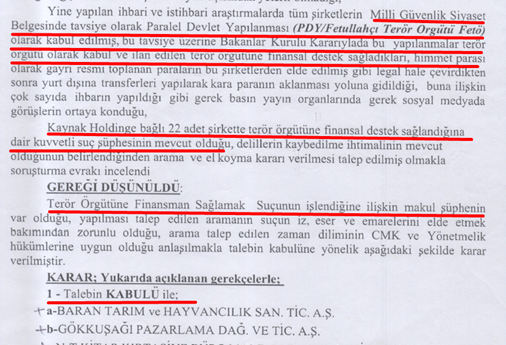
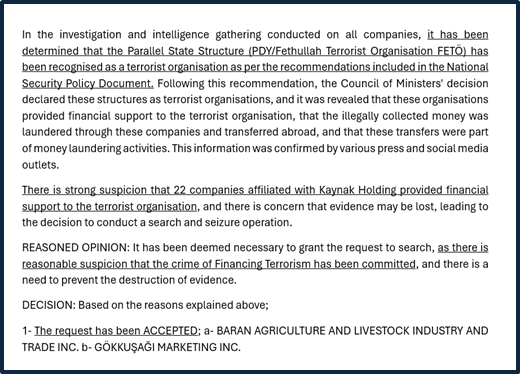
As seen in this decision, the Criminal Judgeships of Peace, which were established by the Erdoğan government in 2014 with the laws enacted by the parliament in order to fight against the Gülen movement, took decisions in the direction desired by the Erdoğan government, not in accordance with the Constitution and universal rules of law. As seen in this example, although there is no final judicial decision on the Gülen movement, the Gülen movement was defined as a terrorist organisation in the court decision only because the National Security Council convened under the chairmanship of Erdoğan made a recommendation.
Unofficial translation of the Istanbul Anatolian 9th Criminal Judgeship of Peace decision above
- On the grounds that they were linked to the Gülen movement, which has become a target of the Erdoğan government, Kaynak Holding and its affiliated companies were first subjected to tax inspections. Following the tax inspections, the company premises were searched on 07/09/2015 due to the aforementioned decision on the grounds of “black money and tax evasion” allegations.
- These repressions, which were initiated against Kaynak Holding and in which different state institutions were involved, show that there is a planned and systematic policy against the Gülen movement. The most important stage of this repression policy is the appointment of trustees to the companies and thus the de facto seizure of the companies.
- In this framework, on 17 November 2015, the Istanbul Anatolian 10th Criminal Judgeship of Peace decided to appoint trustees to 17 companies, a foundation and an association, whose names are specified in the decision, with a single decision and a single justification. This decision was taken by a single judge named Ali Arslan Giritli.
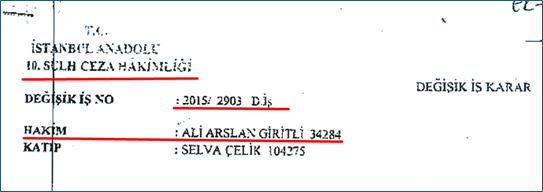

With the decision dated 17 November 2015, the commercial companies to which trustees were appointed are as follows:
- Kaynak Holding Inc.
- Sürat Insurance Brokerage Services Limited Company
- Kaynak Foreign Trade Inc.
- Sürat Tourism Organisation Services and Trade Inc.
- Nuans Tourism Promotion and Advertising Inc.
- Çağlayan Printing, Publishing, Distribution, Packaging Industry and Trade Inc.
- Işık Publishing Trade Inc.
- N-T Book Stationery Office Supplies. Marketing and Tourism Trade Inc.
- Sürat Education Tools and Office Furniture Systems Inc.
- Sürat Printing, Publishing, Advertising and Education Tools Industry Limited Company
- UTT Publishing and Education Supplies Trade Inc.
- Gökkuşağı Marketing Distribution and Trade Inc.
- Sürat Cargo Logistics and Distribution Services Inc.
- Sürat Logistics Inc.
- İtina Food and Nuans Tourism Promotion and Advertising Inc. Beverage and Cleaning Materials Industry Trade and Marketing Inc.
- Sürat Informatics Technologies Industry Trade and Marketing Inc.
- Baran Agriculture and Animal Husbandry Industry Trade Inc.
- Kaynak Foundation
- Kaynak Education Association
- The investigation report prepared by the police and the prosecutor’s office conducting an investigation against the Gülen movement was used as a justification for the decision to appoint a trustee. In the police investigation report, the Gülen movement was referred to as FETÖ- Fethullahist Terrorist Organisation, despite the fact that there was no final judicial decision and there was no terrorist organisation with this name, and it was claimed that the activities of Kaynak Holding were providing financial support to the FETÖ terrorist organisation.
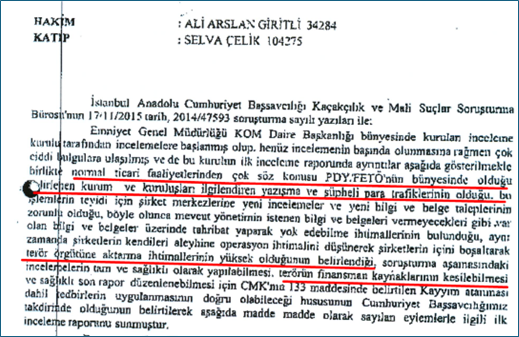
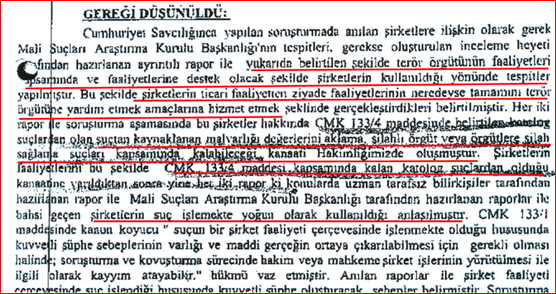
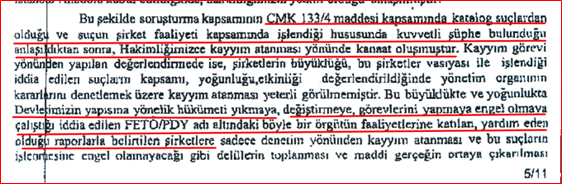
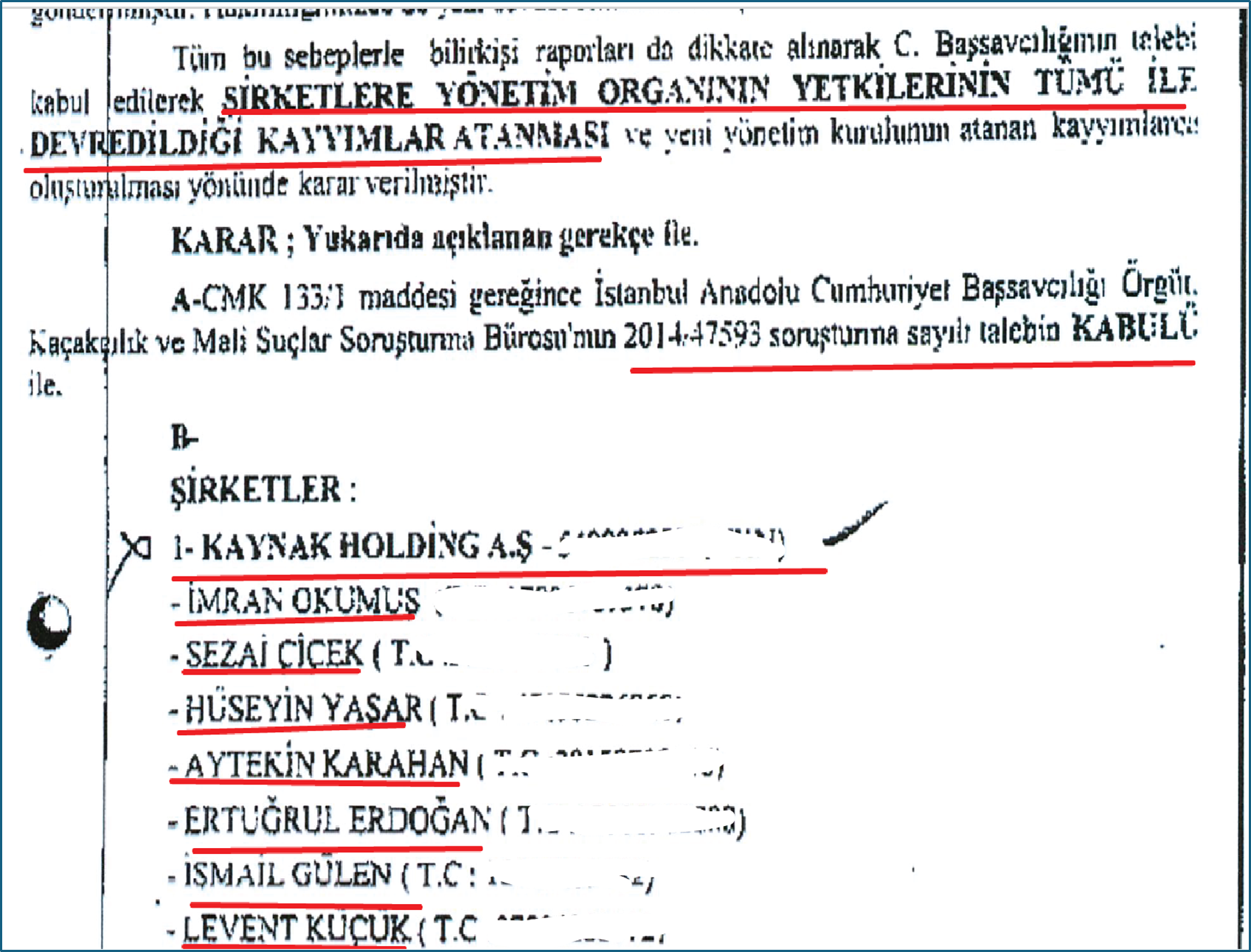
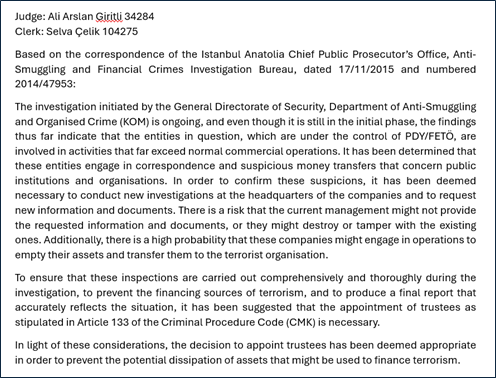

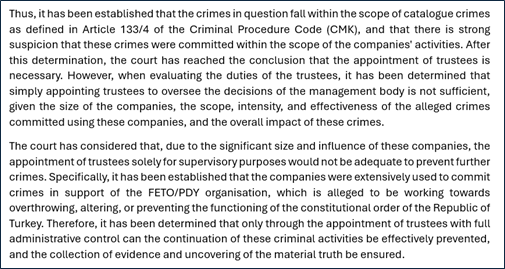
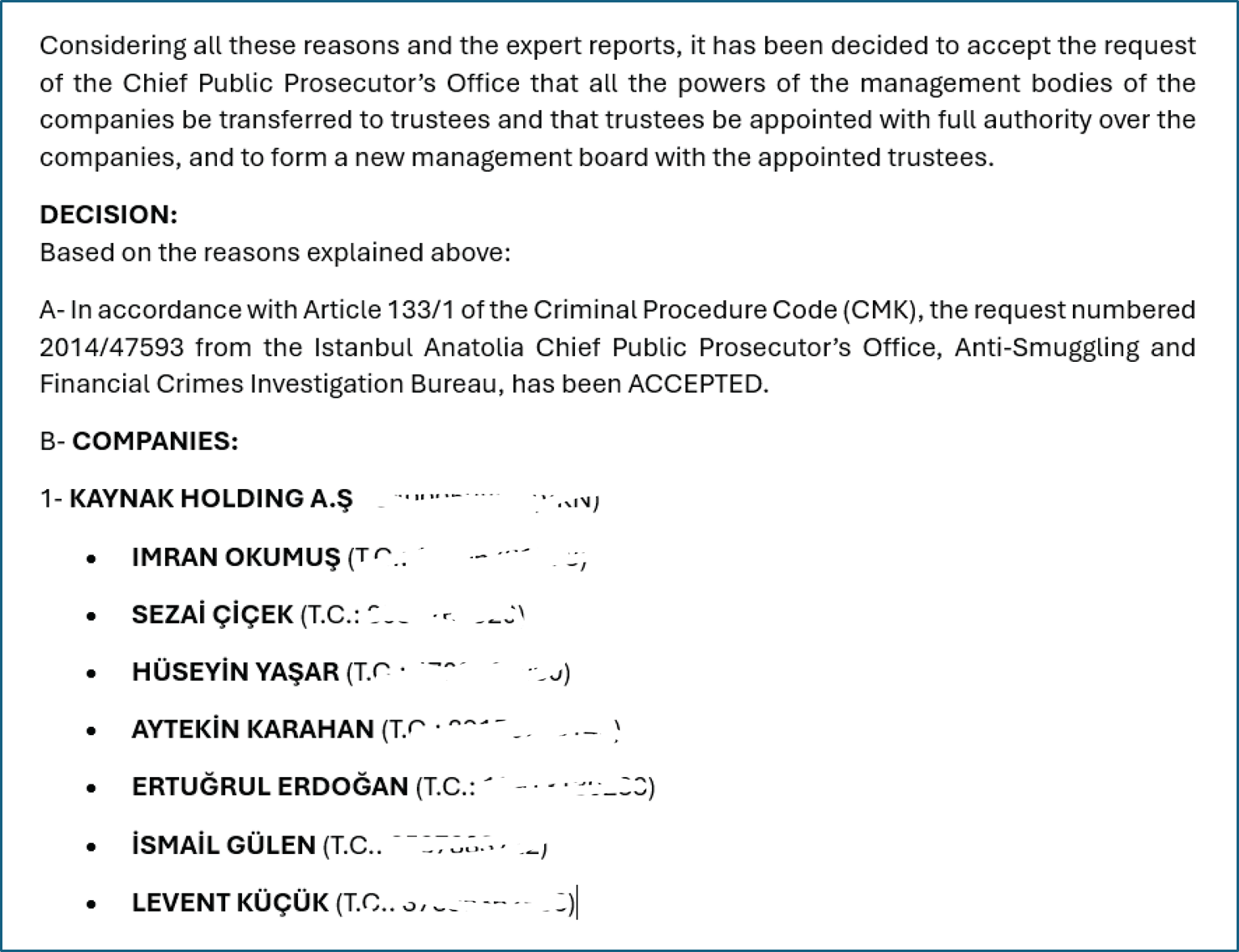
Unofficial translation of an excerpt from Criminal Judge of Peace Ali Arslan Giritli’s decision above
- The Criminal Judgeship of Peace has decided to appoint a trustee for 19 legal entities; however, the said decision was issued without indicating which legal entity (company) was accused of which offence and which evidence related to which company. In the single justification for 19 legal entities, in summary, the following common evidence was relied upon: “during the examination of the company computers, a list named “prayer list” was found, a list named “Trabzon 2012 graduates” was found, company employees constantly mentioned Fetullah Gülen and Gülen asked for prayers from company employees, employees used the words “Hizmet” and “Hocaefendi” together, a senior employee of the company sent an e-mail to a person working at Samanyolu TV using a code name, In one e-mail, it was mentioned that FEM Tutoring Centre students would be placed in jobs; in another e-mail, there was a list of 100 people who were planned to be placed in jobs; in a video examined, it was stated that a school in Kosovo or Albania was built with the support of the Germans; in an e-mail, there was information about the transaction of another company official sending money to a Kaynak Holding employee; in an Excel file titled “seminar (15 November)”, the people in the file were noted as “attending / not attending the religious conversation”, An e-mail content was found regarding the removal of some authors’ books from the shelves of NT stores, an e-mail content contained letters and bank receipts regarding a donation to the Wisdom School Foundation operating in England, upon the request of an overseas audit firm, it was requested to confirm that the amount of 3 000 000 pounds made to the said foundation was not a “debt” but a “donation”, some e-mail contents and an excel file were found, It is understood that Kaynak Holding and its group companies regularly made donations to two universities and the above-mentioned foundations, some company employees sent Fetullah Gülen’s videos, writings and statements to each other via e-mail, some of the controlling shareholders of the companies went abroad after the operation known as the 17-25 December coup attempt, they tried to transfer Kaynak Holding Inc. to a company established abroad and the shareholders of both companies are the same”.
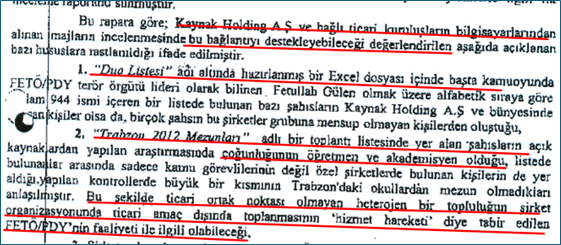
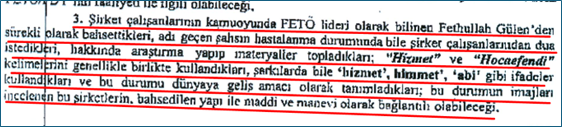
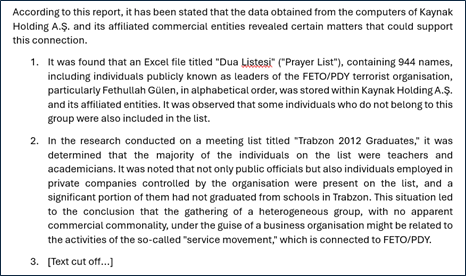

Unofficial translation of an excerpt from the Criminal Judgeship of Peace decision
to appoint a trustee for 19 legal entities
- As a result, a management trustee was appointed pursuant to Article 133/1 of the Code of Criminal Procedure in order to prevent the destruction of evidence and to prevent the continuation of the commission of crimes by stating that “the companies in question were used to provide financial resources to Gülen Schools and organisations (operating legally) in Turkey and abroad” and that Kaynak Holding and its affiliated companies provided financing for the terrorist organisation and made propaganda for the terrorist organisation .
- Although the judge justified his decision on the grounds that “MASAK reports show that the aforementioned companies have been used extensively in committing offences and that the existence of many money laundering activities has been determined“, this justification is completely untrue. Indeed, the MASAK Report states that “although the financial resources coming from abroad or going abroad appear to be legal, the content of these resources cannot be determined“. In none of the reports prepared by MASAK and the General Directorate of Security, there is no finding that the seized companies laundered money. Moreover, the judge’s decision was not based on the offence of money laundering, but on the offences of financing and propaganda.
- The lawyer of the company executives objected to this decision on 25 November 2015. The following points were included in the petition of objection. Istanbul Anatolian 10th Criminal Judgeship of Peace rejected the objection with an unjustified decision stating that “the objection is rejected since it is seen that the relevant companies provide financing for FETÖ/PDY”. On 7 January 2016, an individual application was filed to the Constitutional Court (Application No: 2016/297). However, no favourable decision was received from the Constitutional Court regarding the lifting of the trustee decision.
- When the aforementioned decision is analysed, it is stated that the decision to appoint a trustee is clearly contrary to Article 133 of the Code of Criminal Procedure. Article 133 of the Code of Criminal Procedure, the conditions for the appointment of a trustee were not met, the MASAK and Police Reports relied on in the decision of the judgeship made the opposite determinations regarding the crime of money laundering(clear arbitrariness in the evaluation of evidence), no concrete evidence was presented and shown separately for each company showing that none of the catalogue crimes continued to be committed within the framework of company activities, The evidence relied upon is irrelevant and even ridiculous in terms of the crime charged, the crimes of terrorist financing and terrorist propaganda are not among the catalogue crimes, there is no identified terrorist organisation named FETÖ/PDY(as of the date of the incident), the strong suspicion condition is not met and a trustee cannot be appointed for the purpose of destroying evidence and preventing the commission of a crime in accordance with Article 133 of the Code of Criminal Procedure. 133 of the Code of Criminal Procedure, a trustee cannot be appointed for the purpose of destroying evidence and preventing the commission of a crime, the decision violates the principle of proportionality and Articles 13, 16, 35, 38/9, 48 of the Constitution and especially Article 1 of the ECHR Additional Protocol No. 1.
- Article 133/4 of the Code of Criminal Procedure stipulates the offences for which the measure of appointing a trustee for the management of the company can be applied. In this respect, the appointment of a trustee for the management of the company cannot be applied for an offence that is not included in Article 133/4 of the Code of Criminal Procedure. Approximately 2 years after the decision to appoint a trustee, on 04.2016, a seventh paragraph was added to Article 4 titled “the offence of financing terrorism” in the Law No. 6415 on the Prevention of Financing of Terrorism with Article 29 of the Law No. 6704 [52], and it was regulated that the provisions regarding the appointment of a trustee for the management of the company pursuant to Article 133 of the Code of Criminal Procedure can be applied in terms of the offence of financing terrorism. Therefore, it is not possible to apply the measure of appointment of a trustee for the crime of financing terrorism, although it was not among the catalogue crimes under Article 133/4 of the CPC in November 2015.
- In the concrete case, there are no conditions for the appointment of a trustee:
In criminal law, the measure of “appointing a trustee” is regulated under Article 133 of the Code of Criminal Procedure, and since this measure is a direct interference with fundamental rights and freedoms, it is subject to very strict conditions unlike simple confiscation. According to Article 133 of the Code of Criminal Procedure, “In the event that there are strong grounds for suspicion that the offence is being committed within the framework of the activities of a company and it is necessary to reveal the material truth, the judge or court may appoint a trustee for the conduct of the company’s affairs during the investigation and prosecution process.” In the decision to appoint a trustee to Kaynak Holding, concrete evidence to support this has not been presented.
- In the concrete case, there is none of the catalogue offences:
The protection measure of appointing a trustee is limited to certain crimes and can only be applied in relation to the catalogue crimes listed in Article 133/4 of the Code of Criminal Procedure. It is not possible to apply this measure for acts other than those specified in the Code of Criminal Procedure. It is not possible to appoint a trustee to the company management in connection with a crime that is not included in the catalogue. In the decision of the Criminal Judge of Peace, after referring to the report of the investigation board established within the General Directorate of Security KOM Department and the MASAK report, it is stated as follows “In view of all these facts, Kaynak Holding, its affiliated companies, associations and foundations provide financing for the terrorist organisation and make propaganda for the terrorist organisation” (page 4).”


In other words, the judge’s decision was made on the basis of these two reports and the statements in these reports were accepted within the scope of the catalogue crimes specified in Article 133/4-a-7 “Laundering the proceeds of crime” (Article 282) and Article 133/4-a-8 “Armed organisation (Article 314) or providing arms to such organisations (Article 315)” of the Criminal Procedure Code.
The decision based on these two reports is completely unfair and unlawful. Because it is obvious that the events in the reports are not/cannot be within the scope of “laundering assets derived from crime” and “armed organisation or providing arms to these organisations”. When the allegations in the said reports are analysed one by one, we see the following:
The following items are included in the report of the investigation board established within the KOM Department of the General Directorate of Security (included on pages 1 and 2 of the judgement):
“1- An excel file prepared under the name “Prayer List”,
2- “Trabzon 2012 Graduates” list
3- Employees of the company constantly mentioned Fethullah Gülen and the aforementioned person asked for prayers from the employees even in case of illness”,
4- “Code names (G) and (B) were used in some e-mails”,
5- In an e-mail, there was a mention of the placement activity of FEM tutoring centre students for employment,
6- In one video, a person mentioned that a school, which was thought to be in Albania or Kosovo, was built with the efforts and patronage of the Germans,
7- An official of another company not belonging to Kaynak Holding Inc. sent money to Sedat Koçar, an employee of Kaynak Holding, with the instruction of a person from Turkmenistan,
8- An Excel file named Seminar 15 November,
9- E-mail regarding the removal of some authors from the NT book and stationery store sales list,
10- In some e-mails, a decision was taken to donate money to the Wisdom School Foundation operating in London and receipts showing that the money was transferred,
11- According to some e-mail contents, donations were made regularly every month by Kaynak Holding and its group companies to some organisations operating in Turkey and abroad (Şifa University, Turgut Özal University, Wisdom School)
12- It is seen and considered that there are differentiated data within the scope of Social Security Institution and Tax legislation…”
In the judgement of the judgeship, the findings in the report of the investigation committee established within the KOM Department of the General Directorate of Security are shown as these. Even if these findings are accepted as completely correct and appropriate, the events listed above are not related to the crimes of “laundering the proceeds of crime” and “armed organisation or providing arms to such organisations”, and these findings do not even violate any article of the Turkish Penal Code.
- In this report, there is no finding, let alone a serious allegation, that any of the companies to which trustees have been appointed are engaged in armed organisation activities or supply arms to terrorist organisations. It is a completely abstract allegation that “the companies carry out almost all of their activities for the purpose of aiding terrorist organisations rather than commercial activities”. Which of the 19 companies named in the decision has aided which terrorist organisation and how? How was money transferred to the terrorist organisation and how was it aided? All accounts of the company, all books, all images taken from the computer are in the file. But where is the evidence that will form the basis for the decision? These issues have not been evaluated in the judgement in any way and not a single explanation and concrete evidence has been presented. It should also be noted that aiding a terrorist organisation is not one of the catalogue crimes. What is a catalogue crime is “armed organisation or providing arms to such organisations”.
- The terrorist organisation that is sought to be linked to the companies is completely imaginary.
There is no final judicial decision on the existence of a terrorist organisation called PDY/FETÖ. Therefore, the inclusion of a fictitious organisation allegation in the prosecutor’s request does not make any legal sense. However, the judge should decide according to the evidence in the file. It must show the evidence of the existence of the conditions requiring the appointment of a trustee.
- The Analysis Report issued by MASAK is included on pages 2 to 4 of the Judge’s decision. In this section, which consists of 14 items in total and is presented as “Data determined by MASAK”, there is not a single determination regarding the catalogue offence of “laundering assets derived from crime”.
The decision does not provide any evidence as to what the assets arising from the offence consist of, from which predecessor offences they were obtained and by what means. However, the offence under Article 282 of the Turkish Penal Code cannot be mentioned without identifying the predecessor offences. “In order for there to be an asset value that can be considered within the scope of the offence in question, it must first be derived from a prior offence. …Since the laundering offence is based on the asset values obtained from the predicate offence and since the laundering acts must be carried out on these values, it is important whether the predicate offence has occurred with all its elements” [53]. However, the judge’s decision does not indicate a single predicate offence that constitutes an offence both in Turkey and abroad.
- Which of the 19 companies to which a trustee has been appointed has laundered “assets derived from an offence”? Where is the document/evidence for this? There is no evidence other than abstract allegations, and in the MASAK report itself, it is stated in Article 5 (page 3 in the decision) that ” Although the financial resources coming from abroad or going abroad have a legal appearance, the content of these resources cannot be determined”. Therefore, the statement in the Judge’s decision (p. 5) that “the companies mentioned in the reports prepared by the Financial Crimes Investigation Board were used extensively in committing offences” is a completely abstract allegation.
However, a judge cannot make a decision based on abstract allegations. The judge can decide according to the existence of strong grounds of suspicion in the file. There is no finding in the report of Combating Smuggling and Organised Crime (KOM) that armed organisation activities were carried out or weapons were provided to armed organisations, and there is no finding in the MASAK report that any of the companies to which trustees were appointed “laundered an asset value arising from a crime”. The appointment decision made without determining and demonstrating the existence of strong grounds for suspicion is clearly unlawful.
- No Reasons for Strong Suspicion in Concrete Case
The Code of Criminal Procedure system includes ‘Simple Doubt/Initial Suspicion’ (Art. 160), ‘Reasonable Doubt’ (Art. 116), ‘Sufficient Doubt’ (Art. 170/2) and ‘Strong Doubt’ (Art. 100, 133, 135).
In order for a trustee to be appointed to a company, there must be strong grounds of suspicion that at least one of the offences listed in Article 133/4 of the Code of Criminal Procedure is being committed within the framework of the company’s activities, in other words, strong grounds of suspicion must be established. Strong criminal suspicion must exist both that one of the catalogue crimes has been committed and that this crime has been committed within the framework of the company’s activities. In the Article, a suspicion that is not based on concrete evidence and is only a speculation is not deemed sufficient to apply the measure in question. In order for a trustee to be appointed to the management of a company, there must be ‘strong grounds of suspicion’ that the offence in question has been committed within the scope of the company’s activities [54].
Strong suspicion is the suspicion that an offence has been committed, which has reached a certain intensity and is based on concrete facts. Strong suspicion must be based on concrete facts, not abstract speculations and impressions. In the decision subject to objection, the existence of any reason for suspicion that a) one of the catalogue crimes has been committed b) within the framework of the company’s activities has not been revealed. Let alone ‘strong grounds of suspicion’, even the existence of ‘simple suspicion’ has not been demonstrated. The concrete facts and their bases have not been written in the decision.
- In the concrete case, there is no catalogue crime committed within the framework of company activity
For the appointment of a trustee, it is not sufficient to have a strong criminal suspicion that one of the types of crimes listed in the catalogue is being committed, but these crimes must also be committed within the framework of the company’s activity. Offences committed by one of the shareholders of the company are not accepted within the framework of company activity. As can be seen, what is meant by the term ‘offence within the framework of company activity’ is not individual offences committed by company partners or company employees.
What is in question here is establishing shell companies for the purpose of committing offences and committing criminal offences behind these shell companies. For example, a tourism company is established ostensibly for the purpose of tourism, but the real aim is to smuggle migrants. However, the official authorities are misled by giving the appearance of a legal tourism activity to the outside world. A transport company is established ostensibly, but the real purpose is drug trafficking…. In these cases, the company’s earnings are actually obtained not from the legal activities specified in its statute, but from illegal activities. Since the company does not actually carry out the activities specified in its statute, it either appears to be making a loss or a balance is established with invoices that are not based on real purchases, so-called fraudulent invoices.
As seen in the examples, if a company is established to commit catalogue crimes and this company acts as a tool in committing crimes, it can be said that a crime is committed within the framework of the company’s activities. However, the companies to which trustees are appointed are not shell companies established for the purpose of committing offences. Kaynak Holding and its affiliated companies, on the other hand, were companies with over 8,000 employees and 100 brands active in 16 different sectors, serving the whole of Turkey and having commercial activities with more than 100 countries. All companies within the Holding are the most prominent companies in their respective sectors. All of their activities are well-known and famous in the public opinion. In addition to the above examples, all of the other companies for which a decision to appoint a trustee has been made are among the most taxpaying companies in Turkey, each of which has been fulfilling the activities written in their statutes for many years, providing services under completely legal conditions, each of which is leading in their own sectors. None of them are fronts, all of them are reputable companies in Turkey and abroad. None of them were established to commit offences, and although they have been in service for many years, none of them has been found to have committed an offence within the framework of the company’s activities.
Another example is Işık Publishing Inc. which has published hundreds of books in many literary, historical, religious and philosophical fields and readers from all segments of society have purchased millions of copies of these books to date. Founded in 2005 and continuing its activities for 10 years, Işık Publishing Inc. has not been found or even alleged to have committed any of the catalogue crimes within the framework of the company’s activities. The judge’s decision does not mention the slightest event or fact, let alone a strong suspicion of a criminal offence (which does not exist).
- As a matter of fact, in the concrete case, no offence committed ‘within the scope of the company’s activity’ was shown in the judge’s decision. All of the events shown in the decision within the scope of the offence ‘within the framework of company activity’ are individual events that are not ‘within the scope of company activity’. For example, it is mentioned that a ‘prayer list’ containing 944 names was found in the ‘examination of the images taken from the computers of Kaynak Holding and affiliated commercial organisations’, and this was cited as a justification for the decision to ‘appoint a trustee’ (page 1).


A ‘prayer list’ can only be a spiritual and individual event. It is legally unacceptable to claim that praying to the people whose names are written on a list is ‘within the scope of company activity’. Moreover, there is no such offence type in the Turkish Penal Code. Even if such an offence type is created, it is still not possible to appoint a trustee to the company since this situation is not included in the catalogue crimes in Article 133/4 of the Criminal Procedure Code. In the concrete case, it is not possible to appoint a trustee for 19 companies based on abstract evidence and forced interpretations that do not even specify which person or which company’s computer was used -as in the case of the ‘prayer list’ example-. Therefore, it is flagrantly and completely unlawful for the Criminal Judgeship of Peace to appoint a trustee for 19 companies with a wholesale approach, without indicating which catalogue offence continues to be committed within the framework of which company’s activities and what the concrete evidence of this consists of, separately for each company in its decision.
- For the appointment of a trustee, a catalogue crime must continue to be committed within the framework of the company’s activities. In order to apply for the appointment of a trustee to a company, there must be an offence that is still being committed within the framework of the company’s activities. The appointment of a trustee can only be applied if there are strong grounds of suspicion that one of the offences listed in Article 133/4 of the Code of Criminal Procedure continues to be committed. In this respect, this measure cannot be applied for an act or offence that has already been committed [55]. In the decision subject to objection, there is no determination or even a concrete allegation that one of the catalogue crimes continues to be committed within the framework of the company’s activities.
- There should be no other purpose for the appointment of a trustee other than the purpose of revealing the material truth.
In the concrete case, the conditions of ‘being necessary to reveal the material reality’ are not present. The companies in question have been audited in every aspect by the board consisting of the Social Security Institution, MASAK and Tax Audit experts for approximately 2 years, and all kinds of documents are already available in the auditing institutions. The investigation file requesting a decision to appoint a trustee has also been open for approximately two years, and search and seizure procedures have been carried out twice within the scope of the file, and within this framework, all computers in the companies have been imaged and physical documents have also been seized, all kinds of evidence regarding the allegations in the investigation file have been collected and it is not possible to black out the evidence after this stage.
As a matter of fact, the statement on page 2 of the decision of the Criminal Judgeship of Peace that ‘…approximately 220-230 TB of digital data, all commercial books and documents obtained in total from the aforementioned Kaynak Holding and its affiliated companies…’ clearly reveals that this situation is also accepted by the Judgeship. In the decision of the Judgeship, it is stated that these documents continue to be analysed.
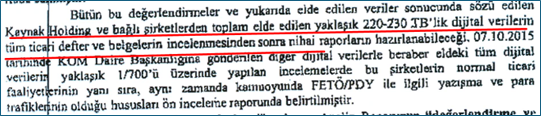
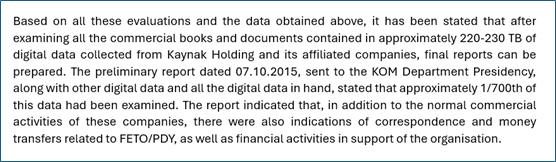
In other words, the information and documents necessary to reach the material reality have been collected and preserved, and the material reality continues to be investigated. At this stage, the appointment of management trustees to the companies by going beyond the purpose of revealing the material reality is clearly against the law.
- In the concrete case, the principle of proportionality was not complied with
According to Article 13 of the Constitution, limitations on fundamental rights and freedoms cannot be contrary to the principle of proportionality. A measure interfering with the right to inviolability of property must be necessary in a democratic society in order to achieve a legitimate aim. This measure must observe a fair balance between the requirements of the general interest of society and the requirements of the fundamental rights of individuals [56].
A decision that directly concerns 19 companies and the life and future of more than eight thousand people working in these companies should be far from arbitrariness. Therefore, as Prof. Dr. Caner Yenidünya emphasises, the principle of ‘proportionality’ is of great importance: ‘The appointment of a trustee for the management of a company, as a protection measure, is required to comply with a number of principles such as apparent justification, proportionality, temporariness and instrumentality. Of course, first and foremost, this protection measure, which imposes an important restriction on the right to property for our citizens, must be applied ‘in accordance with the legal limits’ stipulated in the law. Otherwise, apart from the illegality of the decision, it is undoubtedly a completely arbitrary procedure that removes the guarantee of the law [57].’
If it is possible to obtain evidence by less restricting rights and freedoms without suspending fundamental rights and freedoms such as the right to property and freedom of the press, the appointment of a trustee should not be resorted to in the concrete case.’ [58]
In the concrete case, it is unnecessary to restrict rights and freedoms in order to obtain evidence. It is possible to achieve the same purpose with protection measures that will restrict fundamental rights and freedoms much less. It is possible to resort to other measures before appointing a trustee, and all digital and physical records have already been seized by using that opportunity. There is no longer any question of collecting the evidence necessary for the discovery of the material truth over and over again. In this case, it is in accordance with the principle of proportionality to be satisfied with the examination of the records. In the decision regarding the appointment of a trustee, it is understood that the protection measure is disproportionate. Because, firstly, the books and records of the companies should have been examined. No justification has been provided as to why the books and records were not examined and the management of the companies was seized by a trustee.
Although we believe that there are no conditions for the appointment of a supervisory trustee, in the concrete case, no justification in accordance with the principle of proportionality has been shown as to why the management of the companies has been transferred to the trustee instead of the appointment of an ‘approving trustee’, which restricts rights and freedoms less. However, it is inconceivable that 19 companies operating in tens of sectors, consisting of a gigantic structure with over 8000 employees, hundreds of branches and stores throughout Turkey and operating in tens of sectors, can be managed by seven people who do not know the companies at all. Therefore, the principle of proportionality was clearly violated in the Judge’s decision. In the judge’s decision, it is justified that ‘the appointment of a supervisory trustee would be insufficient for the collection of evidence’. However, neither the ‘’managing trustee ‘’ nor the ‘’supervisory trustee ‘’ has the duty and authority to collect evidence. Prof. Dr. Sami Selçuk has clearly demonstrated the fallacy of this justification: ‘It should not be forgotten that trustees must be impartial. Therefore, the trustee must not have any relationship with the prosecution and defence. It should also be noted that a trustee is not a ‘secret investigator’ (Art. 139). Therefore, the trustee has – or can have- no duty to investigate and collect evidence.’
- The persons appointed as trustees do not have the qualifications of a trustee
Publishing activities in 16 different sectors within Kaynak Holding (Kaynak Culture Publishing Group, Zambak School Publishing Group, Sürat Exams Preparation Publishing Group, Kaynak Copyright Agency); Retail activities (NT Stores); Distribution activities (Gökkuşağı); Printing activities (Çağlayan Print House); Paper activities (Kaynak Paper); Media activities (Kaynak Media); IT activities (Sürat Technology); Educational Tools activities (Sürat Education Tools); Tourism activities (Nüanstur and Sürattur); Cargo activities (Sürat Cargo); Logistics activities (Sürat Logistics) Food activities (İtina Wholesale Food and İtina Meat and Dairy Stores)… It is carried out with more than 8000 personnel in different provinces and districts of Turkey.
How will trustees with the qualifications and equipment to manage services in such different sectors be found for companies managed by hundreds of professional managers, directors and supervisors with different qualifications? In other words, with what qualifications will trustees who do not know the companies at all and have no experience in the sectors in question manage this gigantic structure? Previously, trustees appointed to other companies immediately terminated the employment contracts of top managers and many experienced and trained personnel [59]. In this case, companies will become unmanageable, brand values will be destroyed, and companies will incur more and more losses. At this point, the personalities of the trustees and their perceptions in the society are also of great importance. Considering the issue from this point of view, it is seen that trustees İmran Okumuş and Aytekin Karahan have negative images in the public opinion; they are associated with offences such as bribery, corruption and bid rigging:
Imran Okumuş, one of the trustees, was photographed in the press with Babek Zanjani, who is imprisoned in Iran on corruption charges and is facing the death penalty [60]. Zanjani is known in Turkey as the partner of Reza Sarraf, whose name is associated with bribery and corruption scandals [61].
The name of one of the trustees, Aytekin Karahan, had previously come to the fore with a tender rigging operation [62]. Why were people with a reputation for corruption appointed as trustees when it was possible to appoint a reliable trustee? It is not possible to explain the appointment of trustees whose names are associated with offences such as bribery, corruption and bid rigging. The judge or the court must determine that the trustee appointed by the judge or the court has the knowledge and capacity to supervise or manage the company [63]. In the event that doubts arise about the trustee’s reliability afterwards, he/she must be replaced immediately.
- In the concrete case, how and according to which methods did the judge determine the knowledge, competence, objectivity and reliability of the trustees? There are no criteria in the decision of the Judgeship regarding the qualifications of the 7 trustees, their areas of expertise, their experience in which sector, and the criteria by which they were appointed. For example, was the trustee Sezai Çiçek, a lawyer, selected by lot among the lawyers of the Istanbul Bar Association, which has more than 50,000 members? Or has he managed companies where thousands of people have worked so far, which is incompatible with the profession of lawyer?
- – In addition, ‘the appointed trustee must be impartial and must not have characteristics that may lead him to make acts that may impair his impartiality during the supervision and administration of the company. The judge or the court should not appoint a person as a trustee if it is understood that he cannot act impartially due to his relationship or enmity with the company, or should not decide to replace the trustee when this situation is detected.’ [64]
- However, when we look at the twitter account of Sezai Çiçek, one of the trustees, it is seen that he has been posting messages in favour of the Erdoğan government and AKP for a long time. As a matter of fact, his wife is a member of Başakşehir and Metropolitan Municipality Council from the ruling party. Is it hard not to agree with these allegations in the face of the evaluations on the decision to appoint trustees from the CHP chairman to the MHP MPs, of which we have given a few examples above? Why, when it is possible to appoint impartial trustees, only people who are supporters of a certain political party have been appointed as trustees to justify these allegations? The trustee Sezai Çiçek must have realised this situation, as he immediately changed the name of his twitter account from ‘Hayriye/Sezai Çiçek @ortadoğuhukuk’ to ‘Hayriye Çiçek @ortadoğuhukuk’ after being appointed as a trustee.

Extract from trustee Sezai Çiçek’s X profile
Other trustees can also be found to be biased with a little research. Therefore, the appointment of trustees to the companies owned by people who they see as opponents of their own political views will affect their impartiality. Therefore, these trustees should be dismissed and impartial trustees should be appointed who do not give the impression that they have been specially selected from people who are all in favour of the same political view. Therefore, it is clear that these persons do not meet the conditions for the appointment of a trustee.
- Immediately after the decision to appoint trustees, the appointed trustees firstly ordered that book authored by Fetullah Gülen be confiscated from NT Stores, thus preventing the sale of these books and causing losses to a seized company. Secondly, they also instructed the company printing the books authored by Gülen to stop the printing of the books in question, thereby causing losses to the seized printing company. Thirdly, after the appointment of the trustees, they terminated the employment contracts of dozens of employees without payment of severance and notice pay, and on 26 November 2015, they made the general managers of all the companies to which trustees were appointed resign. On 20 December 2015, they gave instructions to terminate the editorial independence of the magazine ‘Sızıntı’, which was published by a company to which a trustee was appointed. Thus, the editorial policy of a magazine with more than 600,000 monthly customers, which had previously published 443 issues, was completely changed, all customers abandoned the magazine, and the company suffered losses and was brought to the bankruptcy stage. None of these practices have anything to do with ‘obtaining evidence of crime and revealing the material truth’, which is the purpose of appointing a trustee. These practices clearly show that the main purpose of the appointment of trustees is to seize the companies in question without compensation and to prevent the free dissemination of dissenting views in society (ECtHR Art. 10).
- Following the appointment of a trustee to Kaynak Holding by the Criminal Judgeship of Peace in November 2015, the criminal case was heard at Istanbul 33rd Heavy Criminal Court. With its decision dated 03.07.2023, Istanbul 33rd Heavy Criminal Court ruled for the confiscation of Kaynak Holding and 25 affiliated companies pursuant to Article 54/1 of the Turkish Penal Code. This decision was also approved by the Court of Appeal. The file is pending at the Criminal Chamber of the Court of Cassation for the final decision. When this process is taken into consideration, it is seen that Kaynak Holding and the companies within its structure have been de facto taken from the ownership of its shareholders and owners for about 10 years, seized by the Turkish state without compensation, the objections made have no equivalent in the legal order, and the practice of appointing trustees to companies regulated by Article 133 of the Criminal Procedure Code has been transformed into a weapon used against those who oppose the Erdoğan government.
CONCLUSIONS AND RECOMMENDATIONS
The appointment of trustees to thousands of companies in Turkey for alleged links to the Gülen movement has caused serious legal, economic and social problems. This report comprehensively analyses the legal basis, economic impact and social repercussions of trustee appointments. The findings show that trustee appointments are often politically motivated and violate fundamental principles such as the rule of law and property rights.
Trustee appointments have severely undermined the rule of law in Turkey. Justice cannot be achieved in an environment where legal processes are shaped by political interference, courts are unable to make independent judgements and fundamental principles of law are ignored. The trustee decisions taken by the courts were taken under political pressure and these decisions were contrary to national and international legal norms. This situation has undermined confidence in Turkey’s legal system and led to a violation of the right to a fair trial.
From an economic perspective, trustee appointments have negatively affected the financial performance of companies and threatened their economic sustainability. Companies under trustee administration lost their market value, fell into financial difficulties and many had to be closed down. This situation has adversely affected not only the company owners but also thousands of people working in these companies. It has led to an increase in the unemployment rate and deepened economic uncertainties.
From a societal perspective, the trustee appointments have raised serious concerns that property rights are not secure in society. Arbitrary violations of property rights have undermined the confidence of individuals and institutions in property rights and increased social polarisation. People’s fear that their property could be confiscated has led to social unrest and mistrust. This situation weakened the belief in the rule of law and justice in the society at large.
Internationally, the trustee appointments have seriously damaged Turkey’s image as a human rights and rule of law state. International human rights organisations and foreign governments have criticised the trusteeship practices in Turkey and this has had a negative impact on foreign investment in Turkey. Foreign investors hesitated to invest in a country where property rights were not protected, which had a negative impact on Turkey’s economic growth.
A number of legal reforms are needed to make the process of trustee appointments fairer and more lawful. Firstly, the legal regulations on trustee appointments should be brought in line with international legal norms. The purpose of these regulations is to protect fundamental human rights such as the right to property and to ensure the rule of law. The appointment of trustees in accordance with the principles of fair trial will strengthen the independence and impartiality of the judiciary. In this context, concrete steps should be taken to prevent arbitrary practices in legal proceedings and to secure property rights.
In terms of economic measures, improving the financial performance of companies under trusteeship is of utmost importance. Audit mechanisms based on the principles of transparency and accountability should be established. These mechanisms will help to ensure economic stability by making companies’ finances and operational processes more transparent. Moreover, policies that respect property rights should be adopted to restore investor confidence. Investors’ confidence that their investments are safe is critical for economic growth and sustainability.
Social measures should focus on securing property rights and ensuring the rule of law. These steps will increase social trust and reduce polarisation within society. The independent and impartial conduct of legal proceedings is essential to ensure justice and to reinforce public confidence in the rule of law. These measures are vital for the preservation of social peace and tranquillity.
This report aims to help develop policy recommendations by assessing the various dimensions of trustee appointments. Legal reforms, economic and social measures, and future research will provide a better understanding of the legal, economic and social dimensions of trustee appointments. These recommendations will contribute to taking the necessary measures to prevent similar failures in the future. The protection of fundamental principles such as the rule of law, the right to property and fair trial are indispensable elements of a democratic society and necessary steps should be taken to ensure that these values are not violated.
SOURCES
- Battal, Ahmeti, “Kayyum Denetimindeki Anonim Şirketin Yönetimi”, https://dergipark.org.tr/en/download/article-file/270562,
- Şen, Ersan., “Şirket Yönetimi İçin Kayyım Tayini”,“https://www.haber7.com/yazarlar/prof-dr-ersan-sen/1627842-sirket-yonetimi-icin-kayyim-tayini
- https://www.hurriyet.com.tr/ekonomi/yaniti-aranan-soru-nasil-kayyum-olurum-40016003
- https://www.aksam.com.tr/syaset/paralel-yarg-c2turkyey-btrr/haber-318147
- Venice Commission: Turkey, Opinion on the duties, competences and functioning of the criminal peace judgeshps, adopted by the Vence Commsson at ts 110th Plenary Sesson, Venice, 10-11 March, 2017, Paras. 71-72 and 106
- Council of Europe’s Commissioner for Human Rghts. Memorandum on freedom of expression and mead freedom in Turkey, February, 2017
- OHCHR, Report on the impact of the state of emergency on human rights n Turkey, including an update on the South-East, March, 2018, Para. 52
- International Commission of Jurists, The Turkish Criminal Peace Judgeships and International Law
- https://t24.com.tr/haber/samanyolu-tv-dizi-ve-program-cekimlerini-durdurdu,315401
- https://www.sabah.com.tr/gundem/2015/11/05/feto-100-gun-icinde-bitecek
- https://www.star.com.tr/yazar/zamana-kayyum-ve-yakinda-yasanacak-surec-yazi-1093552/
- https://www.bloomberght.com/haberler/haber/1626793-erdogan-bank-asyada-sorumlu-bddk-olur
- Vahay Munyar, https://www.ekonomim.com/kose-yazisi/kayyimdaki-1371-sirketin-643u-iade-edildi-tmsfnin-yonettikleri-146-milyar-lirayi-asti/754513
- https://www.aa.com.tr/tr/ekonomi/fetonun-hain-darbe-girisimi-sonrasi-tmsfye-devredilen-sirketlerin-aktifleri-yuzde-43-artti/1909703
- CHP, OHAL Bilançosu raporu, https://chp.org.tr/yayin/ohal-bilancosu-hak-ihlalleri-raporu/Open
- Vahap Munyar, https://www.ekonomim.com/kose-yazisi/kayyimdaki-1371-sirketin-643u-iade-edildi-tmsfnin-yonettikleri-146-milyar-lirayi-asti/754513
- https://www.tmsf.org.tr/tr/Tmsf/Kayyim/kayyim.veri
- https://www.aa.com.tr/tr/ekonomi/fetonun-hain-darbe-girisimi-sonrasi-tmsfye-devredilen-sirketlerin-aktifleri-yuzde-43-artti/1909703, Temmuz 2016 Dolar/TL kuru: 2.89
- Centel, Nur/Zafer, Hamide, Ceza Muhakemesi Hukuku, 12. Bası, İstanbul 2015., s.427.
- ŞEN, Ersan., “Şirket Yönetimi İçin Kayyım Tayini”,“https://www.haber7.com/yazarlar/prof-dr-ersan-sen/1627842-sirket-yonetimi-icin-kayyim-tayini
- Ersoy, Uğur, Bir Koruma Tedbiri Türü Olarak Şirket Yönetimi İçin Kayyım Tayini
- Yilmaz, Z. Sanem, Sermaye Şirketlerinde Geçici Hukuki Korumalar, İzmir 2004, s.142
- https://www.indyturk.com/node/39041/haber/thy-bas%C4%B1n-m%C3%BC%C5%9Faviri-40-%C5%9Firketin-y%C3%B6netim-kurulu-%C3%BCyeli%C4%9Finden-toplam-7-bin-tl-maa%C5%9F
- Ersoy, Uğur, Bir Koruma Tedbiri Türü Olarak Şirket Yönetimi İçin Kayyım Tayini (CMK M.133), https://dergipark.org.tr/tr/download/article-file/621823
- https://hudoc.echr.coe.int/tur#{%22itemid%22:[%22001-227636%22]}
- Selçuk, Sami., Onursal Yargıtay Başkanı, Bilkent Ünv. Huk. Fak. Ceza ve Ceza Muh. Huk. A.B.D. Öğr. Üyesi, “Varsayımla hüküm kurulamaz”, https://www.hukukihaber.net/gundem/varsayimla-hukum-kurulmaz-h30564.html, ;Yargıtay 16. C.D. 2015/4672 E. ve 2016/2330 K. Sayılı K. (Ergenekon Davası Kararı)
- Anayasa Mahkemesi’nin 03.06.1988 tarih, 1987/28 E. 1988/16 K. Sayılı kararı
- AYM Esas sayısı: 1987/28 Karar sayısı: 1988/16 Karar günü: 3.6.1988 R.G. Tarih-Sayı :20.08.1988-19905 Kararı
- Koca, Mahmut., “Türk Ceza Hukukunda Müsadere”, https://blog.lexpera.com.tr/turk-ceza-hukukunda-musadere/
- Gemalmaz, H.Burak., “Avrupa İnsan Hakları Sözleşmesi Açısından Mülkiyet Hakkının Sınırlanmasında “Adil Denge ” İlkesi”, https://dergipark.org.tr/en/download/article-file/97649
- Gemalmaz, H.Burak., Mülkiyet Hakki, Anayasa Mahkemesine Bireysel Başvuru El Kitapları Serisi – 6
- https://hudoc.echr.coe.int/eng?i=001-71299
- https://www.tr724.com/gasp-edilen-surat-kargo-10da-bir-fiyatina-peskes-cekiliyor/
- https://www.tmsf.org.tr/tr/Basin/List/surat-kargo-hakkinda-duyuru
- Yavuz, Mustafa, “Anonim Şirket Pay Sahiplerinin Mali ve Şahsi Haklar”, https://www.ozdogrular.com.tr/v1/fla-haberler-gizli-245/14562-anonim-irket-pay-sahiplerinin-mali-ve-ahsi-haklar-
- https://www.izettindemir.com/haber/ceza-muhakemesi-hukuku-kapsaminda-tmsf-nin-kayyim-olarak-atanmasi-musadere-ve-mulkiyet-hakki
- Anayasa Mahkemesi’ne göre kanun, genel hukuk kuralları koymalı, genel, soyut ve kişilik dışı olmalı, başka bir deyişle; genel, nesnel ve kişilik dışı hükümler içermelidir. (E. 1963-124, K. 1963/243, K.T.4.12.1963)
- https://yurtsever.org.tr/2024/9-yargi-paketi-tbmm-adalet-komisyonunda-kabul-edildi-531184/
- https://www.ttyatirimciiliskileri.com.tr/tr-tr/kurumsal-yonetim/sayfalar/ust-yonetim
- https://www.ilerihaber.org/icerik/koza39nin-basina-sabah39in-reklam-muduru-getirildi-24226.html
- https://www.hurriyet.com.tr/gundem/kozaya-kayyum-havuz-medyasindan-hudai-bal-ve-umit-onal-40006419
- https://t24.com.tr/haber/kayyum-atanan-aytekin-karahan-kamu-ihalelerine-fesat-suphelisi,317153
- https://www.patronlardunyasi.com/milyon-avroluk-zarar-boydak-holdingten-kotu-kokular-geliyor
- https://www.sozcu.com.tr/akp-vakiflarina-66-milyon-tl-aktaran-alpaslan-baki-ertekin-iktidar-degisirse-gorevi-birakirim-wp7658953
- https://www.tr724.com/isadami-kavurmacinin-sirketine-atanan-kayyim-25-yilda-devlete-45-milyon-tl-borc-takmis/
- https://t24.com.tr/haber/aynes-gida-ya-kayyim-atanan-akp-li-isim-kendi-kurdugu-sirkete-urunleri-dusuk-fiyattan-satmis,836848
- https://www.tr724.com/gasp-edilen-surat-kargo-10da-bir-fiyatina-peskes-cekiliyor/
- https://www.tmsf.org.tr/tr/Basin/List/surat-kargo-hakkinda-duyuru
- https://www.hurriyet.com.tr/yaniti-aranan-soru-nasil-kayyum-olurum-40016003
- https://www.hurriyet.com.tr/gundem/basbakan-erdogan-en-ahlaksiz-darbe-girisimi-25566536
- https://t24.com.tr/haber/erdogan-cadi-aviysa-biz-bu-cadi-avini-yapacagiz-bunu-da-bilin,258112
- https://www.resmigazete.gov.tr/eskiler/2016/04/20160426-11.htm
- Yılmaz, Dr. Sacit, Yargıtay Cumhuriyet Savcısı. “Suçtan Kaynaklanan Malvarlığı Değerlerini Aklama Suçu”, Ankara Barosu Dergisi, 2011/2, s. 79
- Öztürk, Bahri / Tezcan, Durmuş / Erdem, “Nazari ve Uygulamalı Ceza Muhakemesi Hukuku”, Seçkin Yayıncılık, Ankara 2013,
- Kunter, Nurullah / Yenisey, Feridun / Nuhoğlu, Ayşe, Muhakeme Hukuku Dalı Olarak Ceza Muhakemesi Hukuku, Beta Yayınevi, İstanbul 2010, s. 1129.
- https://www.yargitay.gov.tr/abproje/belge/kitaplar/AIHS_KapsamindaMulkiyetHakki.pdf
- Yenidünya, Ahmet Caner, “Şirket Yönetimi İçin Kayyım Tayini Koruma Tedbiri: Şartları ve Hukuka Uygunluğu”,
- Feyzioğlu, Prof. Dr. Metin, https://www.cumhuriyet.com.tr/haber/turkiye/398123/Haksizlik_haksizliktir.html#
- https://bianet.org/bianet/medya/168937-kayyum-ipek-medya-da-60-tan-fazla-kisiyi-isten-cikardi, https://www.aktifhaber.com/kayyim-kanalturk-ve-bugun-tvde-172-kisiyi-daha-cikardi-1262718h.htm, https://www.benguturk.com/ipek-koza-medya-grubu-nda-kayyum-kiyimi!_d14859.html
- https://www.hurriyet.com.tr/kaynak-holdinge-atanan-kayyumlardan-imran-okumusun-zencani-ile-fotografi-cikti-40015922
- https://www.gazetevatan.com/sarraf-in-iran-daki-patronu–reis–babek–594587-gundem/
- https://www.patronlardunyasi.com/haber/Kaynak-Holding-e-atanan-kayyum-KIK-davasinda-supheli-cikti/174530
- Şen, Ersan, “Şirket Yönetimi İçin Kayyım Tayini”, https://www.haber7.com/yazarlar/prof-dr-ersan-sen/1627842-sirket-yonetimi-icin-kayyim-tayini
- Şen, age.