


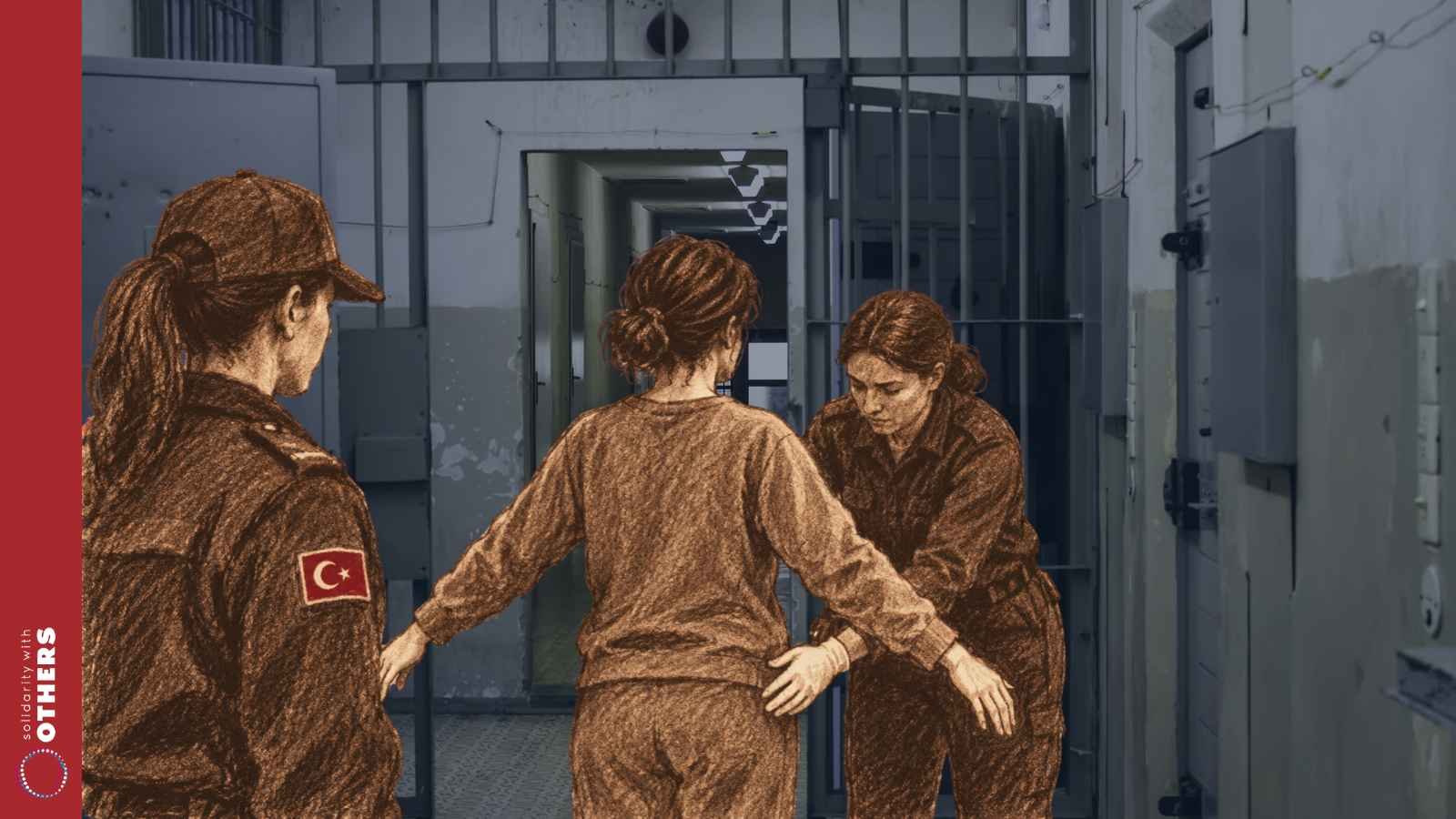
*This is the second article in a series examining the legal framework, political history, and gendered effects of strip searches in Türkiye.
On 12 November 2021, the term “strip search” was removed from Turkey’s prison regulation. It was replaced by “detailed search.” The amendment followed a year of public controversy, survivor accounts, parliamentary interventions, and official denials. It also introduced several safeguards: an intrusive search would be permitted only where the suspected item could not be detected by other means; the prisoner would receive a disposable gown; and the procedure would have to be documented (Türkiye, 2021).
The change was more than terminological. It narrowed the legal threshold and strengthened procedural protections. Yet it did not abolish compelled bodily exposure. The state revised the conditions and vocabulary under which it could continue.
The distinction matters because legal reform should be evaluated at three levels: the rule adopted, its implementation, and the system available to investigate alleged violations. Türkiye made some progress at the first level. The subsequent record shows persistent concerns at the other two.
What Changed in 2021?
Presidential Decision No. 4773 amended Article 34 of the Regulation on the Administration of Penitentiary Institutions. The previous text permitted a naked or body-cavity search where there were “reasonable and serious indications” that a prisoner possessed a prohibited object and the institution’s highest authority considered the procedure necessary. The revised provision added another condition: the suspected object must be impossible to detect by other means (Türkiye, 2021).
The amendment also replaced çıplak arama, or “strip search,” with detaylı arama, or “detailed search.” It required officials to protect the prisoner’s dignity and sense of modesty, provide a disposable gown, avoid unnecessary physical contact, and record the procedure. The searched person and participating officials were expected to sign the record; refusal to sign would also be documented (Bianet, 2021).
These safeguards correspond in part with the Nelson Mandela Rules. Intrusive searches should be exceptional, necessary, proportionate, private, and recorded. Alternatives must be considered first (United Nations General Assembly, 2015). The 2021 amendment therefore cannot be dismissed as a change of vocabulary alone.
Its limits are equally clear. The procedure still permits officials to require the removal of clothing. Its defining feature remains access to intimate areas of the body. A gown and staged removal may reduce the extent or duration of exposure, but they do not transform an intrusive search into an ordinary one.
The amendment also governs penal institutions. It does not resolve the separate legal basis for comparable practices in police custody. This distinction has remained central to later allegations.
The Politics of Renaming
Institutions routinely revise terminology when a contested practice becomes difficult to defend. Renaming may accompany genuine reform, but it can also narrow the terms of public scrutiny.
Daems (2014), examining strip searches in Belgian prisons, uses Stanley Cohen’s sociology of denial to distinguish literal denial, in which an institution says an event did not occur, from interpretive denial, in which the event is acknowledged but redescribed so that its harmful meaning is reduced. An institution may accept that clothing was removed while denying that the procedure was a strip search.
Türkiye’s official position during the UN Committee Against Torture review in July 2024 followed this interpretive pattern. The delegation stated that strip searches had been abandoned in 2021 and replaced by detailed searches. It described the new procedure as exceptional and stated that reasonable suspicion had to be documented (Office of the United Nations High Commissioner for Human Rights [OHCHR], 2024).
The claim can be accurate in a narrow regulatory sense: the expression “strip search” was removed. It remains incomplete as an account of the practice. If a detailed search entails removing or rearranging clothing to inspect intimate parts of the body, it continues to fall within the international definition of a strip search. Domestic terminology cannot determine the application of international human-rights standards.
This is also an evidentiary problem. The public cannot evaluate whether the revised safeguards are effective without access to data: how often detailed searches occur, what individualized grounds are recorded, which alternatives were attempted, what objects were recovered, and how many complaints led to disciplinary or criminal proceedings. An exceptional power becomes difficult to monitor when institutions do not publish the information needed to establish whether it remains exceptional.
Strasbourg and the Duty to Investigate
The European Court of Human Rights has repeatedly emphasized that the legality of an intrusive search depends on its necessity, manner, and context. It has also treated ineffective investigations as an independent human-rights concern.
The case of Elif Kaya emerged from the Gezi period. Kaya was detained in June 2013 and reported being strip-searched after entering prison. In 2022, the European Court found a violation of Article 8, protecting private life, and a procedural violation of Article 3 because the authorities had not effectively investigated her account (Stockholm Center for Freedom, 2022).
A broader study by the Human Rights Foundation of Türkiye examined 18 applications in which the European Court assessed strip-search practices between 2018 and 2022. It reported substantive or procedural Article 3 violations in 14 cases. The study highlighted three recurrent issues: failure to demonstrate necessity, deficiencies in forensic examination, and serious interference with physical, sexual, and psychological integrity. It concluded that states have a very narrow margin of appreciation when claiming that a strip search was necessary (Human Rights Foundation of Türkiye [HRFT], 2022).
These findings place the investigative process at the centre of the issue. A credible complaint requires prompt preservation of records and surveillance material, identification of participating officials, an independent medical and psychological assessment, and an inquiry institutionally separate from the unit implicated. An investigation limited to asking the relevant police or prison administration whether misconduct occurred cannot satisfy that standard.
From International Review Back to Parliament
By 2024, the political dispute that began with the Uşak allegations had not been resolved. It had become personalized around DEM Party member of parliament Ömer Faruk Gergerlioğlu and AKP parliamentary group deputy chair Özlem Zengin.
In December 2024, Gergerlioğlu again raised strip-search allegations in parliament, including claims concerning people detained after demonstrations in support of Palestine. Zengin responded with personal accusations, described his conduct as obsessive, and suggested that he required psychological treatment. The exchange interrupted the parliamentary session (Bianet, 2024).
In February 2025, reports stated that Zengin sought 750,000 Turkish lira in damages, alleging that Gergerlioğlu had defamed her and her party. The filing also reportedly requested the appointment of a guardian on the claim that his mental health was impaired (Gazete Duvar, 2025). No final judgment in that dispute was located in the sources reviewed for this article.
These developments show how a debate concerning detention safeguards can move away from institutional verification and towards the credibility, motives, or mental capacity of the person raising complaints. Spokes et al. (2022) describe a related phenomenon as institutional testimonial injustice: individuals who depend on an institution are required to navigate opaque rules of credibility, while the institution controls the standards by which their testimony will be accepted.
This framework should be applied carefully. A public authority is entitled to dispute inaccurate allegations and protect individual reputations. Yet an institutional response centred on the speaker’s character does not answer the underlying questions. Were intrusive searches conducted? On what grounds? Were they recorded? Were less intrusive alternatives attempted? Did independent investigators examine the allegations?
The Return of the Allegation in 2025 and 2026
Reports of new cases continued after the regulatory amendment. In September 2025, media outlets associated with the Gülen movement reported Gergerlioğlu’s allegation that approximately 20 young women, including university student Süeda Güngör, had been strip-searched upon admission to Şakran Women’s Prison (Bold Medya, 2025). This figure and the circumstances derive from advocacy reporting and parliamentary claims. No independent investigation or judicial finding confirming the allegation was located.
The source limitation should be stated without using political affiliation as a basis for automatic disbelief. Claims involving people accused of Gülen links often circulate through media serving that community because mainstream access is limited. Corroboration remains necessary, but source positionality applies to state denials as well as advocacy reports.
A later allegation reached a different political constituency. On 9 June 2026, Fatoş Pınar Türker, general manager of Istanbul municipality-owned Medya A.Ş. and a defendant in proceedings involving the Istanbul Metropolitan Municipality, told the court that she had been subjected to an intrusive search at Istanbul Police Headquarters on Vatan Avenue. She alleged that officers ordered her to expose her genital area, turn around, and bend over. She also described psychological pressure and threats involving her children (BBC News Türkçe, 2026; T24, 2026).
The location is legally important. Türker’s central allegation concerned police custody, not simply admission to prison. An earlier statement by the Bakırköy Chief Public Prosecutor’s Office had denied that she was strip-searched during admission to prison. That response did not resolve what allegedly occurred at the police headquarters.
Istanbul police denied unlawful conduct and maintained that the procedures complied with applicable rules. On 12 June, the Ministry of Interior announced an investigation and appointed a civil inspector and a police inspector to examine the legal, administrative, and technical aspects of the allegation (Bianet, 2026a). No publicly reported final outcome of that investigation was located as of 2 October 2026.
The decision to investigate distinguishes the case from categorical denial alone. Its significance will depend on whether the inquiry is independent, whether relevant records were preserved, whether Türker and other witnesses were heard under appropriate safeguards, and whether the findings are published.
Changing Targets, Unequal Recognition
The political reception of strip-search allegations has varied with the identity of the complainant. Kurdish women reported sexualized custodial violence for decades. Women accused of Gülen affiliation encountered strong disbelief after 2016. Gezi protesters obtained limited judicial recognition after lengthy proceedings. Türker’s account, arising from a major case against Istanbul’s opposition-led municipality, generated rapid parliamentary and media attention.
These differences do not mean that one group’s claims are more credible than another’s. They show that public recognition is politically distributed. A person’s proximity to established opposition parties, media networks, and professional organizations affects whether an allegation enters national debate.
An intersectional human-rights approach cannot reproduce this hierarchy. Bodily integrity does not depend on whether the detained person is Kurdish, secular, religious, associated with the Gülen movement, a municipal executive, a journalist, a migrant, a trans person, or someone accused of an ordinary criminal offence. The legal threshold must remain the same across categories.
Civil-society organizations have increasingly framed the issue in these terms. In May 2025, the Turkish Medical Association described strip searching as physical, psychological, and sexual violence and criticized the gap between its exceptional legal status and reported routine use (Turkish Medical Association, 2025). In June 2026, the Human Rights Association and HRFT argued that forced stripping outside the requirements of legality, necessity, and proportionality can constitute torture and called for prompt, independent investigations (Human Rights Association & HRFT, 2026).
What Effective Reform Would Require
The period after 2021 does not support the conclusion that nothing changed. The regulatory threshold became stricter, protective clothing and documentation were introduced, and later allegations sometimes prompted formal investigations. Nor does it establish that the problem was resolved. Continued allegations across different institutions and political groups, together with limited public data and unresolved investigations, prevent such a conclusion.
A credible reform process would require publication of anonymized annual data on detailed searches, including their grounds, authorization, alternatives attempted, location, result, and any subsequent complaint. Police custody and prison admission must be regulated separately and clearly. Medical documentation should comply with the Istanbul Protocol, and investigations should not depend on the institution whose personnel are implicated.
The state’s burden extends beyond showing that a regulation exists. It must demonstrate that exceptional powers remain exceptional in practice. The person in custody should not have to prove, from inside an opaque institution, why exposure was unnecessary. The authority that ordered the search should be required to prove why no less intrusive measure could address the identified risk.
Terminological reform can clarify and constrain state power. It can also make an intrusive practice less visible. The difference between those outcomes is determined by records, independent oversight, effective investigation, and equal treatment of testimony.
References
BBC News Türkçe. (2026, June 12). İBB davasında tutuklu Pınar Türker’in “çıplak arama” iddiasına soruşturma. https://www.bbc.com/turkce/articles/cwyk1lpyz92o
Bianet. (2021, November 12). Cezaevinde “çıplak arama” yerine “detaylı arama”. https://bianet.org/haber/cezaevinde-ciplak-arama-yerine-detayli-arama-253234
Bianet. (2024, December 26). AKP’li Zengin Gergerlioğlu’na hakaret etti, DEM Parti’den tepki geldi. https://bianet.org/haber/akpli-zengin-gergerliogluna-hakaret-etti-dem-partiden-tepki-geldi-303081
Bianet. (2026a, June 12). Fatoş Pınar Türker’in “çıplak arama” açıklamaları sonrası soruşturma başlatıldı. https://bianet.org/haber/fatos-pinar-turkerin-ciplak-arama-aciklamalari-sonrasi-sorusturma-baslatildi-320474
Bold Medya. (2025, September 15). İzmir Şakran Cezaevi’nde 20 genç kadına çıplak arama yapıldığı iddiası. https://boldmedya.com/2025/09/15/insanlik-disi-muamele-devam-ediyor-izmir-sakran-cezaevinde-20-genc-kadina-ciplak-arama-yapildigi-ortaya-cikti
Daems, T. (2014). “Ceci n’est pas une fouille à corps”: The denial of strip searches in Belgian prisons. In S. K. L. G. E. Carrington, R. Hogg, J. Scott, & M. Sozzo (Eds.), The Palgrave handbook of criminology and the Global South [Correction: chapter published in Punishment and incarceration: A global perspective, Vol. 19]. Emerald Group Publishing. https://doi.org/10.1108/S1521-613620140000019003
Gazete Duvar. (2025, February 13). AK Partili Zengin’den Gergerlioğlu için “vasi” talebi: “Akli dengesi yerinde değil”. https://www.gazeteduvar.com.tr/ak-partili-zenginden-gergerlioglu-icin-vasi-talebi-akli-dengesi-yerinde-degil-haber-1756891
Human Rights Association, & Human Rights Foundation of Türkiye. (2026, June 11). Çıplak arama uygulaması işkencedir! https://www.ihd.org.tr/icerik/ciplak-arama-uygulamasi-iskencedir
Human Rights Foundation of Türkiye. (2022). Strip search in prisons and detention centers in the light of ECtHR decisions. https://en.tihv.org.tr/scientific-studies/strip-search-in-prisons-and-detention-centers-in-the-light-of-echr-decisions-2022
Office of the United Nations High Commissioner for Human Rights. (2024, July 18). Experts of the Committee against Torture commend Türkiye on its strong commitment to fight violence against women, ask about life sentences in prison and the communication of detainees with family members. https://www.ohchr.org/en/meeting-summaries/2024/07/experts-committee-against-torture-commend-turkiye-its-strong-commitment
Spokes, M., Hothersall, S. J., & Brown, R. J. (2022). Institutional opacity, epistemic vulnerability, and institutional testimonial justice. International Journal of Philosophical Studies, 29(4), 473-496. https://doi.org/10.1080/09672559.2021.1997393
Stockholm Center for Freedom. (2022, January 19). European rights court fines Turkey for unlawful strip-search in prison. https://stockholmcf.org/european-rights-court-fines-turkey-for-unlawful-strip-search-in-prison
T24. (2026, June 10). Fatoş Pınar Türker’in “çıplak arama ve tehdit” iddiaları Meclis gündeminde. https://t24.com.tr/gundem/fatos-pinar-turkerin-ciplak-arama-ve-tehdit-iddialari-meclis-gundeminde,1327983
Türkiye. (2021). Ceza infaz kurumlarının yönetimi ile ceza ve güvenlik tedbirlerinin infazı hakkında yönetmelikte değişiklik yapılmasına dair yönetmelik, Presidential Decision No. 4773. Resmî Gazete, 31657. https://www.resmigazete.gov.tr/eskiler/2021/11/20211112-5.pdf
Turkish Medical Association. (2025, May 28). “Çıplak arama” bir işkence yöntemidir! https://www.ttb.org.tr/585ykwg
United Nations General Assembly. (2015). United Nations Standard Minimum Rules for the Treatment of Prisoners (the Nelson Mandela Rules) (A/RES/70/175). United Nations. https://www.unodc.org/documents/justice-and-prison-reform/Nelson_Mandela_Rules-E-ebook.pdf