

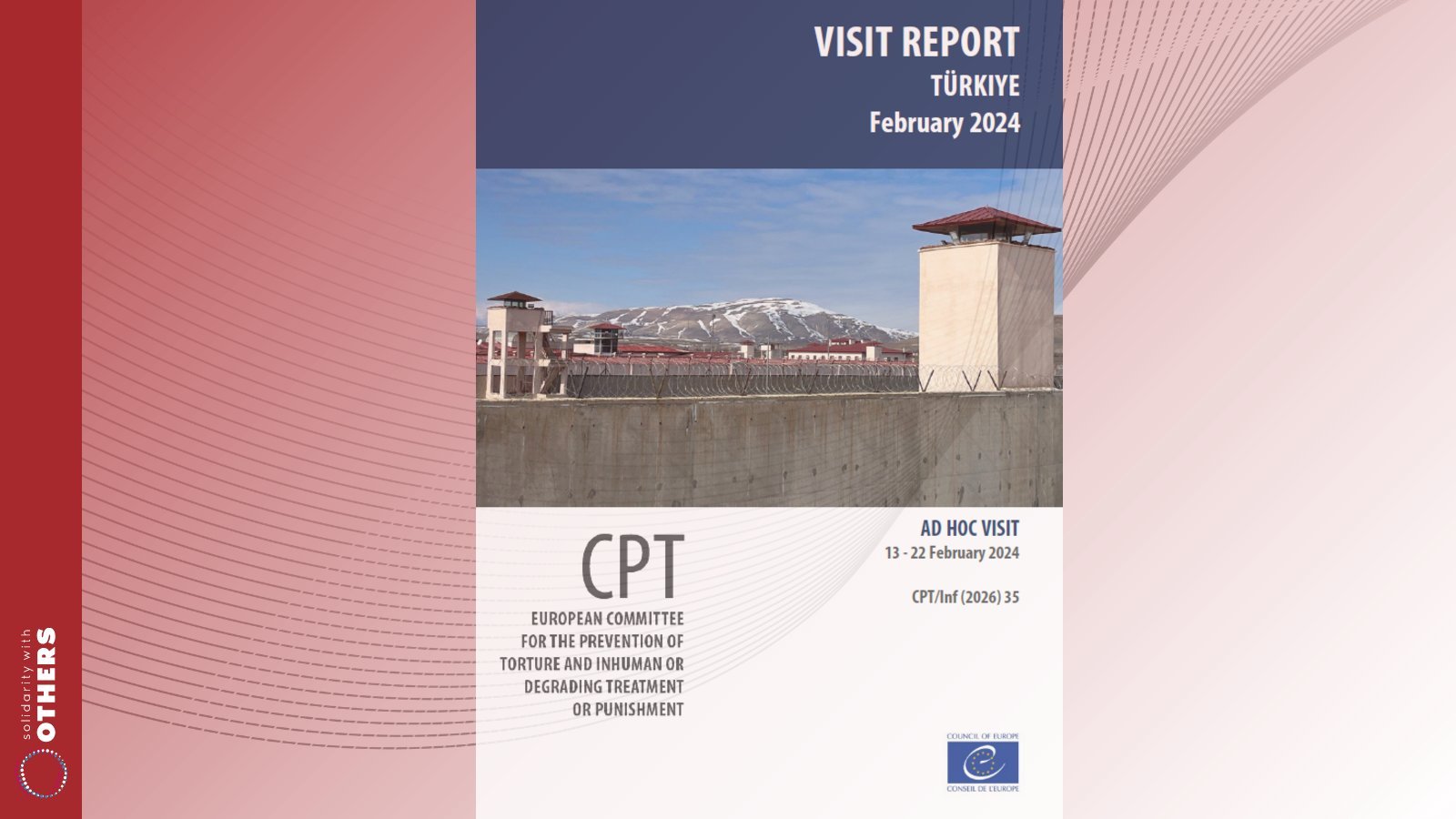
The Council of Europe’s Committee for the Prevention of Torture published two reports on Türkiye on 6 October: one on its periodic visit of January 2021, the other on an ad hoc visit in February 2024.
The 2021 report was transmitted to the Turkish authorities on 13 July 2021. It was published five years and three months later. The 2024 report was transmitted on 16 July 2024. CPT reports are published only with the consent of the State concerned. The reports on the Committee’s visits of August–September 2016, April 2018 and September 2022 remain unpublished.
Both reports record that the delegations received very good co-operation from the authorities and the staff of the establishments they visited.
On police custody, the 2021 report records a significant number of detailed allegations of ill-treatment on apprehension, including of juveniles, said to have been inflicted to extract information or confessions or as punishment. It records “clear and consistent allegations from several persons, notably juveniles, that they had been subjected to electric shocks from hand-held devices”. It finds that ex officio lawyers were granted only after considerable delay so that suspects could be questioned without one present, and that the system of mandatory medical examination of detainees “remains flawed”, with checks not always conducted out of police hearing.
In prisons, the 2021 delegation received credible allegations of ill-treatment by staff at three establishments, in places outside CCTV coverage such as staff offices, including falaka — blows with a plastic pipe to the soles of the feet — at Diyarbakır T-type No. 3 and Kayseri T-type No. 1. At Bakırköy Women’s Prison it heard credible accounts that the director and his two deputies had been personally involved in physical ill-treatment and verbal abuse of girls. At Maltepe Juvenile Prison, boys said that if they misbehaved or self-harmed they were taken out of their ward and beaten; many cells were “in an appalling state” with widespread black mould.
The 2024 visit found falaka again, at Antalya S-type Prison, where one prisoner displayed injuries consistent with his account.
<img src=”https://en.wikipedia.org/wiki/Flogging” alt=”**Foot whipping**, **falanga/falaka** or **bastinado** is a method of inflicting pain and humiliation by administering a beating on the soles of a person’s bare feet. Unlike most types of flogging” />, it is meant more to be painful than to cause actual injury to the victim. Blows are generally delivered with a light rod, knotted cord, or lash.
The prison population figures across the two reports show the direction of travel. In January 2021 the CPT recorded 192,000 prisoners, down from 290,000 at the end of 2019 — the first decline in fifteen years. By June 2024 the figure was around 338,000, an incarceration rate of about 395 per 100,000 inhabitants, which the Committee states is “significantly higher than any other Council of Europe member state”. Justice Ministry data now put the figure at 433,520.
Prisoners serving aggravated life imprisonment were held in small-group isolation and many in de facto solitary confinement for months or years, locked in their cells alone for 21 hours or more a day. The CPT repeats that the regime, as defined in law, “is fundamentally flawed and should be subject to a complete overhaul”. It makes the same finding about mentally ill prisoners held in prolonged isolation, which it says could be considered inhuman and degrading.
At Antalya L-type Prison, prisoners who declared themselves to be gay were held in conditions akin to solitary confinement for up to six months or more while they were escorted by gendarmerie to as many as ten hospital specialisms to be certified as gay. The CPT records that the wait “led some of them to commit acts of self-harm or attempted suicide”, and recommends the practice be ended. At Maltepe L-type No. 3, transgender women said they were required to undress completely, without being allowed to cover their breasts, and to squat repeatedly while naked under the supervision of male officers.
Women at Antalya L-type were required on admission to remove all their clothes at once and squat three times. Mothers imprisoned with their children, and a juvenile girl, said they were strip-searched after every open visit. The CPT states that mothers should never be placed in solitary confinement together with their children as a punishment.
The 2021 report also sets out the limits of domestic monitoring. Türkiye’s National Preventive Mechanism, the Human Rights and Equality Institution, carried out 34 visits in 2019 and twelve in 2020, against some 370 prisons and hundreds of other places of detention, on an annual budget of about €30,000.
The İHD Central Prison Commission said the reports document that torture, ill-treatment and isolation in detention centres and prisons are not isolated incidents but have become a chronic regime of rights violations, and called on the authorities to act on the findings.
A prison population that has risen from 192,000 to 433,520 in five years is the context in which every one of these findings was made. The findings from 2021 were available to the Turkish authorities throughout that rise.
Sources:
1- CPT, “Council of Europe anti-torture Committee publishes two reports on Türkiye focusing on police and prisons”, 6 October 2026: https://www.coe.int/en/web/cpt/turkiye
2- CPT/Inf (2026) 33, Report on the visit to Türkiye, 11–25 January 2021, published 6 October 2026: https://rm.coe.int/48802e2466
3- CPT/Inf (2026) 35, Report on the visit to Türkiye, 13–22 February 2024, published 6 October 2026: https://rm.coe.int/48802e24bb
4- İHD Merkezi Hapishane Komisyonu (@ihdgenelmerkez) on X, 7 October 2026: https://x.com/ihdgenelmerkez/status/2107882232832528890