


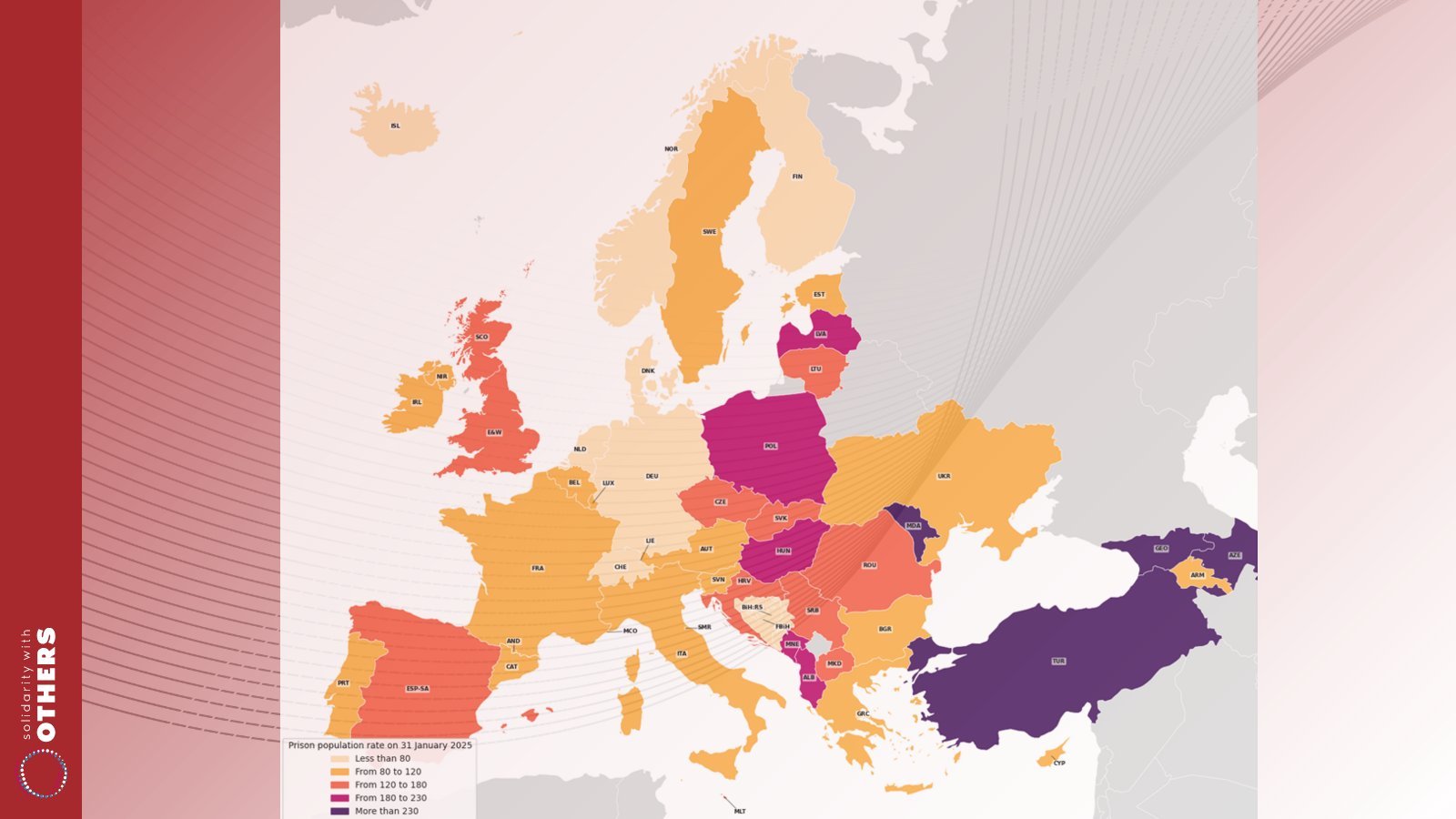
The Council of Europe published its annual penal statistics for 2025 this year, compiled by the University of Lausanne from returns made by all fifty-one prison administrations in the forty-six member states. Türkiye appears at the top of the table on almost every measure, and in several cases it is the maximum value in Europe.
On 31 January 2025 there were 392,456 people in Turkish prisons. The capacity of those prisons is 299,880 places. The difference is 92,576 people. Türkiye told the survey that its stated capacity is calculated to allow every prisoner to sleep in an individual cell, which means the figure describes a system holding almost a hundred thousand people more than it was built for.
The resulting density, 131 prisoners for every 100 places, places Türkiye alongside France at the top of the report’s severe overcrowding group. Across Europe the average is 89 and the median 95; sixteen of the fifty administrations that reported hold more people than they have room for.
The rate of imprisonment is 458 prisoners per 100,000 inhabitants. The European average is 127 and the median 110. Türkiye imprisons its population at three and a half times the European average, and at more than eight times the rate of Norway, the Netherlands or Finland. The next highest rates in Europe are Azerbaijan at 271, Moldova at 245 and Georgia at 232.
What has changed is recent. In 2015 the rate was 223. It has since doubled. In the single year between the 2024 and 2025 surveys it rose by 28.8 per cent, which is about 87,700 additional prisoners in twelve months. Measured over twenty years the increase is 504 per cent, which the report calls staggering and which is the largest change recorded anywhere in Europe; the next largest are Serbia at 67 per cent and Croatia at 63. Twenty years ago Türkiye imprisoned about 76 people per 100,000, which is roughly where Switzerland and Germany stand today.
The flow is at the same scale. In 2024, 457,175 people entered Turkish prisons — 534 for every 100,000 inhabitants, the highest admission rate in Europe against an average of 167.
The staff are not there in any corresponding number. Türkiye reports 4.6 prisoners for every member of prison staff, the worst ratio of any administration in the survey. The European average is 1.7 and the median 1.4. Counting only custodial officers, the figure is 6.1 prisoners each.
Among those 392,456 people are 944 children, living in prison with their mothers. Children may remain until the age of six. No other prison system in Europe comes close: the next highest figures are Poland with 42, Ukraine with 24, Portugal with 18 and Italy with 12. Türkiye separately reports 3,890 detained and convicted persons under the age of eighteen.
One figure runs the other way. The proportion of prisoners held without a final sentence is 14.4 per cent, well below the European average of 30.3. In a system of this size that proportion still amounts to 56,687 people held without a final judgment against them — more than the entire prison population of all but six Council of Europe states.
The report notes without comment that Türkiye recorded 1.4 suicides per 10,000 prisoners in 2024, against a European average of 11.3.
Overcrowding is not a building problem. A prison system holds the number of people that a country’s laws, prosecutors and courts send to it. Türkiye’s prisons are at 131 per cent of a capacity designed for single-occupancy cells because the state is putting roughly half a million people a year through them, and because the number it holds at any moment has doubled in ten years.
Sources:
Marcelo F. Aebi and Edoardo Cocco, Prisons and Prisoners in Europe 2025: Key Findings of the SPACE I survey, Series UNILCRIM 2025/1, Council of Europe and University of Lausanne, updated 2 April 2026.
Council of Europe Annual Penal Statistics — SPACE I 2025, full report, Tables 3, 4, 9, 16 and the country notes for Türkiye.
SPACE I annual reports: https://wp.unil.ch/space/space-i/annual-reports/