

The Council of Europe published its 2025 penal statistics on 19 May. Across 51 prison systems, 1,107,921 people were in custody. Nine systems were severely overcrowded, up from six the year before. The median European imprisonment rate was 110 per 100,000 inhabitants.
Turkey’s was 458. That is the highest in Europe, and it is not close: Azerbaijan, in second place, records 271.
Turkey also recorded the largest single-year increase on the continent — its imprisonment rate rose 29 percent between January 2024 and January 2025. No other system came near. Montenegro was next at 22 percent. Over the same period, rates fell substantially in Ukraine, Slovakia, Georgia, Estonia and Poland.
On prison density, Turkey held 131 inmates for every 100 places, level with France and above Croatia, Italy, Malta, Cyprus, Hungary, Belgium and Ireland.
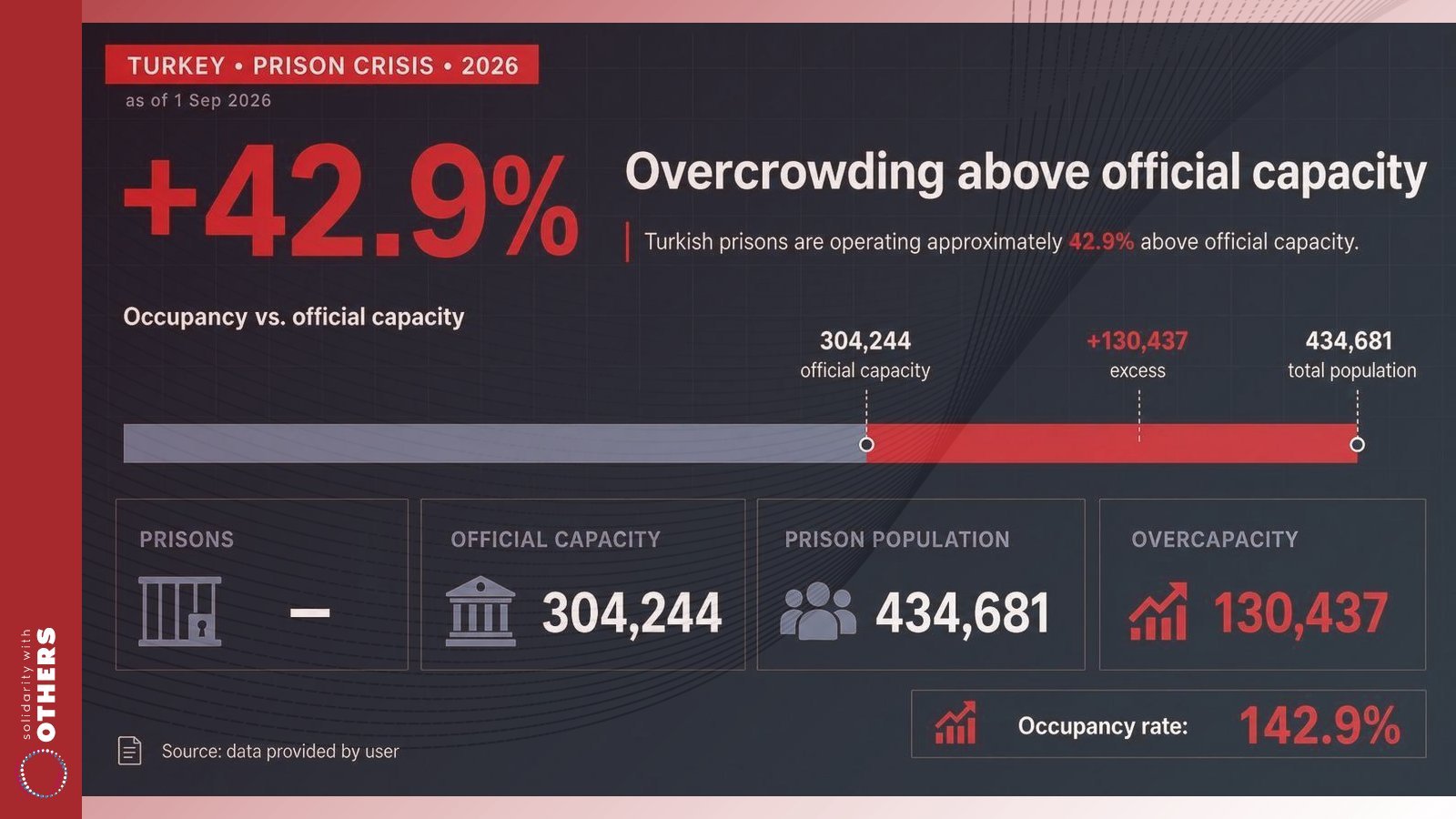
The Council of Europe data is now nineteen months old. Figures compiled for 1 September 2026 by lawyer Ali Yıldız put the Turkish prison population at 434,681 against an official capacity of 304,244 — an occupancy rate of 142.9 percent, and 130,437 people beyond what the system was designed to hold.
That is a rise from 131 to 143 inmates per 100 places in under two years, in a system that was already the most overcrowded in Europe.
Across Europe, one prisoner in four is in pre-trial detention. Overcrowding on this scale is not the by-product of a crime wave. It is what happens when detention becomes routine rather than exceptional.
Sources:
1- https://wp.unil.ch/space/files/2026/06/260626_rapport-space-i-2025.pdf
3- https://x.com/aliyildizlegal/status/2095445119700816052?s=20
Legal Note:
In Yasak v. Türkiye [GC], no. 17389/20, 5 May 2026, the Grand Chamber found that Turkey had violated Article 3 ECHR through the conditions in which Şaban Yasak was held at Çorum Prison for nearly four years.
His personal space ranged between roughly 3 and 4.5 m². He nonetheless slept for long periods on a mattress on the floor.
The Grand Chamber held that the cumulative effect of prolonged overcrowding and inadequate sleeping arrangements imposed a burden well beyond the suffering inherent in detention, and crossed the threshold of degrading treatment. A Chamber had previously found no violation on the same facts. The Grand Chamber reversed it, by nine votes to eight.
The significance for a system at 143 percent of capacity is that Article 3 is not satisfied by clearing 3 m². Overcrowding of this duration and scale can breach the Convention even where personal space is nominally adequate.
Article 3 is absolute. No emergency, no resource constraint and no volume of prosecutions can justify a breach of it.