
Nikoloz Gagnidze
Today is International Migrants Day, a moment, perhaps, to step back from the familiar arguments and ask a more basic question of what is it that is actually argued in the political discord?
One place to start is with a brief historical rewind. Branko Milanovic reconstructed global income data and found that in the middle of the 19th century, the ratio between average incomes in the richest and poorest countries was roughly 4 to 1. The Netherlands and the UK sat at the top, Ceylon (Sri Lanka) and China at the bottom. The gap existed, but it was not yet a chasm. If you wanted to predict someone’s economic destiny, you asked about their occupation, their skills, whether they owned property. The country of their birth mattered, but not decisively.
Today, that ratio between richest to poorest exceeds 100 to 1.
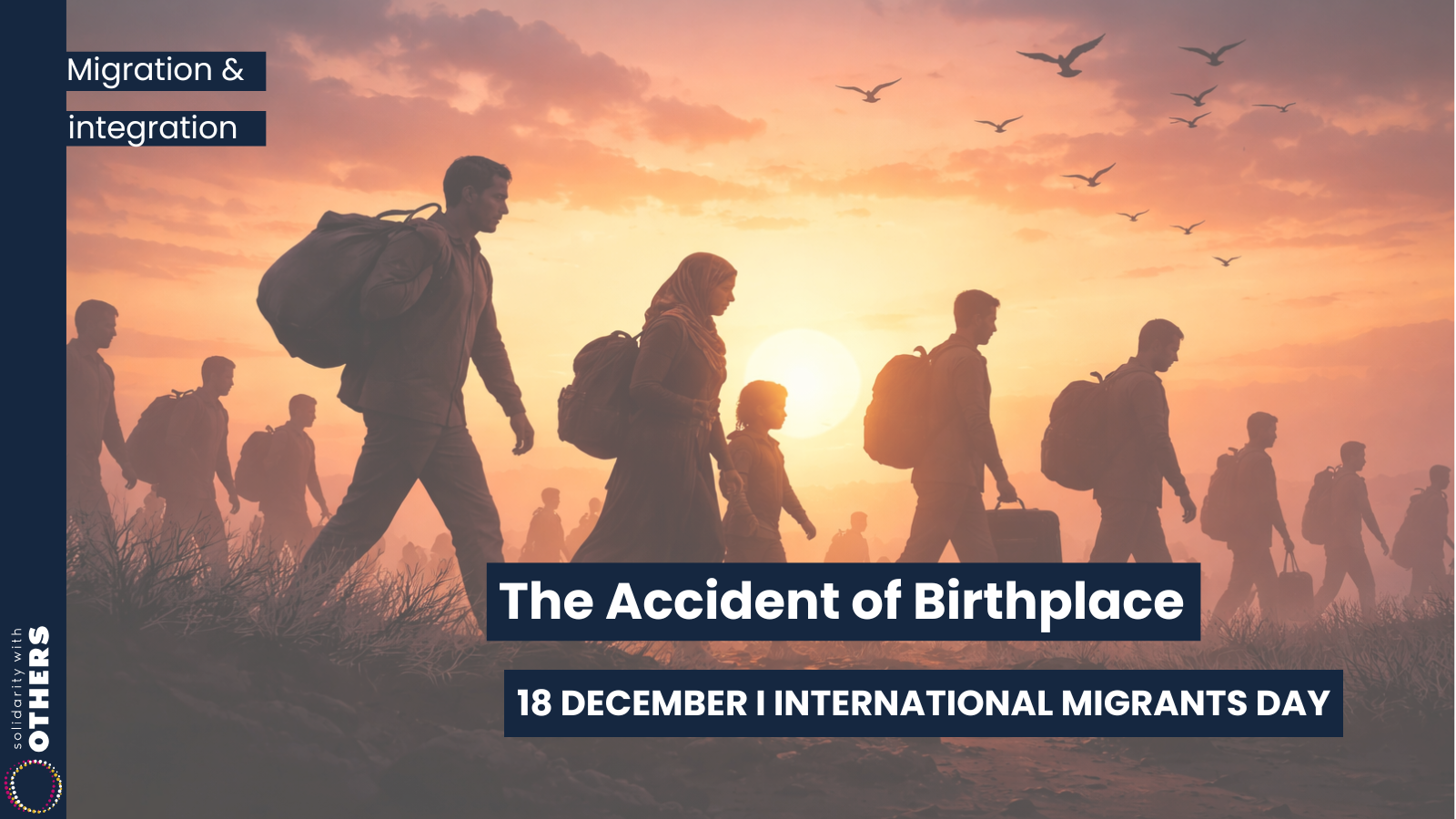
So what happened? The economist Branko Milanovic finds that in the 21st century, more than 80 percent of global income variation is explained by location alone. The passport has become, in a sense, the most consequential asset most people will ever hold and it is assigned at birth by chance. The point I am making is not an argument for any particular policy, it is simply a description of the world as it is currently structured. And it does, perhaps, reframe some questions. People move for reasons. Those reasons do not disappear because a policy is announced or a wall is built.
Whether one thinks such a movement is good or bad, sustainable or not, it becomes harder to treat it as mysterious or deviant.
But of course, most people don’t move. And this too deserves reflection. Simone Weil, writing during World War II, described rootedness as one of the most important and least examined needs of the human soul. To belong to a place, to know its rhythms, to recognize faces on the street, to have the dead buried nearby, this is something that seems to matter deeply to how we construct meaning. Weil thought that the destruction of rootedness, whether by conquest or economic upheaval, was one of the quiet catastrophes of modern life. The unease that many communities feel about rapid change is not necessarily a mask for darker sentiments, though it can be. It may also be an intuition that something real is at stake, something about continuity, memory, the slow accumulation of trust that makes social life possible. These are not small things. Hannah Arendt, herself a refugee from Nazi Germany, observed something troubling about this condition. The rights we call “human rights” (supposedly universal, belonging to everyone by virtue of being human) turn out, in practice, to depend on membership in a political community willing to enforce them. The stateless person, stripped of citizenship, discovers that the rights of humans are not self-executing. They require ‘somewhere’ willing to recognize you, “the right to have rights,” and its absence is the fundamental vulnerability of the refugee, not the lack of this or that specific freedom, but the lack of a place where one’s claim to any freedom is heard at all.
Over the past half-century, barriers to movement have fallen, but selectively. Capital flows across borders with increasing ease. Goods travel global supply chains. Data ignores frontiers entirely. A shirt sewn in Bangladesh reaches a shop in Brussels within weeks. A stock trade executes across continents in milliseconds. This mobility is generally celebrated. It is called efficiency, globalisation, the engine of prosperity. Human beings, however, are different. When people attempt the same border crossings that goods accomplish routinely, they encounter walls, patrols, visa regimes, detention. The Mediterranean has become one of the world’s most dangerous crossings. The EU has spent billions on border externalisation, paying third countries to hold people back, funding coast guards, building surveillance systems. Migration flows have shifted routes, become more dangerous, enriched different smugglers. They have not stopped. The pressure is too great, and pressure finds cracks. The international system for handling forced displacement itself is not working. It was designed in the aftermath of World War II for a different set of problems. The 1951 Refugee Convention assumes that people flee, cross one border, register, wait, and eventually either return home or resettle. That is not how it works now. People move multiple times. Journeys take months and in some cases years. The camps that were supposed to be temporary become permanent-ish.
Having said that, this does not mean borders are pointless or that enforcement is theater all the way down. States do have some capacity to manage flows, to prioritise some movements over others, to set terms. But the gap between what politicians promise and what policy can deliver is vast, and everyone working in this field knows it. The public is told that control is possible if only we are tough enough. Practitioners know that management is possible, control is not. There is no clean solution to any of this and anyone who tells you otherwise is selling something. But some things are better than others. Legal pathways reduce dangerous crossings, people take boats when there is no other way. Investment in origin countries matters, though it is slow and uncertain. Processing asylum claims quickly, instead of leaving people in limbo for months and years, is more humane and more efficient. Integration support pays off over time. Cooperation between countries works better than unilateral posturing, even if it is harder to achieve. And some things are worse. Policies designed only to fake toughness for domestic audiences. Outsourcing border control to governments and war lords that abuse migrants. Letting people drown to send a message. Pretending the problem will go away if we just stop talking about it or scream slogans so loud talking becomes impossible.
One way to read all this is as an inconsistency of the rich world wanting the benefits of global integration without its human consequences. But another reading is that this type of asymmetry is functional. If labour cannot move to where wages are higher, then wages stay low where labour is. The factories and call centres and agricultural operations that produce cheap goods for wealthy markets depend, in part, on workforces that cannot leave. The collapse of the Rana Plaza factory in Bangladesh, which killed over a thousand garment workers in 2013, showed this clearly, the workers who made clothes for well-known brands could not follow those clothes to the countries where they were sold.
It does also raise questions about who benefits from which borders, and why we draw the lines where we do. Every human society has had to face the question of the stranger, the person who arrives from elsewhere, who is not part of the existing web of obligations and trust. The ancient Greeks had a custom, xenia, which made hospitality to travellers a sacred duty, enforced by Zeus himself. The Bible repeats, with insistence, that the stranger must be treated justly. The Quran places the traveller among those with special claims to charity. These traditions did not assume that strangers were saints or that hospitality was costless. They assumed that how a community treats those outside its circle shows something important about its character. These are old ideas and ideals, and they do not translate very much into policy. But they do suggest that the question of migration is not just technical, a matter of numbers and systems and border management. It is also, inescapably, a question about what kind of society we want to be, and what we owe to those born on the “wrong side” of an arbitrary line.
The people who move are not “ILLEGALS” or “INVADERS,” they are human beings making difficult decisions under strong constraints they did not choose. The systems that govern movement are political choices, and those choices have beneficiaries and costs that are not evenly distributed. What do we owe each other across the accident of birthplace? What would it mean to take both rootedness and mobility seriously, instead of sacrificing one to the other? How do we weigh the needs of those who are already here against the needs of those who want to come? These are not questions with obvious answers. They are hard, and the difficulty is part of the point. But the main temptation, for some, is to reach for certainty, to reduce a complicated reality to polarizing political slogans that fit on a sign or a tweet.
References
- Milanovic, “Global Inequality: From Class to Location, from Proletarians to Migrants,” Global Policy, vol. 3, no. 2, pp. 125-134, 2012.
- Pacciardi and J. Berndtsson, “EU border externalisation and security outsourcing: exploring the migration industry in Libya,” Journal of Ethnic and Migration Studies, vol. 48, no. 17, pp. 4010-4028, 2022.
UNHCR, Global Trends: Forced Displacement in 2022. Geneva: United Nations High Commissioner for Refugees, 2023.
- Arendt, The Origins of Totalitarianism. New York: Harcourt Brace Jovanovich, 1951.
- Weil, The Need for Roots. London: Routledge, 1952.