

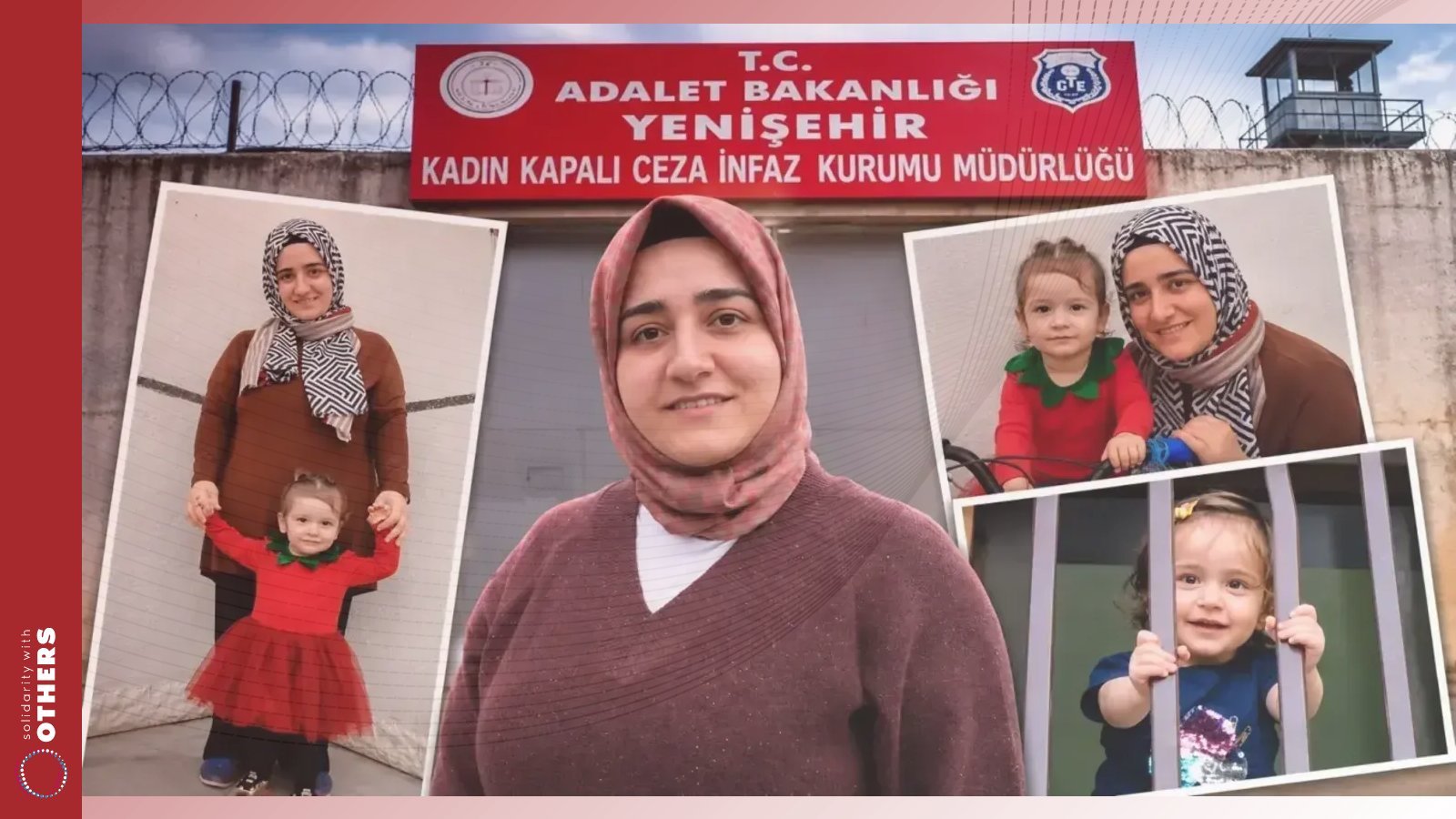
At the entrance to Bursa Yenişehir Women’s Closed Prison in July 2020, a female officer pulled on a pair of gloves and told Leyla Kaya she had never done this before but would be carrying out the search. Kaya was told to undress. She took off her overgarment. “You’ll uncover your head too,” the officer said. She removed her headscarf. “Take it off,” the officer said again. Kaya asked what else there was to remove, and said they should search her over her clothes. “No, that won’t do. You’ll take everything off.” In her words: “It was terrifying.”
Her daughter Azra was held down by several people on what Kaya describes as something like a stretcher, screaming and struggling, and was stripped to her nappy. The adults around them were masked and gloved. The instructions given to Kaya were to sit, to stand, and to cough.
Azra was born in January 2019. The police had come to the family home at about five in the morning on 9 July 2020.
Kaya is a primary school teacher from Pasinler in Erzurum. She married on 16 July 2016, the day after the coup attempt, in an almost empty register office. Her husband was detained that November and spent fifty-six months in prison across two periods, serving his sentence in full before his release in October 2024. For a year and a half she did not visit him, because women were being detained at prison gates. The case against her rested on her having worked at a student dormitory, on her social security record, on an account at Bank Asya and on the ByLock allegation. An anonymous witness identified her from a photograph she says she did not recognise as herself; her own lawyer said the woman in it was not her. She was never brought face to face with him.
She was still breastfeeding when she was taken. In custody she was asked repeatedly whether she would become a confessor and take the benefit of the effective remorse provisions. She refused, saying she had committed no offence. After the remand order, more than five officers surrounded her and asked what kind of mother she was, and whether she had given any thought to her child.
She and Azra spent fifteen days in a quarantine cell with one other woman. There was one bed and a dirty sponge mattress on the floor, no bedding, and a lavatory reached by stepping over where they slept. When she asked for a bottle of water she was told it would not be for her but might be requested from another ward for the child. The two women washed by filling a large bin-liner they had been permitted to bring in. For the first week they were let into the yard for one hour a day, at the hottest part of it. Azra had just learned to walk, and there was nowhere in the cell to walk. They were then moved to a ward holding seventeen women, where the child had no separate food and the eggs were allotted by the number of adults.
On 30 September 2020 Kaya was sentenced to six years and ten months and released under house arrest. She spent eighteen months with an electronic tag, refused permission to visit her husband in prison and refused a day’s leave to attend her brother’s wedding. In July 2026 the Court of Cassation upheld her conviction and it became final. Rather than return to prison and be separated from her daughter, the family left Türkiye three months ago and sought asylum in Germany.
She told nobody about the search for six years. “This is a practice that is normally denied,” she says. “Afterwards there were statements that there is no strip search, that no such thing is done. But I lived it.” She says she is speaking now in order to put it on the record.
The denial she refers to is a matter of public record. In February 2021 the governing party’s deputy group chair, Özlem Zengin, said she did not believe for a moment that strip searches took place in Türkiye and that there was no such thing, and that an honourable, moral woman would not wait a year to speak.
Parliament’s own inspectors had already found otherwise. The Human Rights Committee’s sub-commission on the rights of convicts and detainees recorded strip searches at Bakırköy Women’s Closed Prison following a visit on 6 September 2019. A report on Elâzığ Prison recorded complaints that visitors were strip-searched. A report on Diyarbakır Women’s Closed Prison described searches incompatible with human dignity.
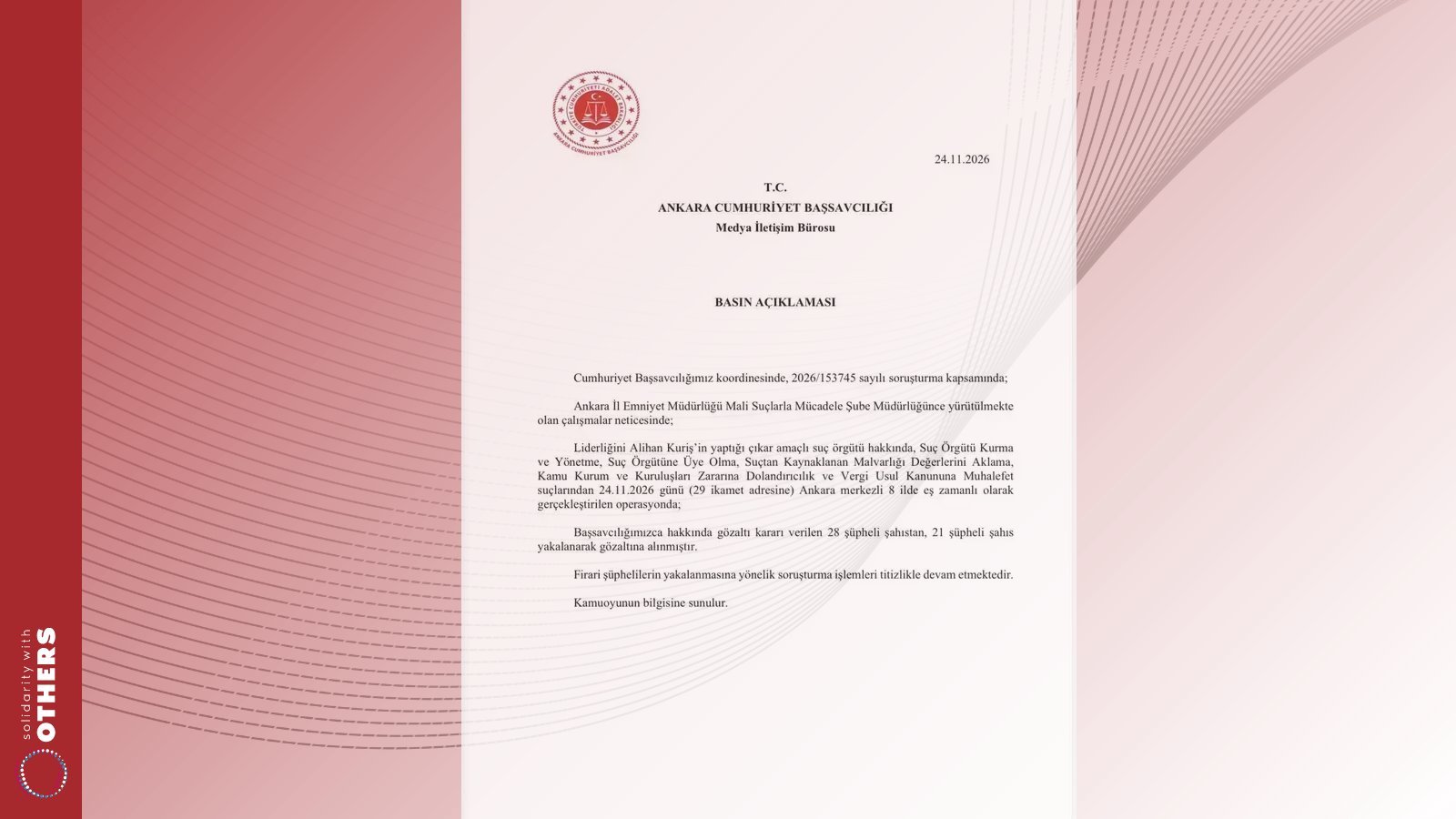
The Ankara Chief Public Prosecutor’s Office opened an investigation into people who described strip searches on social media.
On 12 November 2021 a regulation signed by the President was published in the Official Gazette. It removed the phrase “strip search” from the Regulation on the Administration of Penal Institutions and replaced it with “detailed search”. It added to Article 34/2 the condition that the measure be used where there is no other way of establishing the matter. It provided that the person searched be given a disposable gown, and that a record be drawn up and signed by both the person searched and the officer. The governing principle was rewritten to require respect for human dignity and that the sense of shame not be violated. Lawyers have pointed out that no statute — not the Police Powers Act, not the Code of Criminal Procedure, not the law on the execution of sentences — expressly provides for the practice at all.
In November 2021 the Constitutional Court examined a complaint by Mehmet Arslan, the former co-chair of the DBP, who said he had been strip-searched on entering Rize prison in February 2018. The Court found no violation. Among the circumstances it recorded was that the search had taken place where it could not be seen from outside and in a room with no recording equipment.
A practice that officially does not exist was given a different name, a procedural safeguard and a signed form, and is examined by a court that treats the absence of any record of it as part of the reason it cannot be faulted.
Sources:
TR724 (Sevinç Özarslan), “KHK’lı Leyla Kaya: 17 aylık kızıma ve bana çıplak arama yapıldı | RÖPORTAJ”, 22 November 2026, updated 23 November 2026, and the accompanying interview on TR724 TV.
t24, “AKP’li Özlem Zengin’den çıplak arama iddialarına yanıt”, February 2021.
TR724, “TBMM raporları Özlem Zengin’i yalanladı”, 24 February 2021 (TBMM Human Rights Committee sub-commission reports on Bakırköy, Elâzığ and Diyarbakır prisons).
bianet, “Cezaevinde ‘çıplak arama’ yerine ‘detaylı arama'”, on the regulation published in the Official Gazette of 12 November 2021, with comment from Gökmen Yeşil of the ÇHD.