
Executive Summary
In Turkey, centralized exams serve as the primary gateways to education, professional status, and public employment. Civil service positions carry significant prestige and legal protections; consequently, the perceived fairness of these exams is closely tied to state legitimacy.
Examination scandals long predate recent political narratives, with major incidents including the cancellation of the 1973 university entrance exam, the 1992 Anatolian High School exam, the 1999 nationwide university exam, and the 2010 Public Personnel Selection Examination (KPSS).
In the post-2016 period, structural problems were increasingly reframed as evidence of an infiltration strategy, shifting the debate toward narratives of collective culpability that served political purposes.
After 2016, exam irregularities were recast as evidence of systematic infiltration. A report by the Anti-Smuggling and Organized Crime Department (KOM) claimed that 17,894 individuals were involved in cheating across several public exams, including 13,421 linked to the 2010 KPSS.
A review of 12,392 court decisions (2021–2024) against the Gülen Movement followers found that among 366 exam-cheating cases finalized at the Court of Cassation, 343 (93.7%) ended in acquittal while 23 (6.3%) resulted in convictions.
The extremely high acquittal rate suggests that claims of systematic exam manipulation lack strong evidentiary support when tested in court. This outcome is especially notable given the widespread criticism that Turkish courts are often biased against defendants and have high conviction rates in politically sensitive cases.
The prosecutions relied primarily on witness statements taken under the active remorse provisions rather than material proof, raising serious concerns regarding the evidentiary foundations of the allegations and further weakening claims of a large-scale, coordinated cheating network.
The examination irregularities in Turkey reflect long-standing institutional fragility rather than a coordinated infiltration strategy. Hence, restoring a merit-based system requires transparent exam administration, independent oversight, and the re-establishment of rule-based recruitment procedures.
Introduction
In Turkey, centralized examinations play a uniquely powerful role in the relationship between individuals and the state. They constitute the primary institutional gateways through which access to education, professional status, and public employment is allocated. From secondary school placement to university admission and bureaucratic recruitment, examination systems structure life trajectories, patterns of social mobility, and the composition of state institutions. In a political economy characterized by limited high-quality educational opportunities and a large youth population, these exams are not merely assessment tools; rather, they are the core mechanisms of social distribution.
This centrality has positioned examinations as one of the most politically sensitive institutional domains in modern Turkish history. Far from being neutral instruments, they mediate access to scarce resources, define the boundaries of professional elites, and shape the internal structure of the state itself. Control over recruitment is, essentially, control over the long-term ideological and administrative orientation of public institutions; therefore, examination systems have always been deeply entangled with questions of legitimacy, power, and governance.
The significance of these mechanisms is closely tied to the historical role of the bureaucracy in the Turkish Republic. From the early republican period onward, the civil service has held considerable prestige and authority. Traditionally, a bureaucratic office has represented not only stable employment but also social status, political influence, and membership in a respected professional class. Accordingly, becoming a civil servant has long been associated with upward mobility and incorporation into the institutional core of the state.
The Turkish Constitution explicitly recognizes access to public service as a right of citizens, providing strong legal protections for civil servants. For instance, Article 70 states that every citizen has the right to enter public service and that recruitment must be based on the requirements of the position and the principle of merit.[1] Moreover, Article 129 establishes institutional guarantees designed to protect civil servants from arbitrary dismissal and political interference.[2] These provisions reflect a foundational principle of the republican administrative tradition: the expectation that civil servants owe their loyalty to the state rather than to any particular government. In theory, this framework seeks to preserve bureaucratic neutrality and institutional continuity across changing political administrations.
Since centralized examinations regulate entry into this constitutionally protected and socially prestigious sector, their perceived fairness carries exceptional political and social weight. Public confidence in these systems is, therefore, closely tied to broader perceptions of state legitimacy.
However, in recent years, public debate in Turkey has increasingly framed examination irregularities and recruitment failures through a single dominant narrative: the claim that a specific social movement systematically infiltrated state institutions by cheating in centralized examinations, particularly the Public Personnel Selection Examination (KPSS). According to this narrative, organized networks allegedly gained illicit access to exam materials and distributed answers internally, thereby placing loyal cadres throughout the bureaucracy, judiciary, security forces, and diplomatic service. Similar claims have also been made regarding earlier examination systems, including the university entrance exam (Student Selection Examination – ÖSS), with some commentators arguing that large numbers of individuals gained admission to universities through stolen questions or coordinated cheating networks. Over time, these allegations have acquired the status of an almost self-evident truth in political discourse, functioning as a foundational explanation for institutional crises within the Turkish state.
This report challenges that narrative at the level of institutional analysis. It does not deny the possibility of individual misconduct or even organized wrongdoing in specific cases; rather, it argues that the broader claim of systematic infiltration cannot be sustained as a structural explanation. When examined historically, legally, and empirically, examination irregularities in Turkey appear not as the product of a single actor or coordinated conspiracy but as the outcome of long-standing institutional fragility. In other words, structural weaknesses in examination administration, oversight mechanisms, and accountability structures have created recurring vulnerabilities across multiple examination systems and political periods.
Understanding these problems, therefore, requires moving beyond personalized explanations and toward a more comprehensive analysis of institutional design, governance practices, and the political economy of competition over scarce public opportunities.
Drawing on historical patterns from the 1970s onward, the report demonstrates that examination systems in Turkey have been repeatedly vulnerable to politicization, weak oversight, informal networks, and governance failures across diverse political contexts. From ideological struggles over university access in the pre-1980 period to canceled national exams in the 1990s to unresolved irregularity allegations in the 2000s and the systemic collapse revealed by the 2010 KPSS scandal, vulnerabilities have been structural rather than episodic.
Finally, the report examines the post-2016 transformation of recruitment and legal practice, showing how historical institutional weaknesses were retrospectively reinterpreted through a narrative of collective guilt. It argues that this reframing has facilitated the erosion of rule-based recruitment, the expansion of discretionary appointments, and the weakening of due process, ultimately undermining rather than strengthening a merit-based system.
The History of Examination Cheating in Turkey
In Turkey, centralized examinations have historically functioned as far more than technical assessment tools. They are among the most important institutional mechanisms through which social mobility is organized, professional status is distributed, and political power is indirectly structured. From secondary education to university admission and public sector recruitment, examinations are the principal interface between individuals and the state. Success or failure in these systems shapes not only the trajectory of one’s personal life but also the social composition of the middle class, the professional elite, and the bureaucracy.
Long before contemporary narratives of infiltration and organized cheating, examinations were already entangled with ideological competition, institutional fragility, and informal power networks. The roots of this vulnerability can be traced at least to the 1970s, a period marked by intense political polarization and the gradual erosion of state authority.
1970s: Early Exam Cheating Scandals
One of the earliest large-scale exam scandals occurred in 1973. The university entrance examination held on July 6, 1973, was canceled after it emerged that some of the questions had been leaked in advance.[3] A teacher from a well-known private preparatory course had received a set of mathematics and science questions before the exam and was asked to provide the answers to a selected group of students. A journalist from the newspaper Cumhuriyet obtained copies of these notes, had them notarized before the exam, and later confirmed that the same questions appeared in the official exam booklet.[4] In her reporting, she also suggested that the questions may have been distributed to a group of students associated with a particular right-wing ideological network. Following the newspaper’s reporting, authorities acknowledged that the questions had been stolen and annulled the examination. In the subsequent investigation, only several printing-house workers who had access to the exam materials were prosecuted and imprisoned.
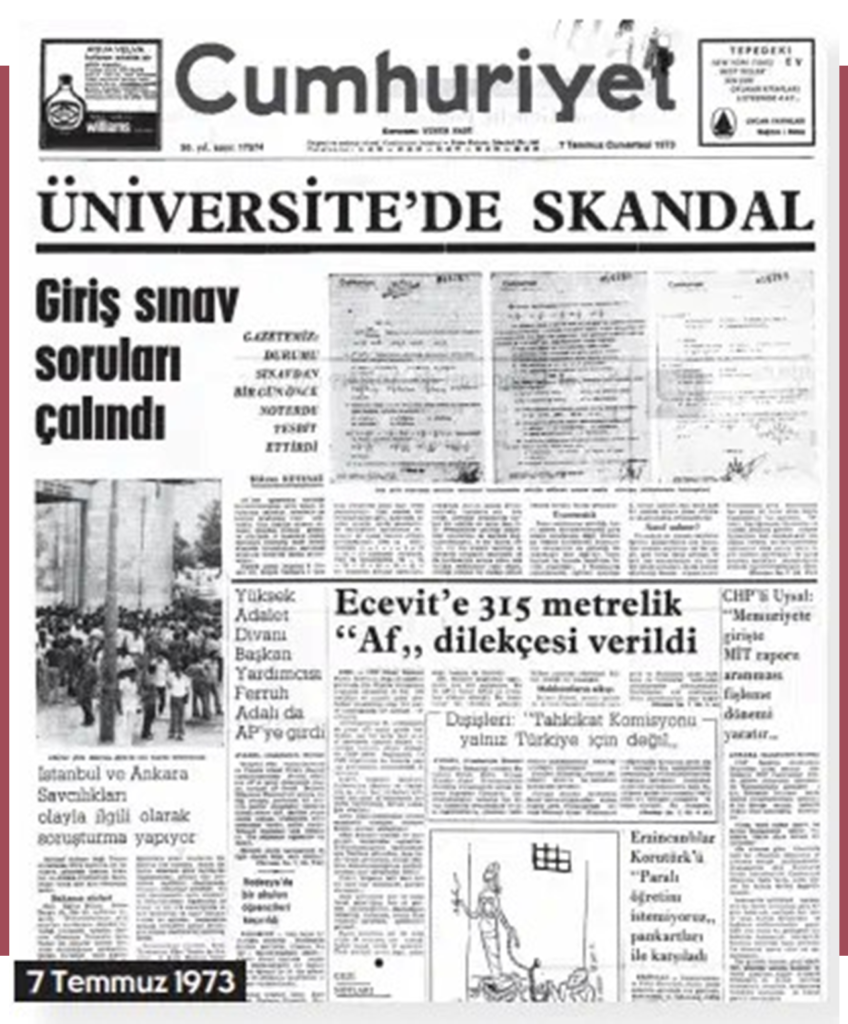
Cumhuriyet, July 7, 1973—”Scandal at the University”: Entrance exam questions were stolen
In August 1970, the entrance examination questions of the Middle East Technical University (ODTÜ) were stolen before the exam. The university’s rector, Prof. Erdal İnönü, referred the incident to the public prosecutor. The Student Union stated that the exam questions had been sold by a student in a hotel before the examination.[5]
According to Prof. Dr. İskender Öksüz, the exam questions had allegedly been stolen by the Federation of Thought Clubs (Fikir Kulüpleri Federasyonu, FKF).[6] The questions were then reportedly purchased by members of the rival nationalist (ülkücü) movement. The FKF, founded in 1965, is a left-oriented student organization that brought together university-based thought clubs and played a central role in socialist mobilization during the 1968 youthmovement.[7]
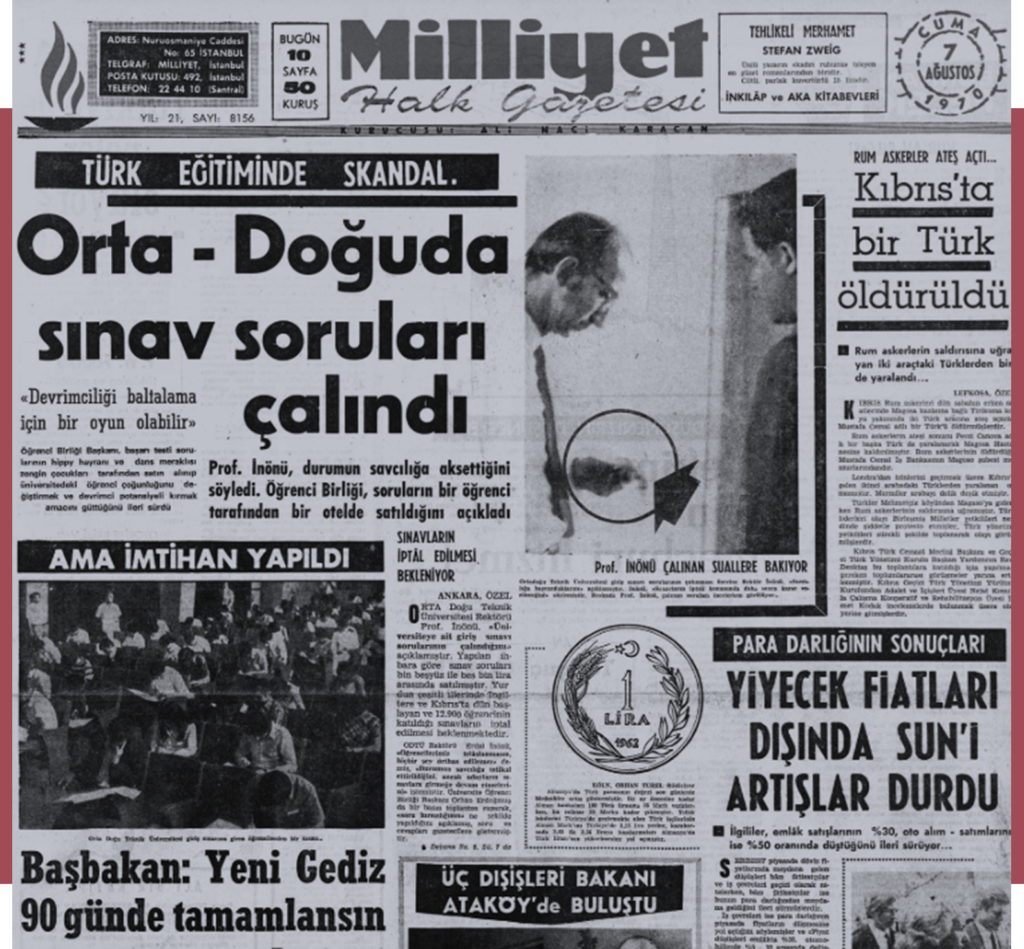
Milliyet, August 7, 1970—”Exam Questions Stolen at Middle East University”
1990s: Repeated Exam Cancellations
The 1990s saw efforts to formalize and centralize examination systems, although without building the institutional capacity necessary to secure them. Several major scandals occurred, leading to official annulments and public crises of legitimacy. One of the most emblematic examples was the cancellation of the 1992 Anatolian High School exam after exam questions were published in national newspapers prior to the test.
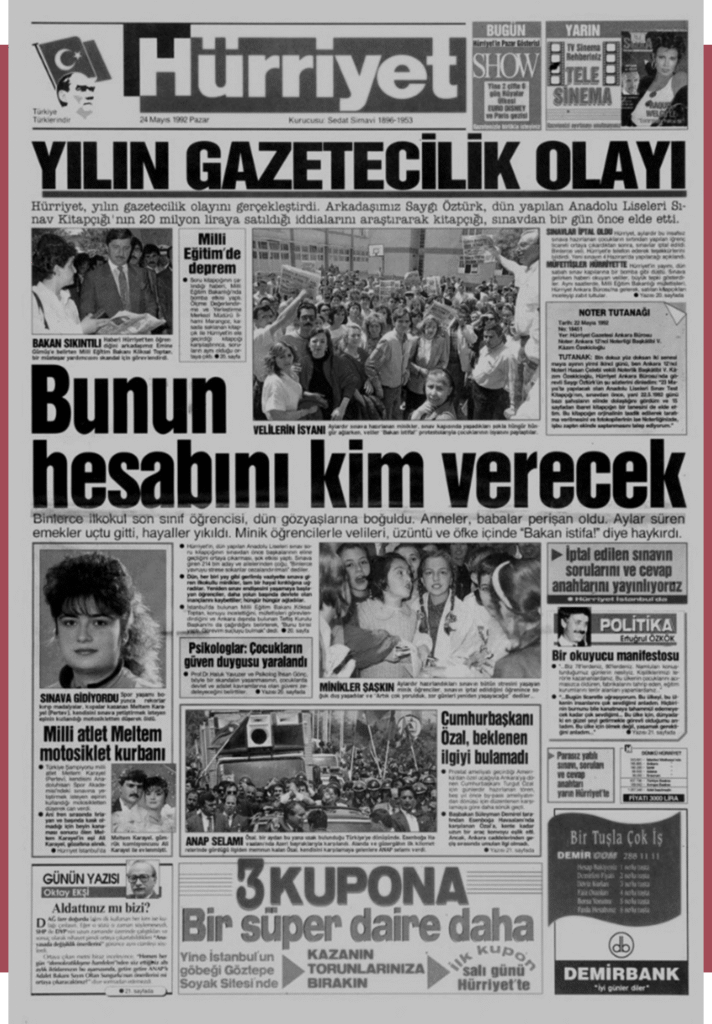
Hürriyet, May 24, 1992—”Journalism Event of the Year”: Exam booklet obtained one day before the test, confirming leak allegations
The 1992 scandal was first uncovered by the newspaper Hürriyet. A day before the nationwide Anatolian High Schools entrance exam, the paper reported allegations that the exam questions had been leaked and were being sold in advance. Hürriyet also announced that it had obtained a copy of one of the exam booklets.[8]
In its May 23, 1992, issue, several of the questions acquired by Ankara correspondent Saygı Öztürk were published after being officially certified by a notary, thus confirming the authenticity of the material and exposing the scandal. Following the newspaper’s report and the public reaction it provoked, the exam scheduled for Sunday, May 24, was canceled.[9] Authorities later organized a new examination, which was held on June 4 1992.
Haydar Karataş, who was arrested in 1992 at the age of 19 and sentenced to life imprisonment on charges described by authorities as left-wing terrorist activities,[10] stated on his YouTube channel in February 2026 that during his imprisonment in 1998, the questions and answers for the university entrance examinations had been provided to inmates.[11]
Moreover, the 1999 university entrance exam (Student Selection Examination – ÖSS) was canceled the evening before it was scheduled to take place. Nearly 1.5 million students had prepared for the exam. The theft was discovered at the Marmara University examination center in Istanbul, where exam materials were being sorted before distribution.[12] Officials found that a courier bag containing exam documents had been cut open and that two booklets were missing. Police launched an investigation and detained several staff members involved in transporting the exam materials.[13]
These episodes were not marginal; they affected large cohorts of candidates and received extensive media coverage. More importantly, they revealed fundamental institutional weaknesses: insecure question production, inadequate logistical controls, and the absence of independent oversight mechanisms capable of conducting forensic audits.
What matters analytically is that these scandals were officially recognized as institutional failures—examinations were canceled, and authorities acknowledged security breaches. Public debate focused on governance deficits rather than ideological conspiracies. The dominant explanation, thus, was incompetence, not infiltration.
The KPSS Reforms
The late 1990s and early 2000s brought new reform efforts. The KPSS reform was intended to operationalize the meritocratic principles articulated in Article 70 of the Turkish Constitution, which states that no criteria other than the qualifications required for the position should be considered in public service recruitment[14]. The system was first implemented on October 17, 1999, during the government of Prime Minister Bülent Ecevit, under the name State Personnel Examination (DMS) and was administered by the Student Selection and Placement Center (ÖSYM). In subsequent years, the exam evolved into what is now known as the KPSS, which has become the primary mechanism for recruitment into various public sector positions in Turkey. Each year, the exam affects roughly one million candidates and has generated a large preparatory ecosystem, encompassing private courses and specialized publications.
Before this reform, hiring practices in various public bodies were largely decentralized and often relied on interviews or discretionary procedures carried out by individual institutions. These practices were widely criticized for enabling arbitrary recruitment and facilitating political patronage and institutional “cadre-building”, i.e. appointing of loyalists in public offices irrespective of merit. The introduction of a centralized examination aimed to limit such practices and strengthen the principle of merit in public service recruitment.
A notable example would be the appointments made after the 1991 elections during the coalition governments formed between the True Path Party (DYP) and the Social Democratic Populist Party (SHP). Justice Ministers Seyfi Oktay and Mehmet Moğultay oversaw the appointment of approximately 2,000 judges and prosecutors. Moğultay openly acknowledged obtaining a staffing quota of five thousand positions from the government and distributing them within the party organization, stating, “Yes, I obtained a five-thousand-person quota from the government. Should I have given these positions to the nationalists instead of my own organization?” He further stated that the judges appointed during his and Seyfi Oktay’s tenure would be “democratic people who will flourish in the future,” adding, “If what I have done is a crime, I will continue to commit it. I will not be discouraged, nor will I leave this office.”[15]
These KPSS reforms aimed to rationalize procedures, standardize testing, and reduce discretionary interference.
2010s: The KPSS Scandal
Nonetheless, allegations of irregularities persisted throughout the 2000s. The 2009 entrance examination for Police Vocational High Schools (PMYO) was canceled following allegations that many of the test questions had previously been used in practice exams at some private preparatory courses. In a statement, ÖSYM announced that the questions had been presented to students under the title of a “KPSS practice test.” According to the investigation, 88 of the 103 questions in those practice tests showed significant similarity to 88 of the 120 questions asked in the PMYO examination.[16]
Abnormally high scores among large groups of candidates triggered public suspicion in the 2010 KPSS scandal.[17] Following allegations that questions from the 2010 KPSS had been leaked, prosecutors requested the contact information of 3,227 candidates who scored 100 or near-perfect marks on the Educational Sciences test. The scandal emerged after 350 candidates achieved a full score of 120 out of 120, raising suspicions that the exam questions had circulated in advance. Investigations were launched by both the Ankara Chief Public Prosecutor’s Office and the Council of Higher Education (YÖK). In the administrative inquiry conducted by YÖK, the disciplinary board concluded that, despite suspicion, there was no definitive evidence. Eight ÖSYM employees who had been suspended during the investigation were given a penalty of a one-tenth salary deduction for abuse of duty.[18] Authorities eventually canceled parts of the examination, implicitly acknowledging a serious failure in exam security.
From an institutional perspective, the 2010 scandal was not a rupture but the culmination of long-standing structural weaknesses, exposing the consequences of centralized risk, weak oversight, and unresolved administrative fragilities that had accumulated over decades. Nevertheless, politically, the event was later reframed. Rather than triggering a sustained program of institutional reform, the scandal increasingly came to be interpreted in public discourse as evidence of organized infiltration.
2020s: Ongoing Exam Controversies
Allegations of exam question leaks have also surfaced in other centralized examinations in Turkey. In 2019, claims emerged that questions from the Medical Specialty Examination (TUS), administered by ÖSYM and taken by physicians seeking specialization, had been leaked before their official release. The exam was held on February 14, 2019, while ÖSYM officially published the questions on February 26. According to the allegations, a Word document containing approximately 240 questions circulated online before the official publication date, and the presence of a phone number in the file led to claims that the questions had been shared through WhatsApp groups.[19] The allegations generated criticism among candidates who had taken the exam, and complaints were reportedly submitted to the Presidential Communication Center (CİMER) requesting an investigation. The private preparation institution TUS Data Preparation Centers, which was mentioned in the claims, denied any involvement, stating that its instructors had taken the exam and reconstructed questions from memory after the test to identify possible errors and prepare objection petitions, a practice they said had been used in previous exam cycles as well.
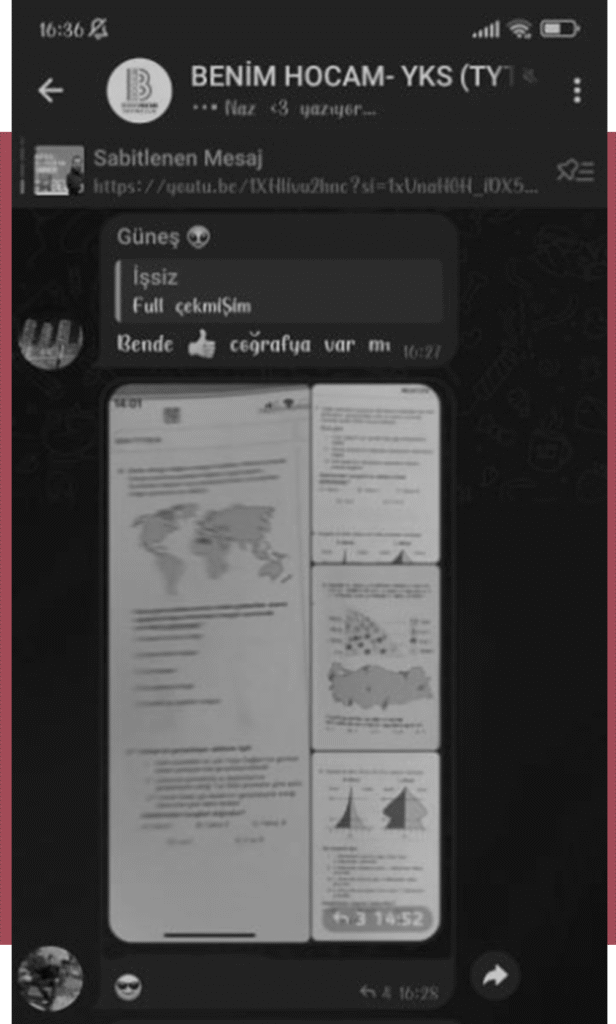
Yeniçağ, June 9, 2024—“Have TYT exam questions been leaked?”: Alleged sharing of exam questions via WhatsApp during the test
Similar allegations have also emerged in more recent examinations. During the 2024 Higher Education Institutions Examination (YKS)—specifically, the Basic Proficiency Test (TYT) session held on June 8, 2024, and attended by over 3.1 million candidates—images claimed to show exam questions reportedly circulated on social media platforms during or shortly after the test.[20] According to online claims, photographs of certain geography questions were allegedly shared in a WhatsApp group during the exam, raising questions among users about how a mobile phone could have been brought into the examination hall. The images were subsequently shared on other platforms, including X (formerly Twitter), Facebook, and Telegram, which generated widespread discussion about exam security. However, ÖSYM rejected the allegations, with ÖSYM President Bayram Ali Ersoy stating that the claims constituted disinformation and announcing that legal action would be initiated against social media posts and media reports that alleged a leak of exam questions.
In 2025, following the announcement that 719 students achieved perfect scores in the High School Entrance Examination (LGS), allegations of irregularities surrounding the exam began to attract growing public attention. An administrative investigation was launched into 29 individuals, and a senior official at the Ministry of National Education (MEB) was dismissed from his position.[21] While the Ministry maintained that the exam had been conducted in a transparent and auditable manner, criticism from opposition figures and education unions persisted.
A report published in the newspaper Cumhuriyet alleged that verbal section questions were shared in WhatsApp groups before the first session of the exam had ended.[22] The same report also claimed that questions from the numerical section were leaked while the second session was still ongoing. The unusually high number of top-scoring students further intensified concerns. In the previous year, 352 students answered all questions correctly in the LGS. In 2025, however, 719 students from 544 different schools achieved the maximum score of 500 points, fueling public debate over possible cheating, although the exams were not canceled.
The Post-2016 Legal–Institutional Rupture: Evidence, Due Process, and the Construction of Guilt
The post-2016 period marks a decisive rupture in the institutional logic governing public recruitment and legal accountability in Turkey. What distinguishes this rupture from earlier examination scandals is not merely its scale but also the way in which historical vulnerabilities were retrospectively reinterpreted through a new legal and political framework. Examination irregularities, previously understood as recurring institutional failures, were reframed as evidence of a long-term, organized strategy of infiltration by a specific social movement. This narrative did not remain at the level of political discourse, as it translated into legal categories, judicial practices, and administrative measures that reshaped the foundations of due process.
At the center of this transformation lies the claim that followers of the Gülen movement, commonly referred to as “Gülenists,” systematically infiltrated public institutions by cheating in centralized public recruitment examinations, most notably KPSS. According to this account, organized networks gained illicit access to exam questions and distributed answers internally, thereby placing loyal cadres across the bureaucracy, judiciary, security forces, and diplomatic service.[23] This proposition gradually acquired the status of a foundational assumption in public debate. It was treated less as a hypothesis requiring rigorous demonstration than as an established truth that could be invoked to justify extraordinary institutional measures.
Exam Cheating Allegations and Trial Outcomes
To be more precise, a report prepared by the Anti-Smuggling and Organized Crime Department (KOM) at the request of the Ankara Chief Public Prosecutor’s Office claimed that 17,894 individuals were involved in cheating across several public examinations by the Gülenists.[24] According to the report, the accusations were distributed as follows: 13,421 individuals in the 2010 KPSS exam, 3,205 in the 2009–2011 police promotion exams, 269 in the 2012 Police Academy exam, 310 in the 2009 Police College entrance exam, 212 in the 2012 district governor candidacy exam, 86 in the 2012 judicial exam for lawyer-candidate judges and prosecutors, and 371 in the 2010–2013 Foreign Ministry professional and consulate officer exams.
Although these figures suggested a comprehensive investigation, the trials later revealed a different picture. A study conducted by lawyer Murat Akkoç and a group of lawyers reviewed thousands of court decisions issued between 2021 and 2024. In total, 12,392 rulings were examined.[25] During this period, 366 exam-cheating cases were finalized at the Court of Cassation. Among them, 334 cases resulted in acquittal at local courts, whereas in 32 cases, the Court of Cassation overturned convictions issued by Assize Courts, ruling that the defendants should also have been acquitted. Only three cases were overturned against the defendants. In other words, about 94% percent ended in acquittal, while 6% resulted in convictions. This outcome is notable given that Turkish courts have often been criticized for bias in terrorism-related cases, with human rights organizations highlighting concerns about the broad use of anti-terror laws, weak evidentiary standards, and limitations on fair trial guarantees.[26]
If a large, organized, and systematic fraud network had existed, one would expect a substantial number of convictions supported by material evidence. High acquittal rates suggest that the legal system, when forced to operate even minimally within procedural standards, cannot sustain the claims made at the level of political discourse.
Fruit of the Poisonous Tree
The overwhelming majority of these cheating cases rely on statements provided by individuals who are also suspects in criminal proceedings and benefit directly from incriminating others. It is important to note that individuals accused of membership in a terrorist organization in FETÖ/PDY (the acronym attributed to the Gülen Movement by the Turkish authorities) cases are often pressured to make use of the “active remorse” provisions. These individuals operate under clear incentive structures: reduced sentences, conditional release, immunity from prosecution, or mitigation of legal consequences in exchange for cooperation with prosecutors.
The European Court of Human Rights argues, “The use of statements given by witnesses in return for immunity or other advantages may cast doubt on the fairness of the proceedings against the accused and can raise difficult issues to the extent that, by their very nature, such statements are open to manipulation and may be made purely in order to obtain the advantages offered in exchange, or for personal revenge. The risk that a person might be accused and tried on the basis of unverified allegations that are not necessarily disinterested must not, therefore, be underestimated.”[27]
This evidentiary weakness is compounded by the conditions under which many of these statements were obtained. Independent human rights organizations, including international bodies, have documented widespread allegations of torture and ill-treatment in detention practices since 2016.[28] These reports describe beatings, electric shocks, stress positions, sleep deprivation, sexual violence, prolonged isolation, and denial of medical care.[29] Such practices are not incidental; they create an environment in which confession is not a voluntary act but a survival strategy.
Under the law, confessions obtained under coercion are fundamentally invalid. Under conditions of physical or psychological pressure, the content of testimony reflects what the detainee believes the interrogator wants to hear, not what actually occurred. In such environments, truth becomes secondary to compliance.
Many defendants in exam-related cases later retracted their statements, claiming that they had confessed under duress, fear, or direct coercion. Under normal legal standards, such retractions would trigger serious judicial scrutiny. In these politically sensitive cases, however, retractions were frequently ignored or dismissed. Courts continued to rely on initial confessions even when defendants provided credible accounts of ill-treatment.
Case Study: The Foreign Ministry Exam Investigation
An illustrative case concerns a group of former diplomats detained in Ankara in 2019 in connection with alleged examination irregularities dating back several years.[30] These individuals, some of whom had served in critical positions within the Ministry of Foreign Affairs, were arrested as part of a broader investigation into supposed past exam fraud. What makes this case analytically significant is not only the absence of material evidence supporting the allegations but also the manner in which the investigation itself was conducted.
The Ankara Bar Association conducted interviews with several of the detainees, later publishing a report documenting systematic patterns of psychological pressure, abusive interrogation practices, and credible allegations of torture.[31] According to the testimonies and photos collected, detainees were subjected to prolonged interrogations, threats, isolation, and various forms of physical and psychological coercion.[32] Some reported being denied access to legal counsel for extended periods, while others described being threatened with harsher charges or retaliation against family members if they refused to cooperate.[33] Some were even subjected to physical torture, including severe beatings, or were threatened with rape using a police baton.[34]
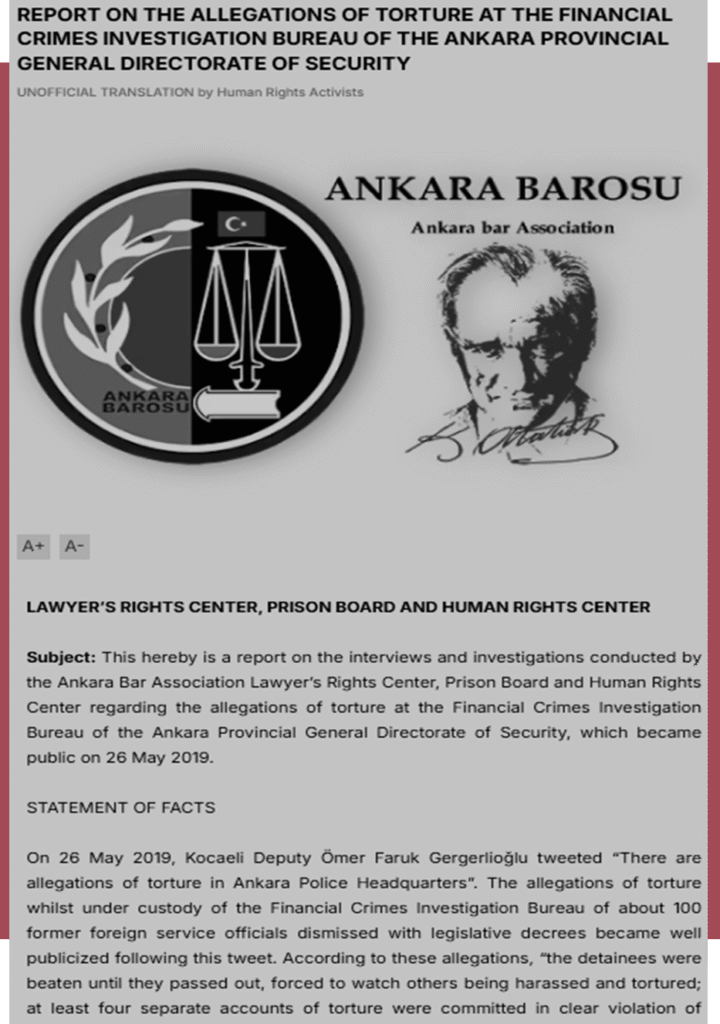
Ankara Bar Association, 2019—Report documenting allegations of torture at Ankara’s Financial Crimes Investigation Bureau
Crucially, the stated objective of the interrogations was not the reconstruction of factual events or the verification of concrete evidence.[35] Questioning was structured almost entirely around the extraction of confessions and the production of names. Detainees were pressured to admit participation in organized cheating networks and to identify other alleged members, even when they explicitly stated that they did not know such structures. Several reported that investigators suggested specific narratives, effectively instructing them on what they were expected to say.
Thus, the Ankara diplomats case reveals the deeper function of torture within the post-2016 legal architecture. What matters is not what one has done but whether one is able—or willing—to produce the expected confession. When high-ranking professionals such as diplomats are subjected to coercive practices without meaningful legal protection, it sends a clear message to all other segments of the bureaucracy.
Recommendations
A genuine reform agenda would, therefore, have to start from a different premise. It would treat examination irregularities as a governance problem rather than a moral conspiracy. It would focus on rebuilding institutional capacity rather than reshaping political identities. Moreover, it would require at least four foundational elements:
Independent examination and recruitment authorities with real legal autonomy: Institutions responsible for testing and hiring cannot remain subordinate to politicians.
Transparent rules: Examination systems must be auditable, traceable, and open to independent technical review. Without transparency, institutional trust cannot be restored.
External oversight and public accountability: Independent audit bodies, parliamentary review mechanisms, and civil society monitoring are not optional add-ons; they are core components of meritocratic governance. Institutions that cannot be scrutinized cannot learn from failure.
The re-establishment of rule-based recruitment as the dominant principle: Written exams, objective scoring systems, and clearly defined criteria must regain priority over discretionary interviews. Where interviews exist, they must be recorded, justified, and subject to judicial review.
Conclusion
This report has argued that examination irregularities and meritocratic failures in Turkey cannot be meaningfully understood through simplified narratives of organized infiltration or collective misconduct. When placed in historical perspective, the vulnerabilities of Turkish examination systems appear as a long-term institutional weakness rather than a recent political anomaly. From the ideological struggles over university access in the 1970s to the canceled national exams of the 1990s to the incomplete reforms of the 2000s and the systemic collapse revealed by the 2010 KPSS scandal, patterns of institutional fragility have persisted across radically different political configurations.
While it is important to acknowledge that the theft or leakage of exam questions has, at times, been a genuine phenomenon in Turkey, available evidence suggests that such practices were not unique to any single period or group. Therefore, allegations of wrongdoing must be evaluated based on individual responsibility and examined through independent judicial processes rather than through assumptions of collective guilt.
The post-2016 period did not introduce examination vulnerability; it reinterpreted it. Structural problems that had previously been recognized as governance failures were reframed as evidence of a single, coherent infiltration strategy. This reframing transformed institutional analysis into a moral narrative, replacing questions of capacity, oversight, and accountability with questions of identity, loyalty, and collective culpability.
The legal and evidentiary examination of this narrative reveals significant weaknesses. Allegations of systematic infiltration have relied heavily on testimonial evidence obtained during criminal proceedings, often provided by defendants operating under strong procedural pressures and incentives to implicate others. Material evidence capable of demonstrating coordinated manipulation of examinations at scale has been limited. Moreover, the empirical outcomes of many exam-related prosecutions, marked by substantial numbers of acquittals, raise questions about the strength of the narrative when tested within judicial procedures.
The most consequential effect of the cheating narrative, however, has not been its explanatory power but its institutional function, which has legitimized a profound transformation in recruitment and governance. Written examinations have been weakened, discretionary interviews expanded, legal safeguards eroded, and political loyalty normalized as an informal criterion of public employment.
There were also allegations in the mid-2010s that the government was considering removing or weakening the KPSS system. In 2015, CHP İzmir deputy Aytun Çıray raised the issue in the Turkish Grand National Assembly (TBMM), claiming that an action plan regarding the possible abolition of KPSS had been prepared by the government. According to these claims, one of the motivations behind such discussions was the difficulty faced by candidates supportive of the Justice and Development Party (AKP) in passing the highly competitive centralized examinations.[36]
Following the attempted coup of July 15, 2016, the requirement of a KPSS score was indeed removed from recruitment procedures in certain key institutions. One example of this is the changes introduced to the recruitment procedures of the Ministry of Foreign Affairs. The requirement to obtain a KPSS score for the Ministry’s entrance examination was removed. Unsurprisingly, in 2017, the daughter of Ambassador Cihad Erginay, who was serving as Deputy Undersecretary responsible for personnel recruitment at the time, ranked first in the Ministry’s entrance examination.[37] In the name of defending a merit-based system, the institutional architecture that made it possible has been progressively dismantled.
A merit-based system cannot be achieved through purges, scapegoating, or retrospective moralization of history; it can only emerge from institutional autonomy, procedural transparency, external accountability, and historical honesty. Without these conditions, examination systems will remain vulnerable, recruitment will remain politicized, and public trust will continue to erode.
[1] Constitution of the Republic of Turkey, Article 70. https://anayasa.gov.tr/media/7258/anayasa_eng.pdf.
[2] Constitution of the Republic of Turkey, Article 129, https://anayasa.gov.tr/media/7258/anayasa_eng.pdf.
[3] Şükran Soner, “12 Mart’ın sınav skandalı, işçi ücretlerini aşağı çekme sabıkaları,” Cumhuriyet, November 6, 2020, https://www.cumhuriyet.com.tr/haber/12-martin-sinav-skandali-isci-ucretlerini-asagi-cekme-sabikalari-1788858.
[4] “ÖSYM’de ilk skandal 1973’de patladı,” Milliyet, April 5, 2011, https://www.milliyet.com.tr/gundem/osymde-ilk-skandal-1973de-patladi-1373691.
[5] “Orta Doğu’da sınav soruları çalındı,” Milliyet, August 7, 1970, https://www.gastearsivi.com/gazete/milliyet2/1970-08-07/1.
[6] Çiko Arif (@gbnbfra_2), “Konuşan Prof. Dr. İskender Öksüz…,” X (formerly Twitter), March 19, 2025, https://x.com/gbnbfra_2/status/1902490887793344895.
[7] Selçuk Şahin Polat, “Fikir Kulüpleri Federasyonu (FKF) tarihi,” Odak Dergisi, November 12, 2022, https://odakdergisi2.com/fikir-kulupleri-federasyonu-fkf-tarihi/
[8] Saygı Öztürk, “Sınav yapılırken, sınav iptal ettirdim,” Sözcü, July 20, 2025, https://www.sozcu.com.tr/sinav-yapilirken-sinav-iptal-ettirdim-p196655.
[9] “Türkiye’nin en şanssız sınav kuşağı 81’liler,” Hürriyet, April 7, 2011, https://www.hurriyet.com.tr/gundem/turkiyenin-en-sanssiz-sinav-kusagi-81liler-17486246.
[10] Pınar Dinç, “Turkish decree on coloured uniforms for coup suspects could sow seeds of future unrest,” The Conversation, January 11, 2018, https://theconversation.com/turkish-decree-on-coloured-uniforms-for-coup-suspects-could-sow-seeds-of-future-unrest-89676.
[11] Haydar Karataş, “Yeni bir Gülenist İslam doğuyor! Avrupa’da Kalvinist temelli yeni bir İslam mı?,” YouTube, February 1, 2026, https://www.youtube.com/watch?v=iD5sqIRhUuQ.
[12] “1.5 milyon öğrenci yıkıldı,” Hürriyet, May 2, 1999, https://www.hurriyet.com.tr/gundem/1-5-milyon-ogrenci-yikildi-39076985.
[13] “1973’ten 2022’ye: Eski Türkiye’de de sorular çalınır, sınavlar iptal edilirdi,” Kronos, August 5, 2022, https://kronos39.news/1973ten-2022ye-eski-turkiyede-de-sorular-calinir-sinavlar-iptal-edilirdi/.
[14] Ölçme, Seçme ve Yerleştirme Merkezi (ÖSYM), “KPSS: Kamu Personel Seçme Sınavı,” accessed March 20, 2026, https://www.osym.gov.tr/TR,8837/hakkinda.html
[15] Bilal Çetin, “Kadrolaşmanın mimarı Moğultay ve Oktay,” Yeni Şafak, January 2, 2007, https://www.yenisafak.com/gundem/kadrolasmanin-mimari-mogultay-ve-oktay-22617
[16] “1973’ten 2022’ye: Eski Türkiye’de de sorular çalınır,” Kronos, 2022.
[17] “2010 KPSS’de kopya sorgusu,” Memurlar.net, October 6, 2014, https://www.memurlar.net/haber/485650/2010-kpss-de-kopya-sorgusu.html
[18] Ibid.
[19] “İddia: Tıpta Uzmanlık Sınavı’nda sorular sızdırıldı,” Diken, February 28, 2019, https://www.diken.com.tr/iddia-tipta-uzmanlik-sinavinda-sorular-sizdirildi/.
[20] “Skandal görüntüler ortaya çıktı: TYT sınav soruları çalındı mı?,” Yeniçağ, June 9, 2024, https://www.yenicaggazetesi.com/skandal-goruntuler-ortaya-cikti-tyt-sinav-sorulari-calindi-mi-807197h.htm.
[21] “LGS’de ‘tam puan’ krizi büyüyor: Şaibe iddialarıyla ilgili 29 kişi soruşturuluyor, MEB’de üst düzey bürokrat görevden alındı,” T24, July 17, 2025, https://t24.com.tr/gundem/lgs-de-tam-puan-krizi-buyuyor-saibe-iddialariyla-ilgili-29-kisi-sorusturuluyor-meb-bilgi-islem-genel-muduru-gorevden-alindi,1250355.
[22] “LGS’de şaibe iddialarını gündeme taşıyan Cumhuriyet Gazetesi Haber Müdürü Can Uğur’a soruşturma!,” Cumhuriyet, July 21, 2025, https://www.cumhuriyet.com.tr/siyaset/lgs-de-saibe-iddialarini-gundeme-tasiyan-cumhuriyet-gazetesi-haber-muduru-can-ugur-a-sorusturma-2420019.
[23] Kemal Gümüş, “FETÖ’nün 9 yılda çaldığı tüm sorular tespit edildi,” TRT Haber, March 12, 2021, https://www.trthaber.com/haber/gundem/fetonun-9-yilda-caldigi-tum-sorular-tespit-edildi-563883.html.
[24] Adem Yavuz Arslan, “Erdogan’s claim disproved by his own courts!,” Politurco, January 13, 2025, https://politurco.com/erdogans-claim-disproved-by-his-own-courts.html.
[25] Adem Yavuz Arslan, “Erdoğan’ın iddiasını, emrindeki mahkemeler çürüttü!,” TR724, January 11, 2025, https://www.tr724.com/erdoganin-iddiasini-emrindeki-mahkemeler-curuttu/
[26] Human Rights Watch, Lawyers on Trial: Abusive Prosecutions and Erosion of Fair Trial Rights in Turkey, April 10, 2019, https://www.hrw.org/report/2019/04/10/lawyers-trial/abusive-prosecutions-and-erosion-fair-trial-rights-turkey.
[27] European Court of Human Rights, Habran and Dalem v. Belgium, App. nos. 43000/11 and 49380/11, § 100, https://hudoc.echr.coe.int/?i=001-170633 ; Adamco v. Slovakia, App. no. 45084/14, §§ 69-71, https://hudoc.echr.coe.int/?i=001-198389
[28] Human Rights Watch, A Blank Check: Turkey’s Post-Coup Suspension of Safeguards against Torture, October 25, 2016, https://www.hrw.org/report/2016/10/26/blank-check/turkeys-post-coup-suspension-safeguards-against-torture.
[29] Finnish Immigration Service, Turkey: Individuals Associated with the Gülen Movement, June 2024, https://migri.fi/documents/5202425/5914056/FIS_Turkey_Individuals+associated+with+the+G%C3%BClen+movement_June_2024+(2).pdf.
[30] “Dışişleri’nde FETÖ’nün sınav yolsuzluğu: 249 gözaltı,” Memurlar.net, May 20, 2019, https://www.memurlar.net/haber/830920/disisleri-nde-feto-nun-sinav-yolsuzlugu-249-gozalti.html
[31] Ankara Bar Association, Report on the Allegations of Torture at the Financial Crimes Investigation Bureau of the Ankara Provincial General Directorate of Security, InstituDE, May 26, 2019, https://www.institude.org/ankara-bar-report
[32] “Turkish lawyers’ group says foreign ministry staff tortured in custody,” Reuters, May 28, 2019, https://www.reuters.com/article/world/turkish-lawyers-group-says-foreign-ministry-staff-tortured-in-custody-idUSKCN1SY27D/.
[33] Hollie McKay, “Turkish diplomat describes physical and sexual abuse in detainment, Ankara dismisses as ‘baseless’,” Fox News, June 11, 2019, https://www.foxnews.com/world/turkish-diplomat-describes-physical-sexual-abuse-detainment.
[34]InstituDE, “Press statement on the occasion of the first anniversary of the torture suffered by purged diplomats in Turkey,” May 26, 2020, https://www.institude.org/announcement/press-statement-on-the-occasion-of-the-first-anniversary-of-the-torture-suffered-by-purged-diplomats-in-turkey-2.
[35] Bold Medya, “Torture of Turkish diplomats – They spoke to BOLD for the first time,” YouTube, July 25, 2021, https://www.youtube.com/watch?v=KtlUpvxnt5A.
[36] “KPSS, AKP döneminde güvenilirliği yitirmiştir,” Yeni Asya, January 22, 2015, https://www.yeniasya.com.tr/politika/kpss-akp-doneminde-guvenilirligi-yitirmistir_316668.
[37] Bahadır Gülle, “Dışişleri Bakanlığı’nda 2010 sonrası neler yaşandı?,” InstituDE, October 27, 2021, https://www.institude.org/opinion/disisleri-bakanliginda-2010-sonrasi-neler-yasandi.