

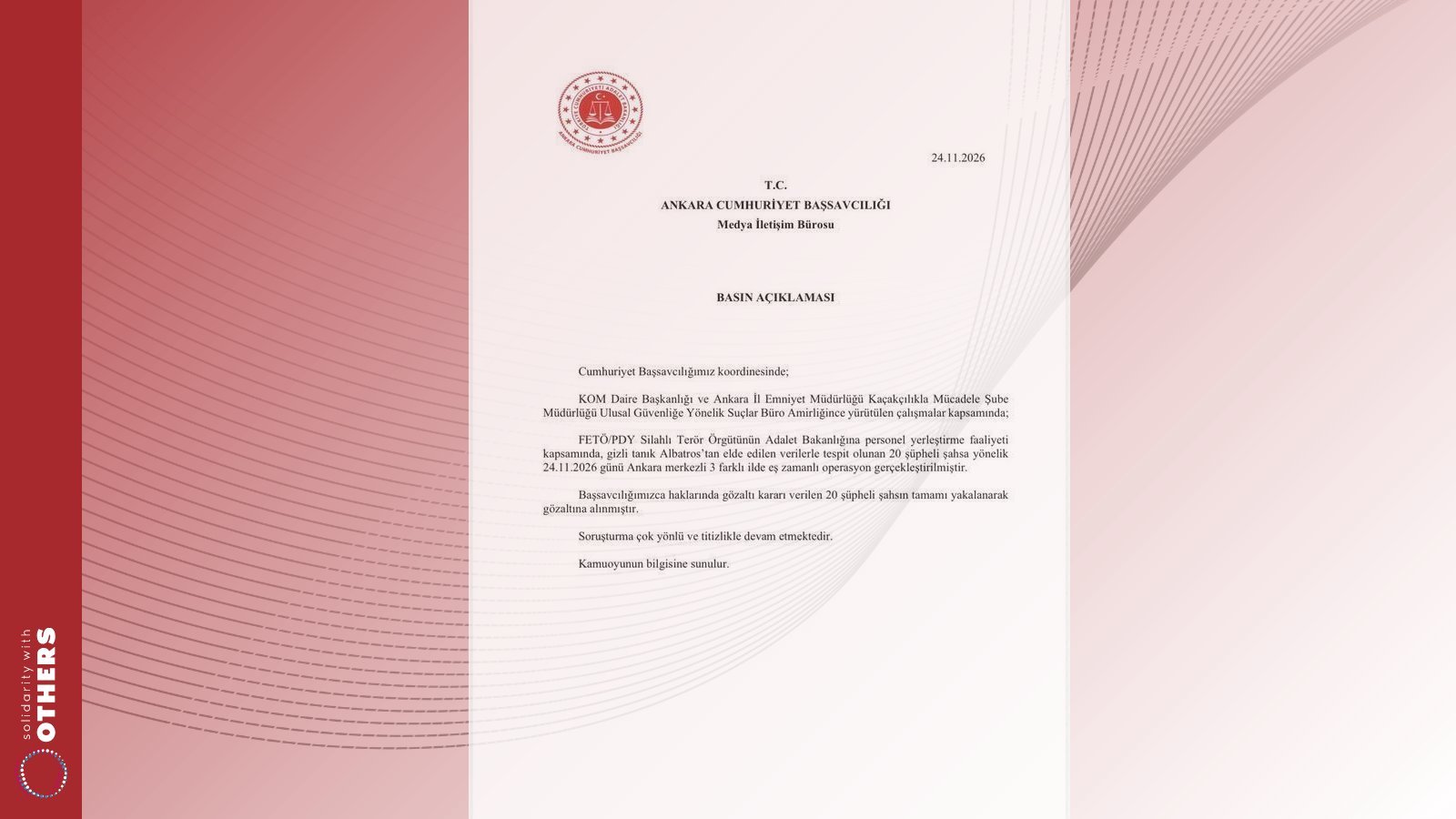
The Ankara Chief Public Prosecutor’s Office announced on 24 November 2026 that twenty people had been detained in simultaneous operations in three provinces centred on Ankara. The investigation concerns what the office describes as the placing of personnel inside the Ministry of Justice. In its own words, the twenty suspects were identified “in line with data obtained from the secret witness Albatros”.
That sentence is the whole of the stated basis. The prosecutor’s office did not name the detainees, state their occupations, or describe what any one of them is alleged to have done. It did not say when Albatros provided the data, and it did not say whether anything else supports it.
Albatros is not new. The same source was cited as long ago as 2018, in an indictment against seven prison officers in Zonguldak. Albatros supplied prosecutors with a list of some six thousand public employees, sorted by their supposed degree of connection to the Gülen movement, and that list went on to be used both in criminal investigations and in dismissals from the civil service. In one case the Inquiry Commission on State of Emergency Measures refused a dismissed police employee’s reinstatement in 2018 on the strength of Albatros’s information, in a file where prosecutors had already declined to bring charges because the evidence was insufficient. The same material that would not support a prosecution was enough to end a career.
That Commission rejected 109,332 of the 127,292 applications it received, close to 86 per cent, before completing its work in January 2023.
Türkiye’s own Constitutional Court has examined what a coded entry from an anonymous source is worth. On 2 April 2026 it delivered two judgments on the same day about another secret witness, code-named Garson, who had handed over digital files said to contain information on some 4,700 people. In the case of Mehmet Emin Okyay it found a violation of the right to respect for private life: the decision against him rested on two codes and nothing else, and the authorities had never checked whether the coding was accurate. In the case of Doğan Doğan it found no violation, because there the coding had been weighed together with two witness statements. The line the Court drew between the two is corroboration.
In Tuesday’s operation, the prosecutor’s statement describes twenty people identified from the data of one anonymous source, and mentions nothing else.
Garson’s own reliability has been questioned in a different way. In 2023 the human rights lawyer Gökhan Güneş published documents showing significant discrepancies between the signatures attributed to that witness on two statements taken nine days apart in April 2017.
A third such witness, code-named Aslan, gave evidence in a 2017 trial in Denizli against 145 defendants he had accused of collecting money for the movement. When the judge read out their names in court, he did not recognise any of them.
The European Court of Human Rights ruled in Süleyman v. Turkey, on 17 November 2020, that a conviction resting on the decisive testimony of an anonymous witness whom the defence had no opportunity to question violated the right to a fair trial. In December 2025, United Nations experts raised concerns about the use of secret witnesses in these cases and about restrictions on defence lawyers’ access to case files, saying that many arrests lacked evidence linking the individual suspect to any criminal activity.
In July 2026 the Justice Minister, Akın Gürlek, stated that more than 127,000 people have been convicted of links to the movement since 2016, that 10,485 remain in prison, and that proceedings are continuing against 83,404 more.
Ten years into these prosecutions, the state can detain twenty people in one morning and tell the public only that an anonymous source listed them.
Note on source language. The terms “FETÖ” and “FETÖ/PDY” appear here as they are used in the Turkish prosecutor’s statement and in Turkish state media reporting. Solidarity with Others does not adopt this language, and it is not the terminology used by the European Court of Human Rights, the United Nations human rights mechanisms or the Council of Europe.
Sources:
TRT Haber, “Ankara merkezli FETÖ operasyonu: 20 gözaltı”, 24 November 2026, 09:46, updated 10:44 (the Ankara Chief Public Prosecutor’s Office statement; KOM Department and the Ankara police anti-smuggling branch; “data obtained from the secret witness Albatros”; three provinces; all twenty detained).
Stockholm Center for Freedom, “Turkey detains 20 over alleged Gülen links based on information from secret witness”, 24 November 2026 (the 2018 Zonguldak indictment; the list of some 6,000 public employees; the 2018 Inquiry Commission refusal; the Garson and Aslan material; the UN experts’ concerns of December 2025; the Justice Minister’s figures).
Constitutional Court, Mehmet Emin Okyay, no. 2023/47320, and Doğan Doğan, no. 2023/1011, both 2 April 2026.
Süleyman v. Turkey, no. 59453/10, 17 November 2020.
Inquiry Commission on State of Emergency Measures, final figures: 127,292 applications, 109,332 rejected.
Ministry of Justice figures announced by Minister Akın Gürlek, July 2026.