

The European Court of Human Rights held on 17 November 2026 that the pre-trial detention of Aydın Akgül, a serving Turkish judge, had not taken place in accordance with a procedure prescribed by law. The violation of Article 5 § 1 was found unanimously. The judgment is final.
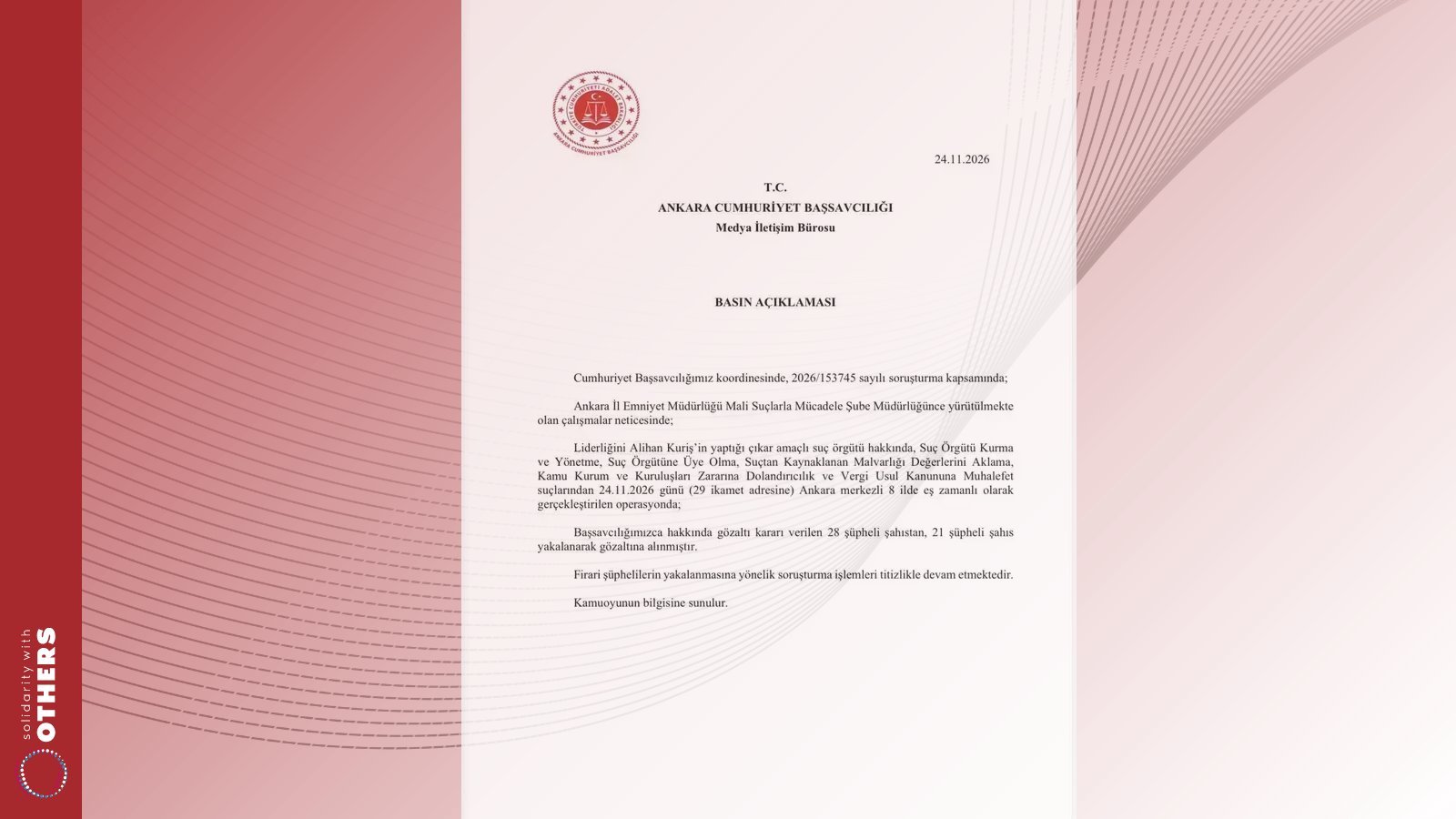
Akgül was born in 1978 and was sitting as a judge in July 2016. On 16 July, the day after the coup attempt, the Ankara chief public prosecutor’s office opened an investigation into suspected members of the Gülen movement within the judiciary, proceeding under the ordinary rules of criminal procedure on the basis that there had been a discovery in flagrante delicto. On 20 July the Edirne Magistrate’s Court ordered his detention for membership of a terrorist organisation. The judge relied mainly on the fact that Akgül had been suspended from his duties, and on the fact that the Ankara prosecutor had asked for an investigation to be opened.
Turkish law gives judges and prosecutors specific procedural protections against arrest and detention, under section 94 of Law no. 2802. Those protections do not apply where a person is caught in the act. The Strasbourg Court found that the domestic courts never established that Akgül had been apprehended while committing, or immediately after committing, any act connected to the coup attempt — and that the finding that he had been was what removed his protection. The Court had said the same in Baş v. Turkey in March 2020, and again in November 2021 in Turan and Others v. Turkey, a judgment joining 427 applications from judges and prosecutors detained in the same way.
The Government asked the Court to read the case in the light of Türkiye’s derogation under Article 15. The Court replied that although the applicant was detained shortly after the event that prompted the state of emergency, a contextual factor to be taken fully into account, the measure could not be said to have been strictly required by the exigencies of the situation.
Akgül applied to the Turkish Constitutional Court. His application was declared inadmissible. He lodged his case in Strasbourg on 21 September 2018 and waited eight years and two months for the judgment. The Court records that he is detained in Samsun.
He will receive nothing. Under Article 41 the Court awards just satisfaction on a claim, and no claim was submitted within the time allowed. The judgment states this in two sentences and makes no award.
Two further judgments were delivered the same day. In Bakırcı and Others v. Türkiye the Court found that three former judges and prosecutors — Recep Bakırcı, Nalan Can and Mecit Özgül — had been detained without reasonable suspicion of an offence. The detention orders had rested on witness statements, on messages exchanged by other people, on money transfers, and in some instances on alleged use of the ByLock application or possession of US one-dollar bills. The Court found the material insufficient to link them to the alleged offences; in Bakırcı’s case the detention order had not assessed what the transfers were for, although he had explained that they involved his brother and another judge. In Bulut v. Türkiye the Court found that the former prosecutor Harun Bulut had likewise been detained without reasonable suspicion, his suspension from office and general references to the gravity of the charges being no substitute for concrete evidence. Each of those four applicants was awarded 5,000 euros, covering damage and costs together.
In June 2026 the Committee of Ministers called on Türkiye to ensure that decisions on pre-trial detention are supported by concrete evidence and comply with legal safeguards.
Between July 2016 and July 2018, 113,290 people were dismissed from public service by emergency decree. A further 4,006 judges and prosecutors were removed by the Supreme Board of Judges and Prosecutors through administrative decisions that were subject to neither judicial nor parliamentary review.
Ten years and four months after a judge was detained on the strength of his own suspension, the Court has repeated, in five pages, what it told Türkiye in 2020 and told it again in 2021 on behalf of 427 of his colleagues. He read it in a prison in Samsun.
Note on source language. The term “FETÖ/PDY” appears in this judgment as the description used by the Turkish authorities, and the Court sets it out in quotation marks as such rather than adopting it. Solidarity with Others follows the same practice: it is the authorities’ terminology, not ours, and not that of the European Court, the United Nations human rights mechanisms or the Council of Europe.
Sources:
Akgül v. Türkiye, no. 46378/18, Second Section Committee, judgment of 17 November 2026.
Baş v. Turkey, no. 66448/17, 3 March 2020, §§ 115-16, 143-58 and 159-62.
Turan and Others v. Turkey, nos. 75805/16 and 426 others, 23 November 2021, §§ 57-64, 79-92, 91 and 98.
Stockholm Center for Freedom, “ECtHR finds Turkey violated rights of 5 former judges, prosecutors detained after 2016 coup attempt”, 23 November 2026 (the two companion judgments; the awards; the Committee of Ministers’ June 2026 decision; the dismissal figures).
Law no. 2802 on Judges and Prosecutors, section 94; Code of Criminal Procedure, Articles 100 and 141; Criminal Code, Article 314.
Legal note
Article 5 § 1 permits deprivation of liberty only “in accordance with a procedure prescribed by law”, a requirement that refers back to domestic law and obliges the State to comply with its substantive and procedural rules. In Akgül v. Türkiye, no. 46378/18, 17 November 2026, § 8, the Court found that the extensive interpretation of in flagrante delicto under section 94 of Law no. 2802 had deprived the applicant of the procedural safeguards afforded to members of the judiciary, without the domestic courts having established that he had been apprehended while committing, or immediately after committing, an act directly linked to the attempted coup. This finding follows the Court’s established case-law in Baş v. Turkey, no. 66448/17, 3 March 2020, §§ 143–158, and Turan and Others v. Turkey, nos. 75805/16 and 426 others, 23 November 2021, §§ 79–92. Having found that violation, the Court decided not to examine the applicant’s remaining complaints under Article 5 §§ 1, 2, 3, 4 and 5 (Akgül, § 11, following Turan and Others, § 98). Whether there was ever a reasonable suspicion against him has therefore still not been determined by any court, domestic or Convention.
Article 15 permits derogation from Convention obligations only to the extent strictly required by the exigencies of the situation. In Akgül, § 9, the Court expressly accepted that the applicant’s detention shortly after the coup attempt — the event that prompted the declaration of the state of emergency and the notice of derogation — was a contextual factor to be taken fully into account in interpreting and applying Article 5. Having taken it fully into account, it held that the measure at issue could not be said to have been strictly required by the exigencies of the situation. The existence of a state of emergency does not, in itself, justify disregarding the safeguards that domestic law affords.
The companion judgments, Bakırcı and Others v. Türkiye, nos. 15133/20 and two others, and Bulut v. Türkiye, no. 24161/18, both delivered on 17 November 2026, concern Article 5 § 1 (c), which requires a reasonable suspicion based on facts or information capable of satisfying an objective observer that the person concerned may have committed the offence. In Akgün v. Turkey, no. 19699/18, 20 July 2021, the Court held that a report recording no more than that the applicant was a user of an encrypted messaging application, and saying nothing of the content of his exchanges or of the persons with whom he had communicated, could not found such a suspicion; it observed that the mere act of using a means of protecting the private character of exchanges could not in itself constitute evidence capable of satisfying an objective observer that an unlawful activity was taking place. In Yüksel Yalçınkaya v. Türkiye [GC], no. 15669/20, 26 September 2023, the Grand Chamber held that conduct that was lawful when it occurred cannot be converted by inference into the material and mental elements of a terrorism offence. The judgments of 17 November apply that line: suspension from judicial office, communications exchanged by third parties, financial transfers whose nature and purpose the detention order did not assess, and the possession of banknotes did not, in these cases, satisfy the threshold, in the absence of sufficiently concrete and individualised incriminating evidence.
Article 46 obliges Türkiye to abide by these final judgments, whose execution is supervised by the Committee of Ministers. At its 1563rd Human Rights meeting of 9–11 June 2026 the Committee urged the Turkish authorities to ensure that detention decisions were based on concrete evidence, that the requirements of Article 100 of the Code of Criminal Procedure were consistently applied, and that deprivation of liberty was used only as a last resort. The recurrence of the same finding in Baş, in the 427 applications joined in Turan and Others, and now in Akgül, illustrates the scale of the unlawful detention practices applied to members of the judiciary after the attempted coup, and underscores the importance of effective individual and general measures under Article 46. In Akgül’s own case the Court made no award under Article 41, no claim for just satisfaction having been submitted within the time-limit allotted.
Beyond the detention-related violations established in these judgments, the mass dismissal of judges and prosecutors raises separate concerns under Article 6 § 1, in particular the right of access to an independent and impartial tribunal, and under the principle of judicial irremovability. In Bilgen v. Turkey, no. 1571/07, 9 March 2021, the Court found a violation of Article 6 § 1 in its access-to-court dimension in respect of a measure affecting a judge’s position, holding that the exclusion of such a dispute from judicial scrutiny required a justification that was absent. Although Legislative Decree no. 685 provided that those dismissed by the Board of Judges and Prosecutors could bring proceedings before the Council of State sitting as a court of first instance, the existence of a remedy does not in itself establish its effectiveness in practice. Recommendation CM/Rec(2010)12 of the Committee of Ministers, in particular paragraphs 49–50 and 69, and the UN Basic Principles on the Independence of the Judiciary, in particular Principles 12 and 17–20, set standards on security of tenure, the permissible grounds for removal, fair procedure and independent review.