

Alessandra Basile *
The Global Gender Gap Index has served as the most practical and accurate tool for measuring the long-term evolution of efforts to close the gender gap over the past decades. By analyzing data across four key dimensions, economic participation and opportunity, educational attainment, health and survival, and political empowerment, it has systematically tracked 145 economies since 2006. The primary aim of this instrument is to identify the distance remaining toward parity by comparing areas of weakness and strength, thereby helping to define and enforce appropriate development measures. [1]However, this year’s findings reveal that the world remains far from this desired goal. Among a constant subset of 97 economies, gender parity has improved by 5.2% since 2006; yet, between 2025 and 2026, the global gender gap closed by a mere 0.4%. Researchers have demonstrated that artificial intelligence (AI) is a contributing factor to the sectoral and occupational segregation women currently experience. Women remain vastly underrepresented throughout the AI value chain, from the infrastructure powering AI to the foundation models and applications built upon it, illustrating that the recent surge in AI entrepreneurship continues to leave women behind.
The European Parliament Research Service published a briefing in March 2026 addressing the well-founded hypothesis that AI is exacerbating the recent backlash against women’s rights and gender equality. A primary reason supporting this claim is the spread of gendered disinformation powered by AI tools, which undermines women in leadership positions and breeds distrust toward democratic rights and values. Early promises that social media would democratize public debates and make them more inclusive have actually yielded the opposite result, instead facilitating online violence, harassment, and misogyny.
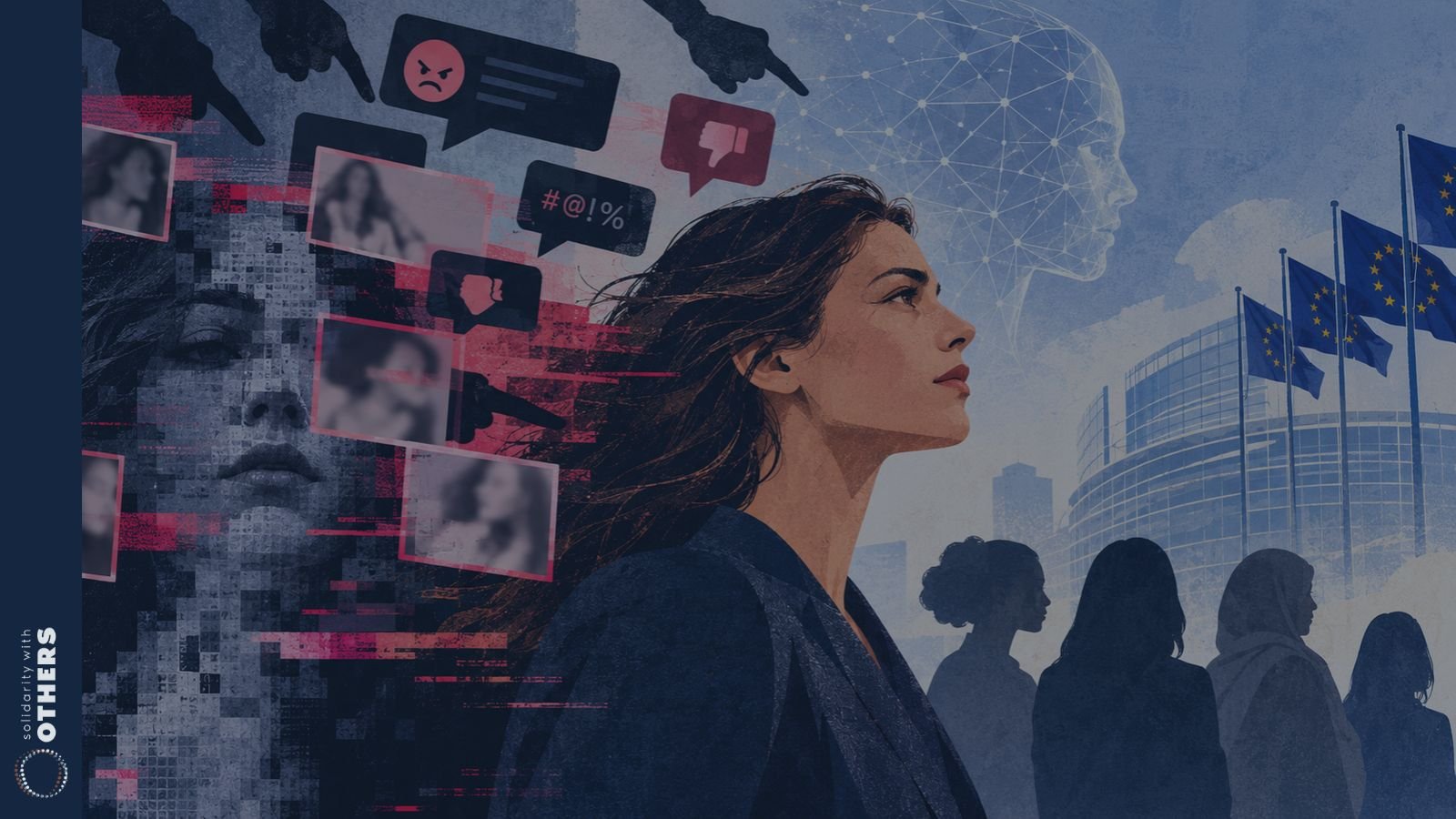
Generative AI plays a crucial role in this environment by enabling the creation and spread of non-consensual deepfakes and digital misogyny. Across European countries, notably in the UK and Italy, there are numerous documented cases of gender-based online attacks designed to shame and silence publicly active women, ultimately excluding them from political participation. Data published by the European Parliament shows that 80.5% of Information and Communication Technology (ICT) specialists in the EU are men, with minority women facing compounded levels of exclusion. Furthermore, the World Economic Forum reports[2] that less than one-third of AI industry staff are women, and one in five men in the sector believes women are less suited for careers in this field. Consequently, rather than functioning as a tool to close the gender gap, AI amplifies existing biases and has severe repercussions for gender equality.
The disproportionate effect of generative AI on women is most evident in the alarming rise of psychological violence and the suppression of democratic participation. Recent reports indicate that deepfake videos increased by 550% online between 2019 and 2023, the vast majority of which constitute non-consensual deepfake pornography. The acronym NCID, identifying the category of non-consensual intimate deepfakes, highlights an abuse that disproportionately affects women, who are the targets of 99% of these attempts. When combined with the existing ecosystem of misogyny, AI significantly aggravates this issue, feeding into thriving online marketplaces in the form of private chats, platforms, and cyber-hate groups where this content is created, shared, and discussed. Additionally, young men are being targeted by a growing industry of explicit AI “girlfriends” and specialized nudification tools, providing instant gratification through the creation of non-consensual sexualized material using real pictures of women and children. The increasing use of AI glasses to secretly collect digital material further facilitates this abuse, fueling a vicious cycle of dopamine addiction exploited by digital entrepreneurs profiting from the booming AI porn market. To address the market impact of such technologies, the EU AI Act entered into force in 2024, with its final provisions taking effect through August 2028. Applying to any organization worldwide placing systems on the EU market (excluding military, defense, and pure scientific research), the Act classifies AI risks as unacceptable, high, limited, or minimal, differentiating regulatory obligations accordingly.[3]
Italy as the first EU country to criminalize sexual deepfakes.
Italy’s legislative response to digital violence was catalyzed in May 2026 when Prime Minister Giorgia Meloni was targeted by AI-generated deepfake nudes portraying her in lingerie. This led to a wave of hateful commentary questioning her fitness for office and triggered a broader cycle of digital harassment.[4] Fueled by a series of similar scandals involving doctored, sexually explicit images of Italian women on pornography websites, Italy became the first EU country to approve a comprehensive law introducing prison terms for deploying AI to cause harm.
Aligning with the EU AI Act, Legislative Decree 160/2026 became effective on September 30, 2026, officially criminalizing the creation and distribution of sexual deepfakes under Article 612-quater of the Italian Penal Code. The penalties for this offense are severe, including up to six years in prison and fines reaching €100,000.
Underscoring the urgent need for such measures, on October 5, 2026 European Parliament President Roberta Metsola after similar attacks targeted parliamentarians stated: “Violence against women offline and online is intolerable and it is deplorable. 60 Members from across this House have been targeted by deepfake pornography websites. And instead of humiliating, this will empower us. And instead of silencing us, this will make us louder. And instead of scaring us, this will make us more determined. It cannot be the new normal.”[5]
[1] EPP Group. (2026, March). Letting AI strip women is a new form of gender-based violence.
[2] World Economic Forum. (2026). Global gender gap report 2026. https://www.weforum.org/publications/global-gender-gap-report-2026
[3] European Parliament. (2026). New EU gender equality strategy (2026-2030). European Parliamentary Research Service. https://www.europarl.europa.eu/thinktank/en/document/EPRS_BRI(2026)791489
[4] The Guardian. (2026, May 5). ‘Think before sharing,’ Giorgia Meloni says as AI-made lingerie image of her goes viral. https://www.theguardian.com/world/2026/may/05/giorgia-meloni-ai-generated-lingerie-image-deepfake
[5] European Parliament. (2026, October 6). President Metsola on Parliament members being targeted by deepfakes [Video]. YouTube. https://www.youtube.com/watch?v=1tiyBmyJ6Jg