
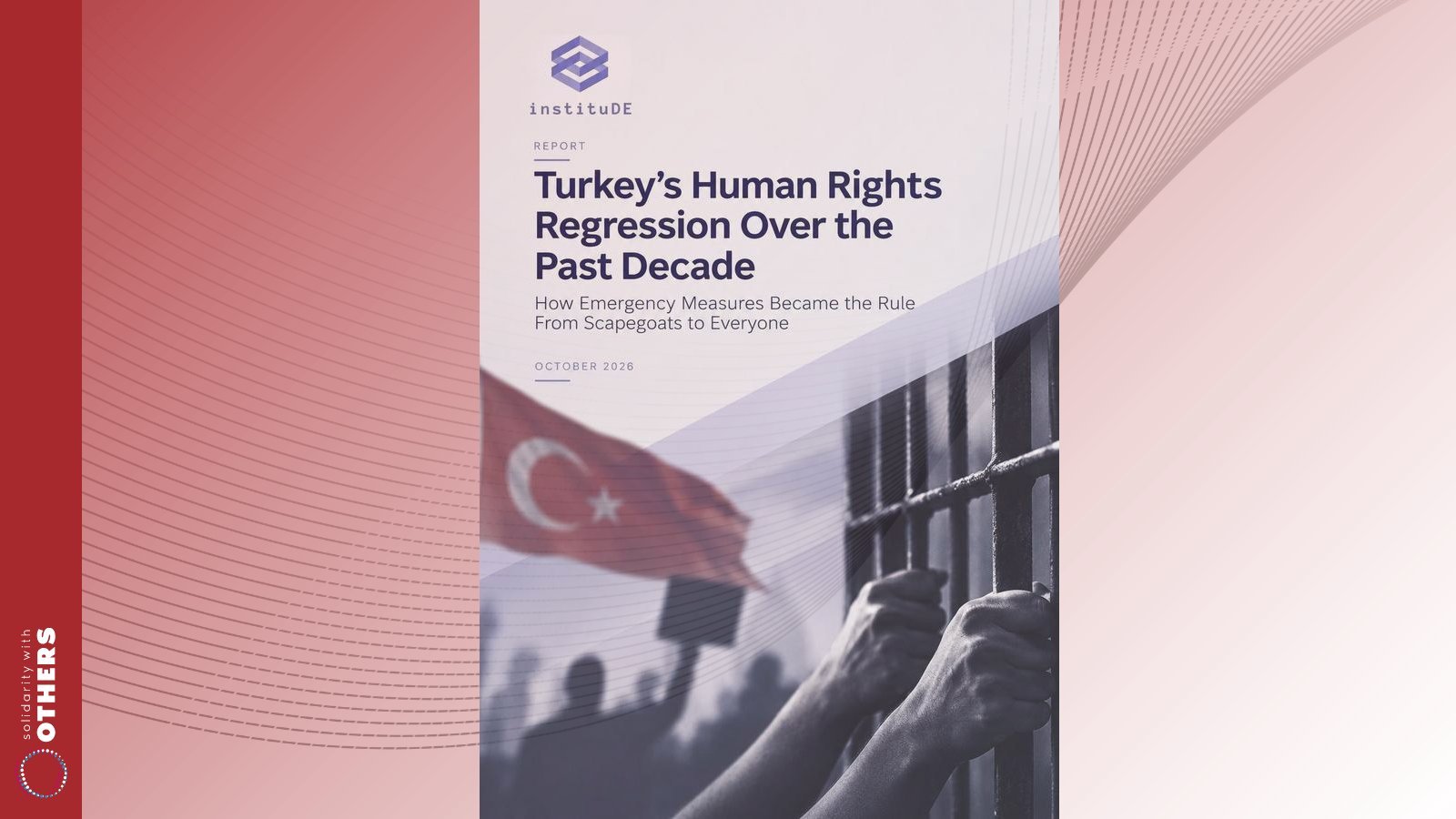
instituDE, the Brussels institute founded by former Turkish diplomats, published a report yesterday by Hakan Kaplankaya, himself a former diplomat who worked as an assistant lawyer at the European Court of Human Rights before entering the foreign service. It is titled Turkey’s Human Rights Regression over the Past Decade: How Emergency Measures Became the Rule, from Scapegoats to Everyone, and its argument is in the subtitle.
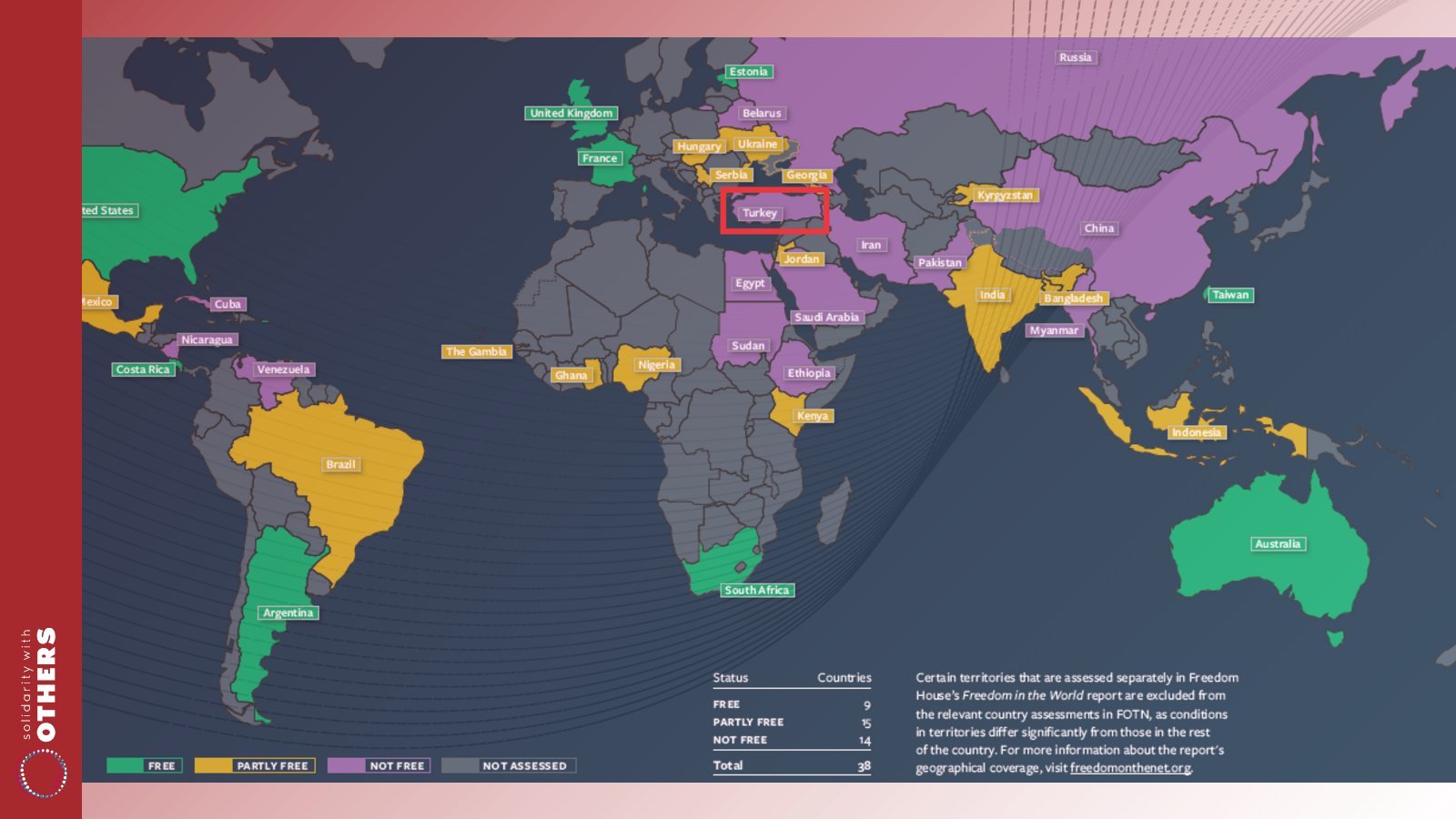
The rankings are summarised first and then set aside. Freedom House moved Türkiye from Partly Free to Not Free in 2018 and now places it among the ten steepest declines of the decade. In the World Justice Project’s Rule of Law Index it fell from 80th in 2015 to 118th of 143 countries in 2025. Reporters Without Borders ranks it 163rd of 180. Transparency International recorded its lowest score, 31, in 2025. The Economist Intelligence Unit calls it a hybrid regime near the authoritarian threshold; V-Dem calls it an electoral autocracy.
“These rankings capture the scale of the decline,” the report says, “but not its mechanics.”
The mechanics begin with numbers. By July 2026 criminal proceedings had been brought against 720,580 people over alleged links to the Gülen movement. Of the 636,744 cases decided, 127,102 ended in conviction — one in five. The rest were acquitted, dropped by prosecutors or given deferred verdicts. Proceedings continue against 83,836 people, and in the first six months of 2026 alone the justice minister reported 1,065 operations and 2,451 people taken into custody.
Almost 130,000 public servants were dismissed by decree without individual reasoning or a hearing, with lifelong bans from public service and cancelled passports. Within hours of the coup attempt, on 16 July 2016, the Judicial Council suspended 2,745 judges and prosecutors — nearly a fifth of the judiciary. The report makes the obvious observation: “A list of that size could not have been compiled overnight.” The total eventually passed 4,000, roughly a third of the profession.
By decree, 180 media outlets, more than 2,300 private institutions, 15 universities, 29 publishing houses, more than 1,500 associations and 141 foundations were closed and their property transferred to the state with no judicial decision at all. The report puts the value of assets seized on this ground above fifty billion dollars.
One figure in the report deserves to be read twice. As at 30 June 2026, the Ministry of Justice had received 1,999,434 denunciations relating to the movement — one for roughly every forty-two people in the country. Nearly four in five, 1,561,489, were dismissed on preliminary review as not even warranting an investigation. The report’s reading is that these figures “say less about the Gülen Movement than about the society around it”: neighbours, colleagues and business rivals using an accusation that could cost its target a job, a passport or their liberty.
International bodies reached consistent conclusions. The UN Working Group on Arbitrary Detention issued 26 opinions between June 2017 and November 2024, finding such detentions arbitrary in each. The report draws attention to the most recent, concerning General Akın Öztürk, whom the authorities present as the coup’s mastermind. If even that detention fails international standards, it argues, the deficiencies cannot be put down to weak individual case files.
At Strasbourg, the Court has concluded the unlawful-detention complaints of 4,107 applicants in group cases, has 9,800 applications pending, and has found violations requiring the reopening of domestic proceedings in 4,501 cases. In Yalçınkaya it noted that the authorities had identified approximately 100,000 ByLock users. Kaplankaya argues these practices should be examined as crimes against humanity — his argument, advanced in a separate article, and one this post reports rather than adopts.
The report’s actual subject is what happened to the instruments afterwards.
Criminal Peace Judgeships were created in June 2014. Their decisions can be challenged only before another judgeship of the same rank, which makes them, in the report’s phrase, “a closed circuit largely immune from effective appellate review”. They order pre-trial detention, access blocking and the appointment of trustees. In July 2018, Law No. 7145 carried emergency powers into ordinary legislation, where they were repeatedly extended after the state of emergency had formally ended.
Then the targets changed and the tools did not.
Parliament lifted deputies’ immunities in May 2016 with the support of the main opposition, whose leader said the proposal was unconstitutional and instructed his party to vote for it anyway. Within a year a CHP deputy was imprisoned under it. Selahattin Demirtaş was arrested in November 2016 and remains in prison despite a 2020 Grand Chamber ruling that his detention pursued the ulterior purpose of stifling pluralism. Elected Kurdish mayors were replaced by appointed administrators in 2014, 2019 and 2024 — and then so was the CHP mayor of Esenyurt.
The trustee mechanism first used against Koza-İpek in 2015 and Zaman in 2016 has since taken the broadcast sector. Can Holding, 121 companies, went under TMSF trusteeship in September 2025, bringing Habertürk, Show TV and Bloomberg HT under state administration. TELE1 was seized in October 2025 and offered for sale in April 2026 at 28 million lira — less than three months of its running costs, according to its editor-in-chief. T24’s website and Bianet’s X account were blocked on 30 September 2026. On 14 October 2026 the TMSF was appointed trustee of Halk TV and its broadcasts were cut. In about twenty months, as the report puts it, the leading opposition broadcaster and several national channels passed under state administration through the same device used against the Gülen-affiliated press a decade earlier.
Of the 1,100-plus academics who signed the Academics for Peace petition in January 2016, 822 were charged with propaganda for a terrorist organisation and 406 were dismissed by decree. The Constitutional Court held in July 2019, by a single vote, that the convictions violated freedom of expression. By late 2025, four had been reinstated.
Osman Kavala has been detained since November 2017. On 25 August 2026 the Grand Chamber described his conviction as a flagrant denial of justice and ordered his release. On 13 October 2026 an Istanbul court refused both release and retrial. In February 2026 the President of Türkiye’s own Constitutional Court said publicly that his court had no authority to enforce Strasbourg judgments.
In September 2026 at least 116 people were arrested across 15 provinces in an operation against LGBTI organisations and human rights defenders; at least 83 were placed in pre-trial detention and more than 160 are under investigation. Amnesty International’s Türkiye account was among the hundreds blocked.
Two other faith communities followed. The Süleymanlı community’s leader was arrested on 13 August 2026 on corruption, money-laundering and tax charges. Days after he publicly criticised that operation, Alparslan Kuytul of the Furkan Foundation was arrested in Adana with his wife, trustees were appointed over companies and 349 social media accounts were blocked. Kuytul had already spent nearly two years in pre-trial detention from 2018 before being acquitted of all charges in 2020. Neither community has ever been designated a terrorist organisation by the government.
And then the opposition itself. İmamoğlu has been detained since March 2025, arrested the day after his university diploma was annulled and days before his party nominated him for the presidency. On 21 May 2026 the Ankara Regional Court of Appeal annulled the CHP’s congress for “absolute nullity”, suspended Özgür Özel and reinstated Kemal Kılıçdaroğlu — a court, in the report’s words, in effect replacing the elected leadership of the opposition party. As at October 2026, 35 CHP mayors were in pre-trial detention and 40 had been removed from office. İzmir’s mayor, who had won the country’s third-largest city by nearly twelve points, joined the governing party this month.
The report’s conclusion is addressed less to the government than to everyone who watched.
“Having turned a blind eye to the persecution of others, Turkey’s political actors and much of the public simply looked away again when the government turned on the Gülen Movement. They treated its followers as acceptable scapegoats whose rights could be suspended without consequence for anyone else. That indifference proved costly.”
Its last sentence is the one to quote in Brussels: “The rule of law cannot be suspended for one disfavored group without being weakened for all.
Source:
Hakan Kaplankaya, Turkey’s Human Rights Regression over the Past Decade: How Emergency Measures Became the Rule, from Scapegoats to Everyone, instituDE (Institute for Diplomacy and Economy), Brussels, 22 October 2026: https://www.institude.org/report/turkeys-human-rights-regression-over-the-past-decade-how-emergency-measures-became-the-rule-from-scapegoats-to-everyone