Miranda Mchedlishvili *
Not All Hate Speech is the Same
Hate speech has traditionally been understood as a social problem rooted in prejudice and community tensions. But not all hate speech is the same. Authoritarian regimes now weaponise hate speech as a tool of digital transnational repression, running coordinated campaigns at industrial scale to silence dissidents beyond their borders. “I don’t know if [Eritreans] hate me or support me because I have been attacked in person too many times,” one Eritrean journalist told the Knight First Amendment Institute.
Europe’s digital regulations were designed for platform accountability and organic community hatred, not coordinated state operations. Recognising this distinction is not merely analytical, it is the first step toward effective governance. Europe’s regulatory frameworks are built to address one type of hate speech and are structurally unprepared for the other. Until that mismatch is acknowledged, responses will continue to miss the threat entirely.
The Traditional Model
Hate Speech as Social Problem:
Hate speech, expressions targeting individuals or groups based on religion, race, ethnicity, nationality, gender, or disability, has long been understood as a social problem rooted in prejudice and community tensions. It enforces power hierarchies, normalises discrimination, and silences marginalised voices. This hate speech emerges organically from existing social tensions.
Digital environments amplify these dynamics. Algorithms connect like-minded users, reinforcing existing prejudices. A hateful meme created in one country can spread to another community within hours. In the end, what changes isn’t the underlying prejudice but its reach.
Current Regulatory Approaches: The EU Model
The European Union (EU) has led through comprehensive digital regulation. The Digital Services Act (DSA) obliges very large online platforms (VLOPs) and search engines to assess and mitigate “systemic risks,” including the dissemination of illegal content and threats to electoral integrity. The AI Act ensures transparency when users interact with machines, while media literacy initiatives help users to recognise manipulation. At the individual level, bystander intervention research shows promise: when users have both the confidence and skills to intervene online, they can effectively disrupt hate speech dynamics and gradually shift community norms.
These tools share a common premise: hate speech emerges organically from individuals or communities, driven by prejudice or social conflict. Responses focus on platform design (reducing algorithmic amplification), individual accountability (removing content, prosecuting inciters), and social dynamics (empowering bystanders, promoting dialogue).
This approach works for hate speech that spreads through personal networks, driven by prejudice or social conflict. But state-weaponised hate speech is not simply a larger or more intense version of the same problem, it is categorically different. The difference lies not only in who produces the speech, but in what purpose it serves: not prejudice seeking expression, but strategy seeking control. As the next section shows, that shift changes everything about how the problem must be understood and addressed.
A Different Phenomenon
Hate Speech as a State Weapon
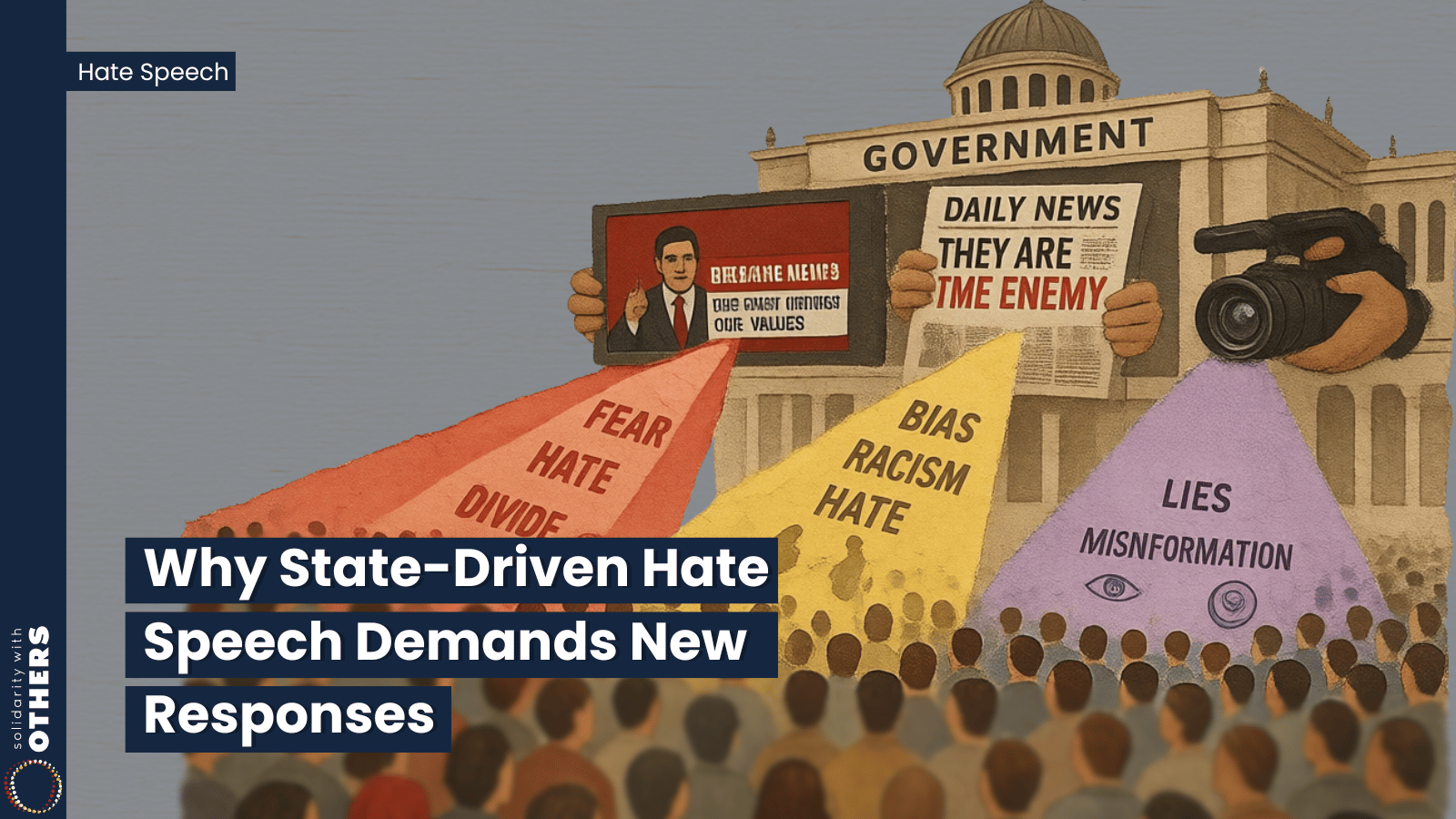
As UNESCO’s framework acknowledges, hate speech lacks a unified international legal definition. This ambiguity creates opportunities for authoritarian states. State-weaponised hate speech refers to coordinated government campaigns that deploy identity-based attacks as a political weapon. Unlike social hate speech, which emerges from prejudice or social tension, these campaigns are strategically planned. Crucially, hate speech functions as a tactic within broader repression campaigns, not the repression itself, operating alongside disinformation, surveillance, and technical attacks to silence specific individuals. While organic hate speech often emerges through peer pressure or casual “banter,” state-level hate speech is calculated, continuous, and transnational. This is what scholars call the “politicization of hate:” hateful rhetoric deployed deliberately for political control, not prejudice seeking expression.
State-weaponised hate speech functions as a governance mechanism. Authoritarian regimes exploit the absence of unified international legal definitions, weaponising domestic laws to label dissidents as threats during crucial moments like elections. The goal is systematic: normalise exclusion, silence opposition through fear, and create a “spiral of silence” that removes critical voices entirely.
How Digital Transnational Repression Works
Research by the Knight First Amendment Institute shows how this works in practice. Between 2019 and 2024, researchers interviewed over 80 human rights defenders, journalists, and activists living in exile. These were people who had fled authoritarian regimes for safety in the United States, United Kingdom, and Europe. Targets reported similar patterns regardless of origin: Rwandan dissidents, Uyghur activists, Syrian journalists, and Eritrean human rights defenders all experienced digital campaigns that followed them across borders, making exile feel anything but safe.
The pattern is systematic. First, states infect targets’ phones with commercial spyware like Pegasus, accessing all communications, locations, and contacts. Then come the attacks. Coordinated harassment campaigns on social media use state-funded “digital armies” that blend official operations with what appears to be organic criticism. Disinformation spreads to destroy the credibility of targeted individuals. Technical attacks crash dissidents’ websites and independent media platforms. States exploit the surveillance data to threaten family members back home, forcing exiles into silence.
The power imbalance is extreme. Individual targets have minimal digital security. States employ private intelligence firms, professional hackers, and sophisticated operations funded by national budgets. The goal is achieved: self-censorship. Victims stop or limit their online presence and withdraw from activism. Authoritarian actors abuse legal gaps, claiming international human rights laws don’t apply beyond their borders. In parallel, host countries struggle to respond, partly because they conduct their own extraterritorial surveillance, weakening their ability to condemn these practices.
Why Current Frameworks are limited
Having established the distinction between social hate speech and its state-weaponised counterpart, it becomes clear why existing regulatory frameworks struggle to contain the latter. What limits existing legal models isn’t lack of design quality, but fundamental mismatch in scope. The DSA was created for platform governance, not state-weaponised hate speech campaigns. Two critical gaps illustrate why this framework struggles to contain state-level actors.
Treating Attacks as Design Flaws
The DSA’s language reveals an underlying assumption: harmful content emerges as an unintentional side effect of how platforms work. The regulation addresses risks like “amplifying illegal content” as byproducts of algorithmic recommendations, things that happen accidentally when platforms prioritise engagement.
There’s an important difference between platform failures and coordinated attacks. When algorithms group users by interest and promote divisive content to boost engagement, that’s a fixable design flaw. When a government deploys thousands of synchronised accounts to target a specific journalist in exile, that’s not a technical problem, it’s an attack.
The DSA treats both as “systemic risks” requiring platform mitigation. Platforms detect patterns, remove content, file compliance reports. But there’s no mechanism to identify the state actors behind campaigns. No pathway to hold governments accountable. No recognition that content removal alone can’t stop operations backed by national intelligence budgets. The platforms take down today’s posts. The state creates new accounts tomorrow and continues.
When Individual Voices Can’t Scale
The bystander intervention approach described earlier relies on individual voices creating meaningful social pressure. But this mechanism fails when confronting state operations.
Systematic campaigns involving thousands of accounts operating simultaneously create conditions where individual intervention can’t achieve meaningful impact. One person’s counter-speech becomes a single voice covered by thousands of coordinated messages. The numerical imbalance makes substantive engagement impossible.
It’s not that people lack skills or courage, but that the scale is categorically different. While counter-speech remains a critical democratic tool, it still has limits. It lacks the industrial throughput required to counteract state-driven campaigns in real-time.
The Way Forward
The distinction between social hate speech and state-weaponised hate speech isn’t merely academic. It determines effective responses and their inherent limitations. Current frameworks work for hate speech emerging from community tensions. But when governments deploy hate speech as a weapon of transnational repression, these tools can’t address the threat.
The mismatch is structural. Regulations addressing algorithmic amplification can’t counter deliberate state attacks. Bystander intervention can’t scale to industrial-level information warfare. Traditional content moderation operates on a post-by-post basis while state operations function as continuous campaigns.
What’s needed is recognition that state-weaponised hate speech represents a distinct category of threat requiring coordinated action. Host states have to protect victims and establish legal frameworks for transnational digital repression. International cooperation is essential. This could include visa restrictions for officials overseeing digital repression units, asset freezes targeting surveillance technology purchases, and multilateral agreements recognising digital transnational repression as grounds for diplomatic consequences.
Civil society organisations provide essential support and documentation but can’t substitute for diplomatic and legal mechanisms. The core principle is solidarity, but solidarity must be institutionalised, not merely expressed. Transnational hate campaigns succeed through isolation. Coordinated responses, linking states, civil society, and international institutions, disrupt this mechanism and shift from reactive content moderation to strategic accountability. Ultimately, recognising state-weaponised hate speech as a distinct category of threat is not optional: it is the first and most essential step toward governance that is fit for purpose.