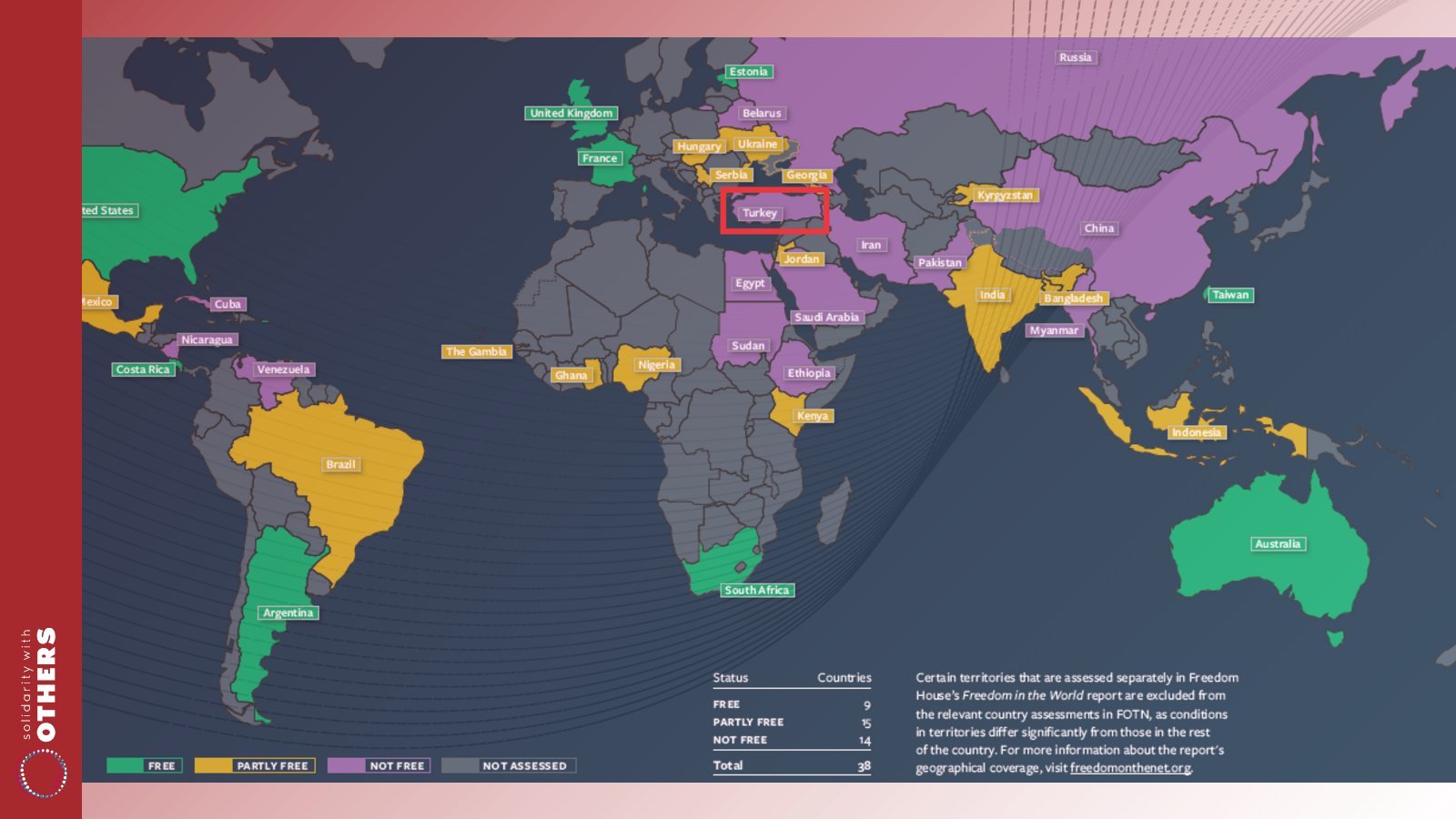
Freedom House published Freedom on the Net 2026 this week, covering June 2025 to May 2026. Global internet freedom declined for the sixteenth consecutive year. Of the thirty-eight countries assessed, conditions worsened in sixteen and improved in eight.
Türkiye scored 31 out of 100 and is rated Not Free. That is unchanged from last year, and it is the lowest score in the Europe region by thirty-five points. Estonia scored 91, France and the United Kingdom 75, Hungary 69, Serbia 66. The regional average without Türkiye is 75.
The three components explain more than the total does. On obstacles to access Türkiye scored 14 out of 25. On limits on content, 10 out of 35. On violations of user rights — the section covering prosecutions, surveillance, criminal penalties for speech and violence against those who speak — Türkiye scored 7 out of 40.
Two indicators moved this year, in opposite directions. The infrastructure score improved by one point because connectivity damaged in the 2023 earthquakes has largely been restored. The intimidation and violence score fell by one point, Freedom House says, “due to an uptick in harassment and physical attacks against online journalists”. The journalist Hakkı Sağlam was assaulted in Eskişehir in January 2026. The publisher Nafiz Koca was shot in Elazığ in October 2025. Türkiye’s score held steady because repaired cable offset attacks on journalists.
Freedom House records that social media was throttled during opposition demonstrations, that authorities issued scores of orders to block websites and remove content, that journalists, activists and ordinary users faced criminal charges over their posts, and that pro-government troll networks amplified disinformation.
The abridged report gives no figures for Türkiye. Others do.
The Freedom of Expression Association, through its EngelliWeb project, recorded that at least 1,270 X accounts were blocked in Türkiye during September 2026 alone. In the whole of 2025 the figure was 995. One month exceeded the previous year by 275 accounts. Roughly nine in ten were withheld by the platform itself.
İFÖD was able to establish the legal basis for 115 of those 1,270 blocks — nine decisions and a single letter of request. For the remaining 1,155 it could not. The decisions were not published and were not served on the people whose accounts were closed. Ninety-one per cent of a month’s censorship has no visible legal reason attached to it.
Among the accounts blocked were those of journalists and news organisations, LGBTI+ and women’s organisations, human rights defenders, academics and economists. Among the grounds İFÖD could identify were investigations into the Gülen movement, the Tevhid and Furkan communities, and the Alihan Kuriş case — the financial investigation into the Süleymanlı community in which nineteen more people were remanded this week.
On 1 October the EngelliWeb account was blocked. X informed it that the order had come from the Cyber Security Presidency under Article 8/A of Law No. 5651, the emergency provision that requires compliance within four hours. The project that documents Türkiye’s internet censorship was censored by the body that now administers it.
The report’s central structural finding concerns something else, and Türkiye appears in it.
Age assurance — laws requiring platforms to check users’ ages — is spreading faster than any other internet regulation in years. Ten of the thirty-eight countries assessed had proposed, passed or implemented such laws by June 2026. Australia’s under-16 ban, the first, took effect in December 2025; around five million accounts were deleted, and 85 per cent of under-16s surveyed said they were still using social media anyway. A breach at a Discord vendor in October 2025 may have exposed 70,000 photographs of government identity documents submitted for age appeals.
Türkiye’s parliament passed a bill in April 2026 that would bar under-15s from social media. It had not been fully approved by the end of the coverage period. What distinguishes it is the mechanism: age-gating would be enforced solely through e-Devlet, the state’s own digital identity portal. Every social media account in the country would be tied to a real name held by the state.
Freedom House’s assessment is worth quoting in full, because it is unusually direct for a body that scores rather than campaigns: people in Türkiye “are routinely arrested and imprisoned over their online expression, particularly for criticism of President Recep Tayyip Erdoğan, and the proposed e-Devlet age-assurance framework poses significant risks for Turkish citizens who turn to the internet to discuss problems in their country.”
The booklet places that passage directly alongside its account of China, where the Communist Party has used child-protection language since at least 2012 to mandate real-name registration.
A government that blocked more than a thousand accounts in one month, and could not or would not produce a reason for nine in ten of them, is preparing to require every user in the country to log in with a state-issued identity.
Sources:
1- Freedom House, Freedom on the Net 2026: Seismic Shifts on the Global Internet, by Kian Vesteinsson, coverage period 1 June 2025 – 31 May 2026: https://freedomhouse.org/report/freedom-net/2026/seismic-shifts-global-internet
2- Freedom House, Türkiye country report, Freedom on the Net 2026: https://freedomhouse.org/country/turkey/freedom-net/2026