

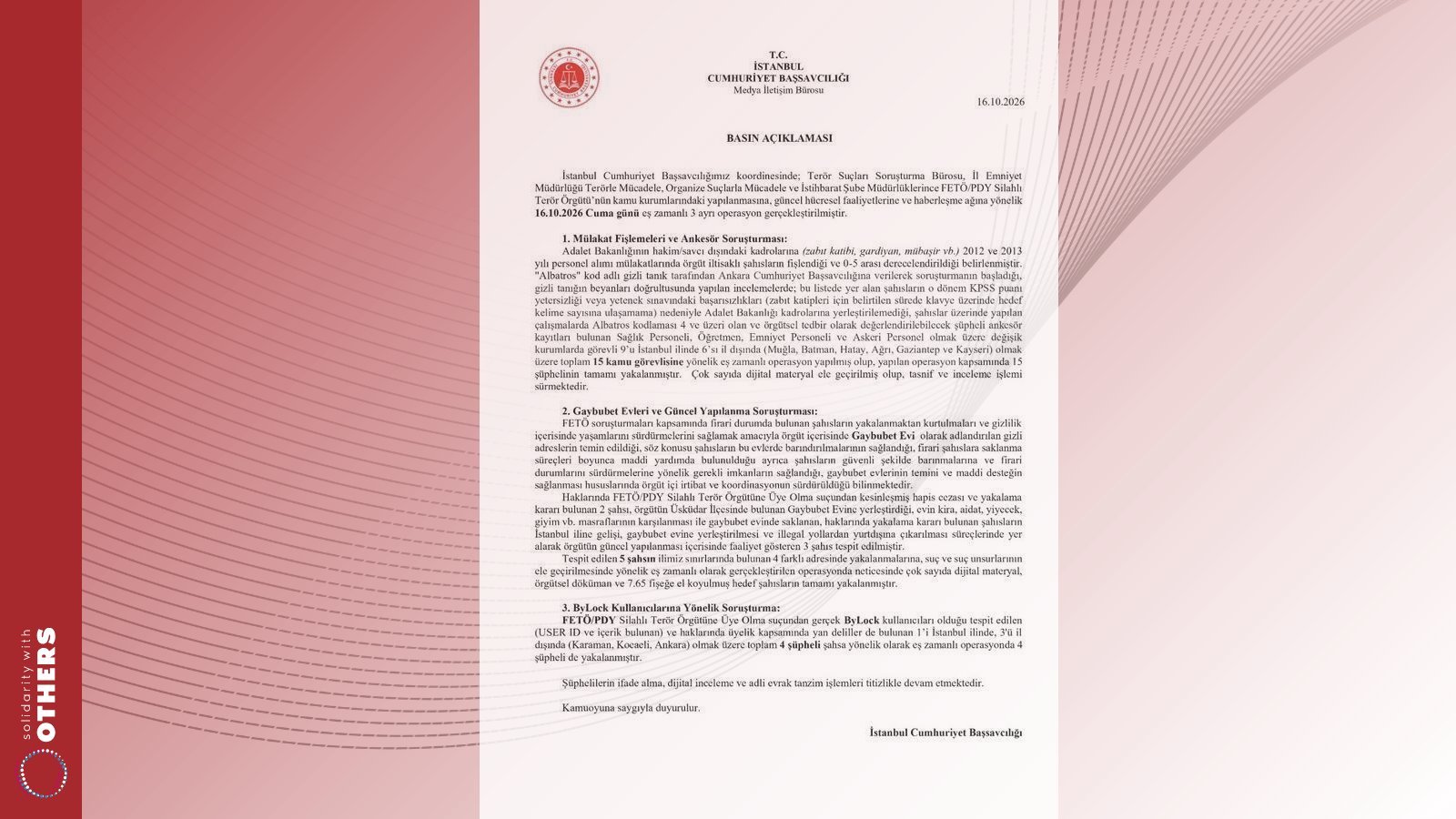
The İstanbul Chief Public Prosecutor’s Office announced on Friday that 24 people had been detained in three simultaneous operations. The statement sets out what each group is said to have done. For fifteen of the twenty-four, it sets out nothing they did.
Those fifteen are accused in connection with recruitment interviews held in 2012 and 2013 for Ministry of Justice posts other than judge and prosecutor — court clerk, prison guard, usher. The prosecutor’s account is that candidates connected to the organisation were profiled on a list and graded from 0 to 5, and that the investigation began based on the statements of a secret witness codenamed “Albatros”.
The statement then says what happened to the people on that list. They were not appointed. Their KPSS scores were insufficient, or they failed the aptitude test — for court clerks, not reaching the required number of keystrokes in the time allowed.
The fifteen detained are health workers, teachers, police officers and military personnel. They are serving public officials who passed the state’s own vetting and have been employed by it for more than a decade. What is attributed to them personally is a grade of 4 or above on a document compiled by someone else, and payphone records described as “assessable as organisational tradecraft”. No act by any of them is described.
The second operation is different, and should be read as different. The statement alleges specific conduct: that two people with final convictions and outstanding arrest warrants were housed in a flat in Üsküdar with their rent, dues, food and clothing paid, and that three others brought them to İstanbul, placed them there and worked on moving them out of the country. Five people were detained at four addresses. The items seized are listed as digital material, organisational documents and “7.65 fişek”. As published, the sentence gives a calibre without a quantity.
The third operation concerns four people described as genuine ByLock users, with the statement specifying that a user ID and content were found and that there is supporting evidence of membership. What that supporting evidence consists of is not stated.
That parenthesis is the most telling sentence in the document, because it is written against a judgment. In Yüksel Yalçınkaya v. Türkiye, the Grand Chamber held in September 2023 that Turkish courts had treated ByLock use as conclusive proof of every element of the offence, in violation of Articles 7 and 6 § 1, and that the problem was systemic. Specifying a user ID answers the question whether the right person was identified. It does not answer the question the Court actually decided.
On 5 May this year the Grand Chamber went further. In Yasak v. Türkiye it set aside a Chamber judgment that had found no violation and held that a conviction under Article 314 § 2 breached Article 7 because the domestic courts had, in its words, listed the items of evidence and automatically jumped to the conclusion that criminal intent was present. Membership, the Court held, requires proof of a personal, functional or hierarchical link to the organisation. Intent cannot be inferred from taking part in educational, economic or civic life that was lawful when it took place. The Government accepted that none of the acts imputed to the applicant had been prohibited at the time. Among the evidence the Court examined were telecommunications traffic records and the statements of witnesses who had used the effective-repentance provisions.
Friday’s statement lists items of evidence and reaches a conclusion about membership. It does not describe, for fifteen of the twenty-four, any conduct at all.
The scale of the Strasbourg record on this line of cases is now a matter of arithmetic. After Yalçınkaya came Demirhan and Others, with 239 applicants. On 16 December 2025 the Court decided Bozyokuş and Others, Karslı and Others and Seyhan and Others, covering 2,420 applicants, holding that establishing ByLock use had served “on its own, as conclusive proof of the presence of all the constituent elements of the crime” and that this stemmed from “a systemic problem affecting a large number of persons”. On 23 June 2026 three further judgments covered 893 applicants. On 29 September 2026 three more covered 947. Including Yalçınkaya and Yasak, 4,501 applicants have now had violations found in this line.
The remedy the Court has pointed to each time is the reopening of proceedings under Article 311 of the Code of Criminal Procedure. Yalçınkaya himself was retried in Kayseri and convicted again, on the same charges. A Committee of Ministers request for an account of the steps taken, due by the end of June 2026, went unanswered.
Three days before Friday’s announcement, in Kaya v. Türkiye, the Court held that statements by anonymous witnesses must be corroborated by objective elements, and that allegations expressed in abstract and unsubstantiated terms cannot found a reasonable suspicion.
“FETÖ” and “FETÖ/PDY” are the Turkish authorities’ designation and appear here as quotation only. This organisation does not adopt them.
Nobody detained on Friday has been charged, brought before a judge or convicted. Every figure above comes from the prosecutor’s office, and the Turkish outlets that carried the announcement added nothing to it. The question the Strasbourg judgments put is not whether these twenty-four people are guilty. It is whether being named on a list, by someone whose identity is withheld, for a job that was never given, is a criminal act.
Sources:
1- İstanbul Cumhuriyet Başsavcılığı, Medya İletişim Bürosu, Basın Açıklaması, 16 October 2026: https://x.com/istanbulCBS/status/2110995897760829678
2- European Court of Human Rights, Yüksel Yalçınkaya v. Türkiye [GC], no. 15669/20, 26 September 2023: https://hudoc.echr.coe.int/eng#{“itemid”:[“001-250157”]}
3- European Court of Human Rights, Yasak v. Türkiye [GC], no. 17389/20, 5 May 2026: https://hudoc.echr.coe.int/eng?i=001-250158